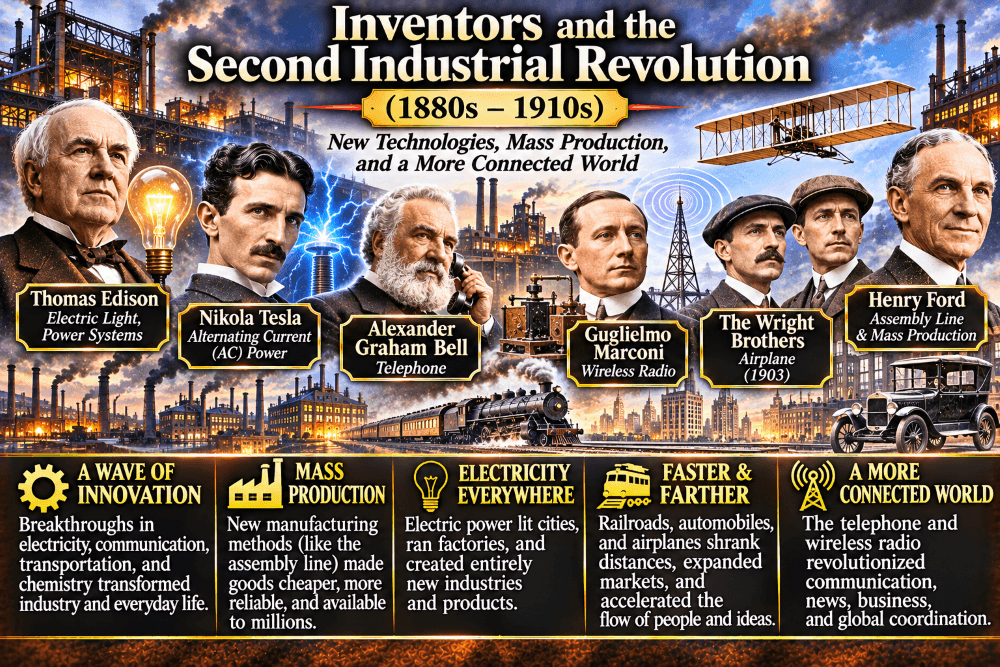
Between the 1880s and the 1910s, the world changed faster than at almost any time in history. Light bulbs replaced gas lamps, telephones shrank distance, steel skeletons raised skyscrapers, and the first cars and airplanes appeared. This was the Second Industrial Revolution, an age powered by electricity, steel, chemistry, and oil, and driven by inventors who learned to turn ideas into businesses.
How It Differed From the First
The first Industrial Revolution, covered earlier in this series, centered on steam, coal, iron, and textiles. The second was different in important ways.
- Science-based: Advances increasingly came from systematic research, not just tinkering.
- New energy: Electricity and petroleum joined coal.
- New materials: Cheap steel, aluminum, and synthetic chemicals opened new possibilities.
- Bigger organizations: Corporations, banks, and managers coordinated work at a much larger scale.
- Shifting leadership: Germany and the United States rose to challenge Britain.
The Engines of Change
Steel
Cheap steel became the backbone of railways, bridges, ships, and buildings.
- New processes, including the Bessemer and Siemens-Martin methods, made steel affordable at scale.
- Companies like Carnegie Steel, later part of U.S. Steel, became industrial giants.
- Steel frames made skyscrapers possible, reshaping cities.
Electricity
Electric power transformed homes and factories.
- Thomas Edison‘s work on the light bulb and power stations opened the age of electric lighting.
- The War of the Currents settled how electricity would be delivered, with alternating current winning out.
- Electric motors freed factories from the layout of steam-powered shafts and belts.
Chemistry
Industrial chemistry became a major field.
- German firms such as BASF and Bayer built research laboratories and dominated dyes and pharmaceuticals.
- In 1886, Charles Martin Hall in the United States and Paul Héroult in France independently developed a process for producing aluminum cheaply, turning a precious metal into a common one.
- Later, the Haber-Bosch process made synthetic fertilizer possible.
Oil and the Combustion Engine
Petroleum fueled a new kind of machine.
- Standard Oil and others built the oil industry.
- In 1886, Karl Benz patented a motor vehicle, widely regarded as the first practical gasoline-powered automobile.
- Gottlieb Daimler, Rudolf Diesel, and others developed engines that powered cars, trucks, and ships.
- In 1903, Orville and Wilbur Wright achieved powered flight at Kitty Hawk.
Communications
Information began to move faster.
- Alexander Graham Bell‘s 1876 telephone and the growth of telephone networks connected people.
- Guglielmo Marconi developed wireless telegraphy, and in 1901 reportedly sent a signal across the Atlantic.
- Printing and office technology advanced, including the Linotype machine in 1886 and Herman Hollerith’s punched-card tabulator, used in the 1890 U.S. census, a forerunner of the company that became IBM.
Inventors as Entrepreneurs
The Invention Factory
Edison’s laboratory at Menlo Park, New Jersey, became a model of organized invention.
- Rather than relying on lone genius, he assembled teams and resources to solve problems systematically.
- This approach foreshadowed the corporate research labs discussed in our chapter on the German chemical industry.
Patents, Capital, and Partnerships
Inventors needed more than ideas.
- Patents protected their work, as in the case of Bell and Singer, though they also led to costly lawsuits.
- Capital came from backers like J.P. Morgan, who financed Edison’s electric ventures and later consolidated industries.
- Partnerships combined invention with business skill, a pattern seen as far back as Boulton and Watt.
Some inventors prospered and others did not. Tesla’s brilliant ideas did not make him rich, while businesspeople like Edison and Westinghouse built corporations.
The Organization of Modern Business
New inventions required new ways of organizing.
- Corporations and finance: Limited liability, holding companies, and investment banks supplied capital.
- Management: Scientific management and administrative hierarchies helped coordinate large workforces.
- Mass distribution: Railroads, department stores, catalogs, and chain stores brought goods to customers.
- Marketing and branding: Companies like Kodak, Coca-Cola, and Heinz built national brands.
A Culture of Mass Consumption
Technology changed everyday life.
- Electric lights extended the day, and appliances changed household work.
- Photography, telephones, and later cars changed how people lived and traveled.
- Packaged foods and ready-made clothes became common.
Many of these goods spread through installment plans, advertising, and new retail formats.
The Costs
The age of invention also had a darker side.
- Labor conflict: Disputes like the Homestead and Pullman strikes showed tensions between workers and owners.
- Inequality: Enormous fortunes concentrated in a few hands, prompting antitrust laws and debates about philanthropy.
- Environment: Factories, mines, and chemical plants polluted air and water.
- Colonial extraction: Raw materials such as rubber, palm oil, and diamonds were extracted under harsh conditions, often through coerced labor.
Lessons from the Second Industrial Revolution
- Invention needs organization. Breakthroughs scaled when paired with capital, management, and distribution.
- General-purpose technologies reshape everything. Electricity and the combustion engine changed industries far beyond their origins.
- Innovation clusters. Advances in steel, chemicals, energy, and communications fed one another.
- Progress has trade-offs. Gains in productivity came with human and environmental costs.
Frequently Asked Questions
What was the Second Industrial Revolution? It was a period from roughly the 1870s to the early 1900s marked by electricity, steel, chemicals, petroleum, and new communications technologies, along with larger corporations and mass production.
How was it different from the first Industrial Revolution? The first centered on steam, coal, and textiles, while the second was more science-based and driven by electricity, steel, chemicals, and the internal combustion engine.
Which inventors were key? Notable figures include Thomas Edison, Nikola Tesla, Alexander Graham Bell, George Westinghouse, Karl Benz, Rudolf Diesel, Guglielmo Marconi, and the Wright brothers.
Which countries led the Second Industrial Revolution? The United States and Germany emerged as leaders, challenging Britain’s earlier dominance.
Related Articles
- Scientific Management: Frederick Taylor’s Big Idea
- Jesse Livermore: The Boy Plunger of Wall Street
- Heinz, Kellogg, and Hershey: Inventing Packaged Food
- J.P. Morgan: The Banker Who Rescued Gold and Built Steel
- Homestead and Pullman Strikes: Labor vs. Capital
- F.W. Woolworth and the A&P: Birth of the Chain Store
- Gospel of Wealth: Carnegie and Modern Philanthropy
About The History of Entrepreneurship
This article is part of The History of Entrepreneurship, an ongoing series exploring how entrepreneurs, civilizations, technologies, financial institutions, and business innovations gradually created the modern economy.
Leave a Reply