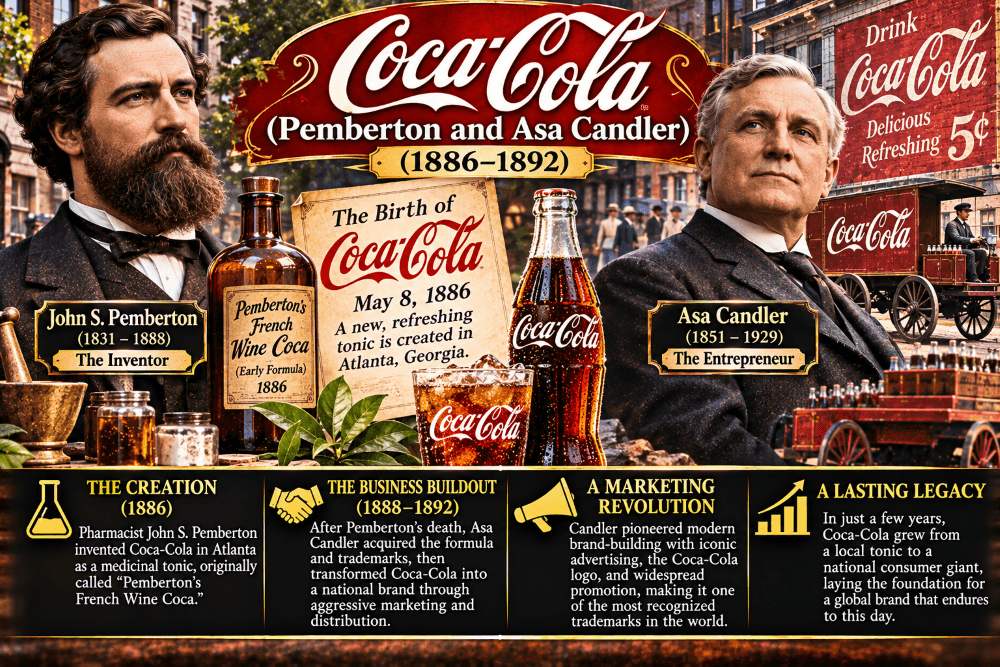
Coca-Cola did not begin as a global brand. It began in 1886 as a medicinal syrup mixed in an Atlanta pharmacy, created by a wounded Civil War veteran searching for a remedy for his own pain. The product only became a business success thanks to a second man, Asa Candler, who turned a patent medicine into one of the most recognized brands in the world. The story shows how a brilliant marketer can matter more than the original inventor.
John Pemberton and the Birth of a Formula
A Pharmacist in Pain
John Stith Pemberton was an Atlanta pharmacist and Confederate veteran who had been wounded in the Civil War.
- Like many wounded veterans, he reportedly developed a dependence on morphine and searched for a substitute.
- He experimented with tonics, including a coca wine inspired by the popular European product Vin Mariani, which he sold as “Pemberton’s French Wine Coca.”
- In 1886, Atlanta and surrounding Fulton County enacted prohibition laws, forcing him to reformulate his drink without alcohol.
A Non-Alcoholic Syrup Is Born
The result was a syrup that Pemberton called Coca-Cola.
- The name referred to two key ingredients: the coca leaf and the kola nut, a source of caffeine.
- His bookkeeper, Frank Robinson, suggested the name and is credited with writing the flowing script logo that remains famous.
- It was first sold in May 1886 at Jacobs’ Pharmacy in Atlanta, for five cents a glass, mixed with carbonated water at the soda fountain.
Early sales were modest, with commonly cited accounts putting them at only a handful of drinks per day at first.
A Patent Medicine in Disguise
In its first years, Coca-Cola was marketed as a health product.
- It was promoted as a “brain tonic” and a remedy for ailments such as headaches and fatigue.
- Its original formula included coca leaf extract, which contained small amounts of cocaine, a fact that later became controversial. Cocaine was removed from the formula in the early 1900s.
- This was typical of the patent medicine era, a period covered earlier in this series, when bold health claims were common and regulation was minimal.
Asa Candler Takes Over
Pemberton’s Decline
Pemberton was in poor health and in debt, and he sold off pieces of the business to various partners.
- He died in 1888 of stomach cancer.
- Ownership of the rights to Coca-Cola was fragmented and the transfers were messy and sometimes disputed.
- This created an opportunity for someone with capital and vision.
A Businessman Assembles the Pieces
Asa Griggs Candler, an Atlanta druggist and businessman, saw the potential.
- Beginning in 1888, he bought up rights from various holders, gaining full control by 1891.
- In 1892, he incorporated The Coca-Cola Company in Georgia.
- He reportedly paid only a small sum for control, which later seemed like one of the great bargains in business history.
Candler’s Marketing Playbook
Candler’s real talent was marketing, and his techniques helped define modern branding.
- Free samples and coupons: He distributed coupons for a free glass of Coca-Cola, an early example of coupon marketing that encouraged people to try the product.
- Branded merchandise: The company gave away items such as clocks, calendars, and serving trays carrying the Coca-Cola logo, keeping the brand in front of customers.
- Consistent branding: The distinctive script logo appeared on signs, painted walls, and products everywhere.
- Selling to fountains: The company sold syrup to soda fountains in drugstores, which were popular social spaces.
- Reframing the product: Candler shifted emphasis away from a medicine toward a refreshing drink everyone could enjoy.
By the mid-1890s, Coca-Cola was reportedly sold in every state of the United States.
The Bottling Decision That Scaled the Brand
In 1899, two businessmen from Chattanooga, Benjamin Thomas and Joseph Whitehead, negotiated the rights to bottle Coca-Cola.
- Candler agreed, reportedly for a nominal fee, partly because he underestimated the bottling market.
- The company sold syrup to independent bottlers, who invested their own capital in plants, equipment, and delivery.
- This franchise-style system allowed rapid expansion with relatively little investment from the parent company.
The arrangement became a foundation of Coca-Cola’s global growth.
Controversies and Costs
The early history includes ethical and regulatory issues.
- Health claims: Early advertising presented the drink as a remedy, despite limited evidence.
- Cocaine: The presence of coca extract raised concerns and was eventually phased out.
- Regulation: The Pure Food and Drug Act of 1906 and later federal actions, including a case over caffeine, brought greater scrutiny to the industry.
- Public health: In later decades, sugary drinks became the subject of public health debate.
What Happened Next
- Candler became wealthy, served as mayor of Atlanta, and made major donations, including to Emory University.
- In 1919, he sold the company to a group of investors led by Ernest Woodruff for about 25 million dollars.
- Under later leadership, particularly Robert Woodruff, Coca-Cola expanded around the world.
Lessons from Coca-Cola
- Marketing can outweigh invention. Pemberton created the formula, but Candler built the brand.
- Consistency builds recognition. A uniform logo and message made the product unforgettable.
- Partners can scale faster than you can. Franchise bottling expanded distribution with limited capital.
- Origins can be messy. The company’s early years involved dubious health claims and disputed ownership.
Frequently Asked Questions
Who invented Coca-Cola? John Stith Pemberton, an Atlanta pharmacist, created Coca-Cola in 1886, with his bookkeeper Frank Robinson naming it and designing its script logo.
Did Coca-Cola originally contain cocaine? Early versions used coca leaf extract, which contained small amounts of cocaine. It was removed from the formula in the early 1900s.
How did Asa Candler build Coca-Cola? Candler bought up the rights, incorporated the company in 1892, and used coupons, branded merchandise, and consistent branding to build national recognition.
Why was bottling important to Coca-Cola’s success? In 1899, the company began licensing independent bottlers, who invested their own capital, allowing rapid expansion with limited cost to the parent company.
Related Articles
- War of the Currents: Edison, Tesla and Westinghouse
- Standard Oil Trust: How a Legal Device Built a Monopoly
- Cecil Rhodes and De Beers: Building a Diamond Monopoly
- Krupp and Siemens: Steel, Electricity and Empire
- German Chemical Industry: The Birth of Corporate R&D
- Zaibatsu: Iwasaki Yataro and Meiji Japan’s Mitsubishi
- Goldman Sachs and Lehman Brothers: Wall Street’s Rise
About The History of Entrepreneurship
This article is part of The History of Entrepreneurship, an ongoing series exploring how entrepreneurs, civilizations, technologies, financial institutions, and business innovations gradually created the modern economy.
Leave a Reply