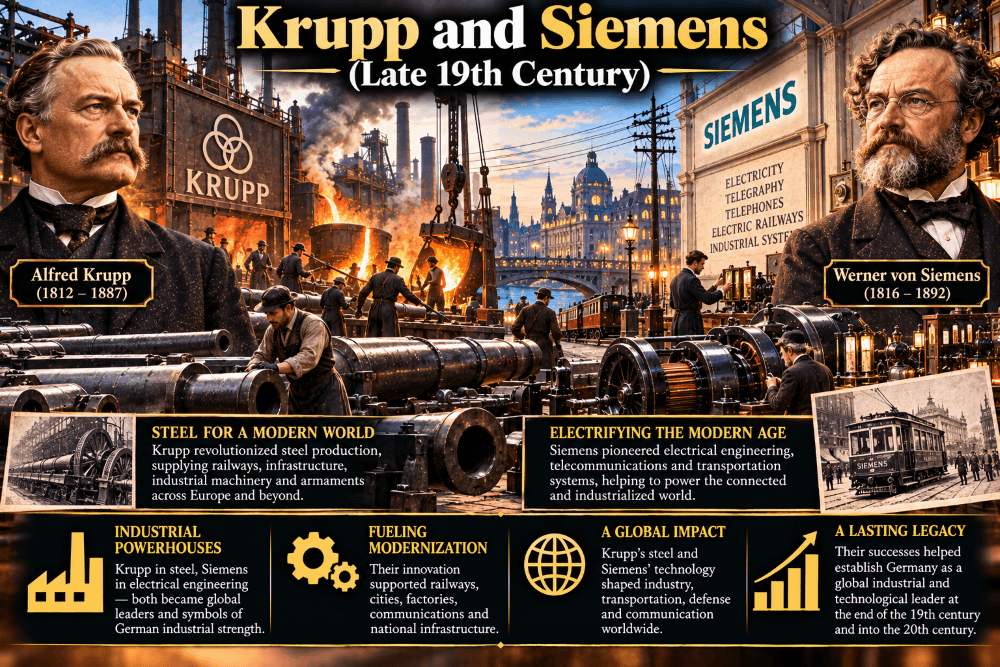
By the late 19th century, Germany had gone from a patchwork of states to an industrial powerhouse that rivaled Britain. Two family-built enterprises, Krupp and Siemens, stood at the center of that transformation. One forged steel, rails, and cannons in Essen. The other wired the continent with telegraphs, generators, and electric trains. Together they show how heavy industry, science, and state power combined, and what that combination ultimately cost.
The Context: A New Germany
Germany was unified in 1871 under Prussian leadership, creating a large, single market with a strong state.
- Railways, steel, coal, and machinery formed the backbone of the Second Industrial Revolution.
- The new state needed arms, railways, and telegraph networks, and it turned to domestic firms.
- Companies that could supply these needs at scale grew into giants.
Krupp and Siemens took different routes, but both thrived in this environment.
Krupp: The Steel Dynasty of Essen
From Near-Bankruptcy to Industrial Power
Friedrich Krupp founded a cast-steel works in Essen in 1811, but he died in 1826 with the business in poor shape. His son Alfred Krupp took over as a teenager and built it into one of Europe’s largest industrial enterprises.
- Alfred obsessively focused on quality, steel metallurgy, and technical improvement.
- He pioneered seamless steel railway tires, a durable product that suited the booming railroad market. The company’s famous three-ring emblem, registered in 1875, is linked to this product.
- He showcased his steel at world exhibitions, including the 1851 Great Exhibition in London, to win customers.
The Cannon King
Krupp’s most famous products were steel guns.
- He developed breech-loading steel cannons that were stronger and more accurate than older bronze or iron artillery.
- The Prussian army became a major customer, and Krupp guns played an important role in Prussia’s victories, including the Franco-Prussian War of 1870 to 1871.
- Krupp also sold weapons to many other governments, which earned the firm a reputation as an international arms dealer.
By the time Alfred died in 1887, Krupp’s Essen works employed roughly 20,000 people and was among the largest industrial enterprises in Europe.
Vertical Integration
Krupp controlled many stages of production, from raw materials to finished goods.
- It owned or secured coal and iron ore sources.
- It operated its own steelworks, forges, and machine shops.
- Later, it expanded into shipbuilding and naval armor, reflecting Germany’s growing naval ambitions.
Krupp remained family-controlled, which let it pursue a long-term, secretive, and highly centralized strategy.
Siemens: The Electrical Counterpart
Werner von Siemens and Johann Georg Halske founded Siemens & Halske in Berlin in 1847, starting with telegraph equipment. We explored its science-driven approach in the chapter on the German chemical and R&D revolution, so here the focus is on how Siemens complemented Krupp.
- International reach: Siemens built long-distance telegraph lines, including the Indo-European line connecting London and India, completed around 1870, and helped lay submarine cables.
- Electrification: The firm moved from telegraphs into electric power, lighting, and railways.
- A family network: Werner’s brothers, including Wilhelm Siemens in Britain, built a transnational family enterprise.
The Link: Steel and Furnaces
A direct technical link connects the two companies’ worlds. Wilhelm Siemens developed a regenerative furnace in the 1850s that, combined with work by French engineer Pierre-Emile Martin, led to the Siemens-Martin open-hearth process for making steel. This process became a major method of steelmaking across Europe, supporting exactly the type of industry Krupp led.
Two Models, Shared Strategies
| Krupp | Siemens | |
|---|---|---|
| Core business | Steel, rails, armaments | Telegraph, electrical equipment |
| Approach | Vertically integrated, family-controlled heavy industry | Science-led, internationally diversified |
| Link to the state | Military supplier | Infrastructure and communications supplier |
Despite the differences, both firms shared several strategies.
Corporate Welfare as a Business Tool
Both companies offered benefits to their workers, a practice sometimes called industrial paternalism.
- Krupp built worker housing, health funds, pensions, and company stores, tied to expectations of loyalty and discipline.
- Siemens introduced pension and benefit schemes and, reportedly, a shorter working day by the early 1890s.
- These programs helped attract and retain skilled workers and discourage labor unrest in a period of growing socialist movements.
Historians note that Chancellor Bismarck’s national insurance laws of the 1880s, which created health, accident, and pension insurance, were partly designed to blunt the appeal of socialism, in a similar spirit.
Close Ties to the State
Both firms thrived on government relationships.
- The Prussian and later German state was a major customer.
- Their success supported national goals, from military strength to modern communications.
- The relationship created enormous opportunities and, over time, deep dependence.
The Costs and Later History
Arms and Rivalry
Krupp’s success was tied to arms, and its naval armor and weapons fed the arms race that preceded World War I.
The Nazi Era
The two firms’ later history includes dark chapters.
- During World War II, Krupp used large numbers of forced laborers, including prisoners and concentration camp inmates.
- After the war, Alfried Krupp, the head of the company, was convicted at Nuremberg of crimes including plunder and the use of slave labor. His sentence was later reduced, and his property restored in 1951.
- Siemens also used forced labor during the war.
The same industrial capacity that built railways and power plants was mobilized for war and atrocity.
Lessons from Krupp and Siemens
- Scale and integration create power. Controlling the full chain gave Krupp resilience and influence.
- Science and diversification create flexibility. Siemens’s broad technical base let it move across fields.
- Welfare can be both generous and strategic. Corporate benefits improved lives while also serving the company’s interests.
- Power tied to the state is double-edged. Government demand fueled growth but linked the firms to militarism.
Frequently Asked Questions
Who was Alfred Krupp? Alfred Krupp took over his family’s steel business as a teenager and grew it into one of Europe’s largest industrial enterprises, known for seamless railway tires and steel cannons.
What was the Siemens-Martin process? It was an open-hearth steelmaking method that built on Wilhelm Siemens’s regenerative furnace and Pierre-Emile Martin’s work, and it became a major method of producing steel.
Why did Krupp and Siemens offer worker benefits? Benefits such as housing, health funds, and pensions helped attract and retain skilled workers and discouraged labor unrest, while also reflecting the paternalistic management style of the time.
What happened to Krupp after World War II? Alfried Krupp was convicted at Nuremberg for plunder and the use of slave labor, though his sentence was later reduced and his property returned in 1951.
Leave a Reply