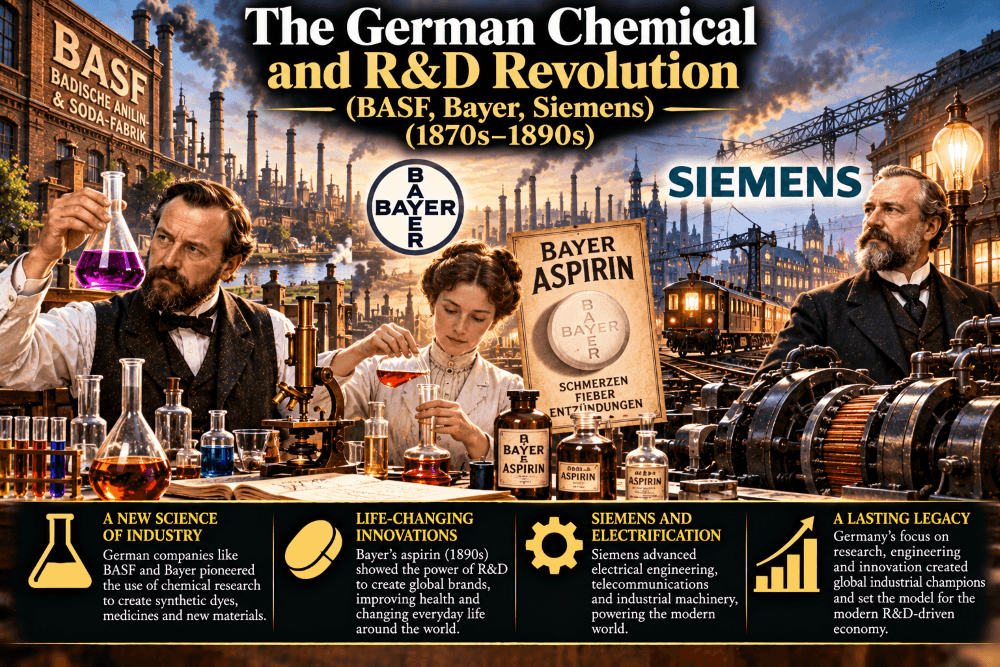
Britain launched the Industrial Revolution, but by the late 19th century Germany had found a new way to win: organized research. The German chemical industry, along with electrical giants like Siemens, turned scientific discovery into a managed business function. Between the 1870s and 1890s, firms such as BASF and Bayer hired armies of trained chemists, built laboratories, and treated innovation as something a company could plan, fund, and scale.
Why Germany Became a Science-Based Economy
Germany’s rise in chemicals and electrical engineering was not an accident. Several forces came together.
- Universities and technical colleges: Germany had a strong tradition of university research and specialized technical institutes that produced large numbers of trained chemists and engineers. Justus von Liebig’s teaching laboratory at Giessen had helped set the pattern decades earlier.
- Industrial demand: Textiles, agriculture, and a growing urban population created demand for dyes, medicines, fertilizers, and electrical equipment.
- Patent law: Historians often point to the 1877 German patent law, which favored patents on processes, as an incentive for firms to invent new ways of making products.
- Willing capital: Banks and investors were prepared to fund long-term projects.
The result was a system where universities, companies, and capital reinforced one another.
The Dye Revolution
A British Discovery, a German Industry
Synthetic dyes began in Britain, when William Perkin created the dye mauve in 1856. But Germany took the technology and scaled it.
- Firms such as BASF, founded in 1865 in Mannheim, and Bayer, founded in 1863, built large chemical operations around coal-tar chemistry.
- German companies hired chemists to systematically search for new compounds and improve production methods.
- By the early 20th century, German firms dominated the global synthetic dye market.
Alizarin and Indigo
Two products illustrate the strategy.
- Alizarin: After chemists synthesized the red dye alizarin in 1868, BASF developed a commercial process in 1869, threatening the market for the natural dye extracted from the madder plant.
- Indigo: Adolf von Baeyer first synthesized indigo in 1880, but making it cheaply took years of research and substantial investment. BASF launched commercial synthetic indigo in 1897.
- A human cost: Synthetic indigo undercut natural indigo grown in India, hurting the farmers and workers who depended on that crop.
This is a clear example of creative destruction, how science-based innovation can create winners and also destroy established livelihoods.
Bayer and the Research Lab
Organizing Discovery
Bayer’s growth illustrates how the company built research into its structure.
- Carl Duisberg joined Bayer as a chemist in 1884 and later became a leading figure at the company.
- He championed systematic research laboratories and a structure that linked chemists, testing, and production.
- Bayer moved from dyes into pharmaceuticals, using the same chemical knowledge.
Aspirin, and a Cautionary Tale
In 1897, Bayer chemist Felix Hoffmann synthesized acetylsalicylic acid, and Bayer began marketing it as Aspirin in 1899. Credit for the discovery has been debated, with another Bayer chemist, Arthur Eichengrün, later claiming a larger role.
Bayer also marketed heroin in the late 1890s as a cough remedy, a product later recognized as dangerously addictive. It is a reminder that rapid commercialization can outrun understanding of risk.
Siemens and the Electrical Age
From Telegraph to Power Systems
Siemens, founded as Siemens & Halske in Berlin in 1847 by Werner von Siemens and Johann Georg Halske, began in telegraph equipment and expanded into electrical power.
- Werner von Siemens helped develop the dynamo-electric principle in the 1860s, making generators more practical.
- The company demonstrated an electric locomotive in Berlin in 1879 and helped introduce electric trams in the early 1880s.
- Siemens expanded into lighting, power generation, and electrical infrastructure across Europe.
Science Meets Business
Werner von Siemens strongly believed in tying science to industry.
- He supported creating the Physikalisch-Technische Reichsanstalt, a national research institute established in the 1880s.
- His firm invested in laboratories and in recruiting scientifically trained engineers.
- This approach helped German electrical companies compete with American rivals such as Edison’s companies.
The R&D System Takes Shape
Taken together, these companies created a new kind of enterprise.
- In-house labs: Companies established dedicated research laboratories staffed with university-trained scientists.
- Systematic search: Instead of waiting for lucky discoveries, chemists tested compounds in an organized way.
- Scale and integration: Firms linked research to large-scale manufacturing and global sales.
- Cooperation with universities: Companies recruited graduates and consulted professors.
This model of corporate R&D later influenced firms in the United States and elsewhere.
The Costs and the Darker Legacy
The same industrial system also had serious downsides.
- Pollution: Chemical plants discharged waste into rivers, and environmental damage became a growing concern.
- Consolidation: The major dye makers cooperated and consolidated, eventually forming I.G. Farben in 1925, which brought together BASF, Bayer, and other chemical firms.
- War and atrocity: I.G. Farben became deeply entangled with the Nazi regime, using forced labor, including at a facility near Auschwitz, and a subsidiary supplied the Zyklon B gas used in the Holocaust. Siemens also used forced labor during World War II. After the war, I.G. Farben was broken up, and its former components, including BASF and Bayer, were refounded as separate companies.
- Dual-use science: BASF’s Haber-Bosch process, commercialized in 1913, enabled synthetic fertilizer and also supplied materials for explosives.
Lessons from the German Chemical Industry
- Make innovation a system. Germany’s edge came from organizing research, not just from individual geniuses.
- Connect science and business. Close links with universities and technical schools fed the pipeline of talent and ideas.
- Scale discoveries. Taking an idea from the lab to mass production was as important as the discovery itself.
- Innovation has consequences. New technologies can destroy old industries, harm the environment, and be turned toward terrible ends.
Frequently Asked Questions
Why did Germany lead the chemical industry in the late 19th century? It combined strong universities and technical schools, industrial demand, supportive patent law, and willing capital, and its companies invested heavily in organized research.
What was significant about synthetic indigo? BASF launched commercial synthetic indigo in 1897 after years of research, and it undercut natural indigo grown in India, hurting farmers who depended on the crop.
Who invented Aspirin? Bayer chemist Felix Hoffmann is traditionally credited with synthesizing it in 1897, though another chemist, Arthur Eichengrün, later claimed a larger role.
What was I.G. Farben? I.G. Farben was a chemical conglomerate formed in 1925 from companies including BASF and Bayer. It was broken up after World War II because of its ties to the Nazi regime.
Related Articles
- Zaibatsu: Iwasaki Yataro and Meiji Japan’s Mitsubishi
- Goldman Sachs and Lehman Brothers: Wall Street’s Rise
- Gustavus Swift: The Refrigerated Railcar That Fed America
- Alexander Graham Bell: The Telephone and a Patent Race
- Sears and Montgomery Ward: The Catalog Revolution
- Erie War: Vanderbilt’s Battle With Gould and Fisk
- Wall Street and the Ticker: Speed Becomes the Edge
About The History of Entrepreneurship
This article is part of The History of Entrepreneurship, an ongoing series exploring how entrepreneurs, civilizations, technologies, financial institutions, and business innovations gradually created the modern economy.
Leave a Reply