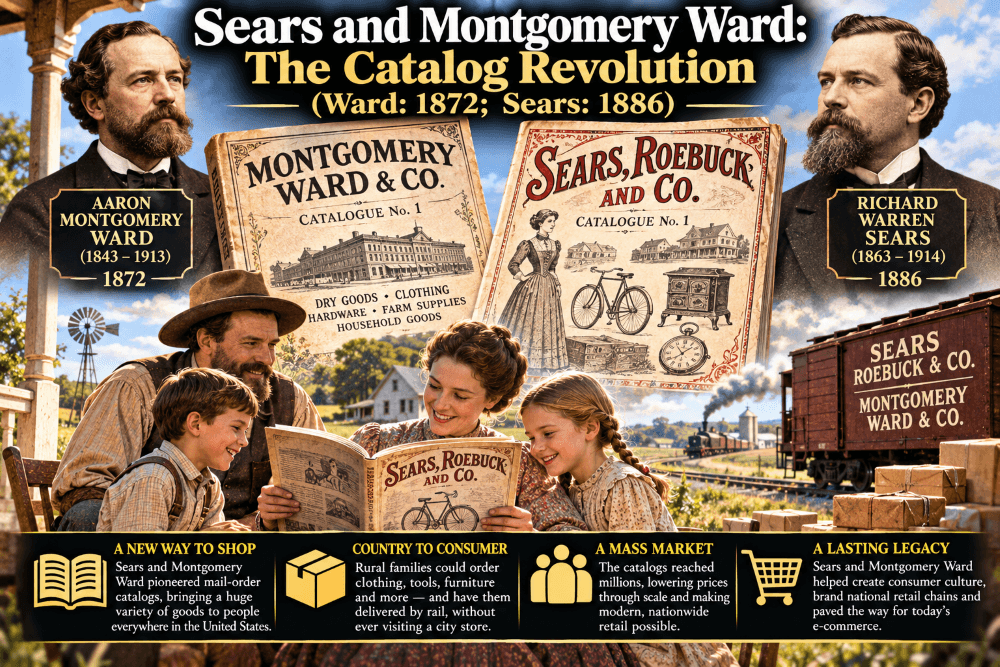
For most Americans in the 1870s, shopping meant a trip to the nearest general store, where choices were limited and prices were often high. Sears and Montgomery Ward changed that by turning the printed catalog into a store that could reach anyone with a mailbox. Their mail-order businesses, launched in 1872 and 1886 respectively, brought a nationwide selection of goods to rural families and rewrote the economics of retail.
The Problem: Rural America Had Few Choices
Most Americans at the time lived outside big cities, and their access to goods was surprisingly constrained.
- Rural customers typically relied on a single local general store, which faced little competition and often charged high prices.
- Goods passed through multiple middlemen before reaching the shelf, and each layer added to the final cost.
- Credit at local stores could tie farm families to one merchant, leaving them with little bargaining power.
This gap between what rural customers wanted and what they could easily buy created an opening for anyone who could reach them directly.
Aaron Montgomery Ward Invents the Catalog Model
A Single Sheet in 1872
Aaron Montgomery Ward, a Chicago salesman, founded his mail-order business in 1872 with a simple idea: sell directly to rural customers by mail at lower prices.
- His first catalog was reportedly just a single sheet listing a small number of items.
- He cut out middlemen by buying goods in bulk, often for cash, and passing savings on to customers.
- Chicago’s role as a major railroad hub let him ship orders efficiently across a wide area.
Selling to Farmers and Winning Their Trust
Ward found a natural audience among farmers, many of whom were frustrated with the prices charged by local merchants.
- He aligned his business with farmers’ interests, at a time when agricultural cooperatives and farm organizations were pushing for lower costs.
- He built trust through a bold promise: customers could return goods and get their money back if they were not satisfied.
- That guarantee mattered enormously, because buying by mail from a distant stranger required a leap of faith.
Over time, his single sheet grew into a thick catalog that became a fixture in rural homes.
Richard Sears and Alvah Roebuck Join the Race
From Railroad Agent to Watch Seller
Richard Sears came to retail from an unlikely place. He worked as a railroad station agent in Minnesota, where a fortunate accident helped launch his career.
- In 1886, he reportedly acquired a shipment of watches that a local jeweler had refused, and sold them to other station agents along the railroad line.
- The venture proved profitable, and he started a watch business, later bringing in watchmaker Alvah Roebuck to handle repairs.
- By 1893, the company had become Sears, Roebuck and Co., and it moved toward a broad general catalog.
A Master of Promotion
Sears had a rare talent for marketing and copywriting.
- He wrote catalog copy in a persuasive, personal style that spoke directly to rural readers.
- He emphasized low prices, and the catalog’s growing size and range became selling points in themselves.
- His enthusiasm sometimes led to exaggerated claims, a pattern that created quality and trust problems the company later had to address.
Julius Rosenwald and the Operations Behind the Catalog
Turning Orders Into a System
A catalog is only as good as the system that fills the orders, and Sears’s rapid growth strained its operations. Businessman Julius Rosenwald, who joined in 1895 and later became president, brought discipline to the company.
- He focused on efficient order processing, standardized procedures, and quality control.
- The company built large fulfillment facilities in Chicago designed to handle enormous volumes of mail orders.
- Under this operational approach, Sears overtook Montgomery Ward as the leading mail-order retailer in the early 20th century.
Infrastructure That Made It Possible
The mail-order model depended heavily on public infrastructure built during this era.
- Railroads moved goods across the country quickly and cheaply.
- Rural Free Delivery, which expanded mail service to farms in the late 1890s and early 1900s, brought catalogs and parcels to rural doorsteps.
- Parcel post, introduced in 1913, lowered shipping costs for packages and further boosted mail-order business.
Why Sears and Montgomery Ward Mattered
Expanding Choice and Lowering Prices
The impact of these catalogs on ordinary life was substantial.
- Rural families gained access to a range of goods once available mostly to city dwellers.
- The catalogs increased competition, putting pressure on local merchants to improve prices and selection.
- Some historians have also noted that mail order gave customers a way to shop without facing the discrimination they sometimes encountered in local stores, though this varied by place.
A Blueprint for Modern Retail
The model pioneered by Sears and Montgomery Ward anticipated many features of later retail, including e-commerce.
- They relied on direct-to-consumer sales, broad selection, money-back guarantees, and efficient logistics.
- Both companies later moved into physical stores, with Montgomery Ward and Sears opening retail locations in the 1920s as car ownership grew and customers moved to cities.
- Their catalog era offers an early template for how distance can be overcome by information, trust, and delivery.
Lessons from Sears and Montgomery Ward
- Remove the middleman and share the savings. Direct selling gave customers lower prices and gave the sellers a strong competitive edge.
- Guarantees build trust at a distance. Money-back promises made buying from a stranger feel safe.
- Operations matter as much as marketing. Sears’s rise depended on Rosenwald’s focus on efficient fulfillment, not only on Sears’s gift for promotion.
Frequently Asked Questions
Who started the first mail-order catalog business in the United States? Aaron Montgomery Ward is widely credited with launching the first major general mail-order business in 1872, beginning with a single-sheet catalog sold to rural customers.
Why were mail-order catalogs so important to rural America? They gave farm families access to a broad selection of goods at lower prices than local general stores often offered, and they delivered those goods through the railroads and the postal system.
How did Sears become bigger than Montgomery Ward? Richard Sears’s marketing talent and Julius Rosenwald’s focus on efficient operations helped Sears overtake Montgomery Ward as the leading mail-order retailer in the early 1900s.
What role did the postal system play in the catalog boom? Rural Free Delivery and, later, parcel post made it cheaper and easier to deliver catalogs and packages to rural customers, which fueled mail-order growth.
Related Articles
- Erie War: Vanderbilt’s Battle With Gould and Fisk
- Wall Street and the Ticker: Speed Becomes the Edge
- The Atlantic Cable: Cyrus Field’s Costly Persistence
- The Department Store: Retail’s Quiet Revolution
- The Birth of Modern Management: Railroads Invent the Org Chart
- Early Advertising: How Hype Became a Business Tool
- Singer Sewing Machine: Selling What No One Could Afford
About The History of Entrepreneurship
This article is part of The History of Entrepreneurship, an ongoing series exploring how entrepreneurs, civilizations, technologies, financial institutions, and business innovations gradually created the modern economy.
Leave a Reply