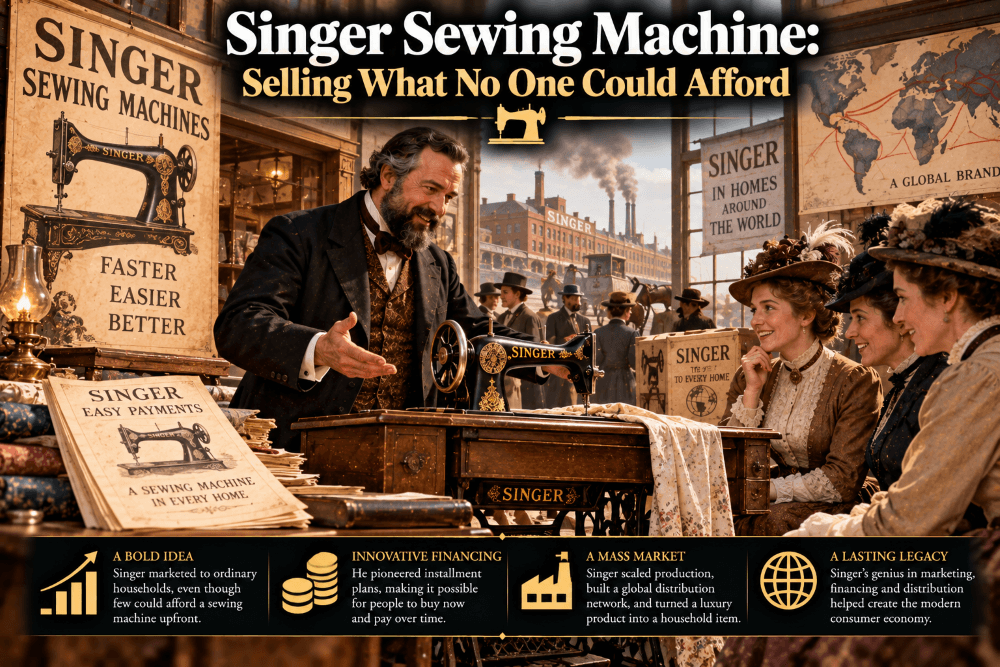
The Singer sewing machine wasn’t the first sewing machine ever built, and Isaac Singer wasn’t even its original inventor. What made Singer’s company the dominant force in the industry by the 1850s wasn’t the machine itself. It was a business model innovation that solved the one problem no competitor had cracked: how to get an expensive product into the hands of customers who couldn’t afford to pay for it upfront.
Isaac Singer Enters an Existing Market
A Crowded, Contested Field
By the time Isaac Singer became involved in sewing machine manufacturing in 1850, the technology already existed in several competing forms.
- Elias Howe had patented a significant sewing machine design years earlier, and his patent covered core mechanical elements used across the emerging industry.
- Several other inventors and manufacturers were already producing competing sewing machine designs with varying degrees of commercial success.
- The market was crowded, legally contested, and far from settled when Singer entered it.
Singer’s genuine contribution came through practical design improvements rather than foundational invention.
Improving the Design
Singer made meaningful mechanical improvements to existing sewing machine technology, even though he built upon ideas that predated his involvement.
- He developed a more stable, practical machine design, including improvements to the needle mechanism and overall build quality.
- His version offered genuine advantages in reliability and ease of use compared to many competing machines on the market.
- These design improvements helped differentiate his product, though they weren’t by themselves enough to guarantee commercial dominance in such a crowded field.
The Patent War
A Legal Battle Over Core Technology
Singer’s sewing machine business quickly ran into serious legal conflict with Elias Howe, who held patents covering fundamental elements of the technology.
- Howe pursued legal action against Singer and other manufacturers, arguing their products infringed on his original patented design.
- This dispute threatened to derail the entire emerging sewing machine industry in costly, prolonged litigation.
- Multiple manufacturers found themselves tangled in overlapping patent claims and competing lawsuits throughout the early 1850s.
Resolving Conflict Through Patent Pooling
Rather than continuing destructive legal warfare indefinitely, the major sewing machine manufacturers, including Singer, eventually reached a groundbreaking resolution.
- In 1856, these competing companies formed what’s often cited as one of the first patent pools in American business history, combining their various patents and agreeing to share licensing fees.
- This arrangement allowed each company to continue manufacturing without constant litigation risk, in exchange for paying into a shared licensing structure.
- This resolution let Singer and his competitors focus their energy on market competition rather than continued legal battles.
The Installment Plan That Changed Everything
An Expensive Product, Out of Reach
Despite legal resolution and genuine product improvements, Singer’s sewing machines faced a fundamental business problem: they were expensive, often costing more than many working families could reasonably afford outright.
- Sewing machines represented a significant purchase for most households during this period, well beyond typical discretionary spending.
- This price barrier meant that even a genuinely superior product struggled to reach its full potential customer base.
- Simply lowering the price wasn’t necessarily viable without undermining the company’s profitability.
Introducing Installment Payments
Singer’s company, under business partner Edward Clark’s guidance, introduced an innovation that would prove far more consequential than any mechanical improvement: the installment payment plan.
- Customers could purchase a Singer sewing machine by making smaller periodic payments over time, rather than paying the full price upfront.
- This approach effectively transformed an unaffordable lump-sum purchase into a manageable, ongoing household expense.
- This model dramatically expanded Singer’s potential customer base to include far more working and middle-class families who previously couldn’t access the product.
This single business model shift arguably had more impact on Singer’s eventual market dominance than any specific mechanical advantage the machine itself offered.
A Template for Modern Consumer Finance
Singer’s installment plan represents one of history’s most influential early examples of consumer credit financing.
- It directly demonstrated that expanding payment flexibility could unlock enormous previously inaccessible demand.
- This approach became a widely adopted model across numerous industries selling higher-cost consumer goods in the following decades.
- Modern financing options, from auto loans to buy-now-pay-later services, trace meaningful conceptual roots back to this 19th-century innovation.
Building a Global Sewing Machine Empire
Aggressive Marketing and Distribution
Beyond financing innovation, Singer’s company pursued aggressive marketing and distribution strategies that further accelerated its market dominance.
- The company established extensive sales networks and demonstration showrooms, allowing potential customers to see the machine’s capabilities firsthand.
- Advertising campaigns emphasized the machine’s time-saving benefits for household sewing tasks.
- This combination of accessible financing and assertive marketing helped Singer become the dominant global sewing machine brand within a relatively short period.
International Expansion
Singer’s company expanded well beyond the American market, establishing manufacturing and sales operations across multiple countries.
- This international expansion made Singer one of the first truly global American consumer product companies.
- The installment payment model that worked domestically was successfully adapted for international markets as well.
- This global reach reinforced Singer’s position as a dominant force in the sewing machine industry for decades.
Lessons from the Singer Sewing Machine
- Business model innovation can outweigh product innovation. Singer’s installment plan likely mattered more to his success than his mechanical improvements.
- Removing a purchase barrier can unlock entirely new markets. Making payments manageable expanded Singer’s customer base dramatically beyond what price alone would have allowed.
- Legal conflict can be resolved through structured cooperation. The sewing machine patent pool shows how competitors can convert destructive litigation into a shared, functional system.
Frequently Asked Questions
Did Isaac Singer invent the sewing machine? No, sewing machine technology already existed before Singer’s involvement, including patents held by Elias Howe. Singer made meaningful design improvements but built upon existing innovation rather than inventing the concept outright.
What was the sewing machine patent pool? Formed in 1856, it was an agreement among competing sewing machine manufacturers, including Singer, to share patents and licensing fees rather than continuing costly, overlapping patent litigation.
Why was the installment plan important to Singer’s success? It allowed customers to pay for an otherwise unaffordable product through smaller periodic payments, dramatically expanding Singer’s potential customer base beyond those who could pay the full price upfront.
How did Singer become a global company? Beyond its installment financing model, Singer expanded aggressively through international manufacturing and sales operations, becoming one of the first major global American consumer product brands.
Related Articles
- The Suez and Panama Canals: One Man, Two Fates
- Limited Liability: The Law That Democratized Business
- Wells Fargo: Banking Built on the Gold Rush
- Sam Brannan: California’s First Gold Rush Millionaire
- Levi Strauss: The Immigrant Who Invented Denim
- The California Gold Rush: Where Merchants Beat Miners
- Thomas Edison: Turning Invention Into Business
About The History of Entrepreneurship
This article is part of The History of Entrepreneurship, an ongoing series exploring how entrepreneurs, civilizations, technologies, financial institutions, and business innovations gradually created the modern economy.
Leave a Reply