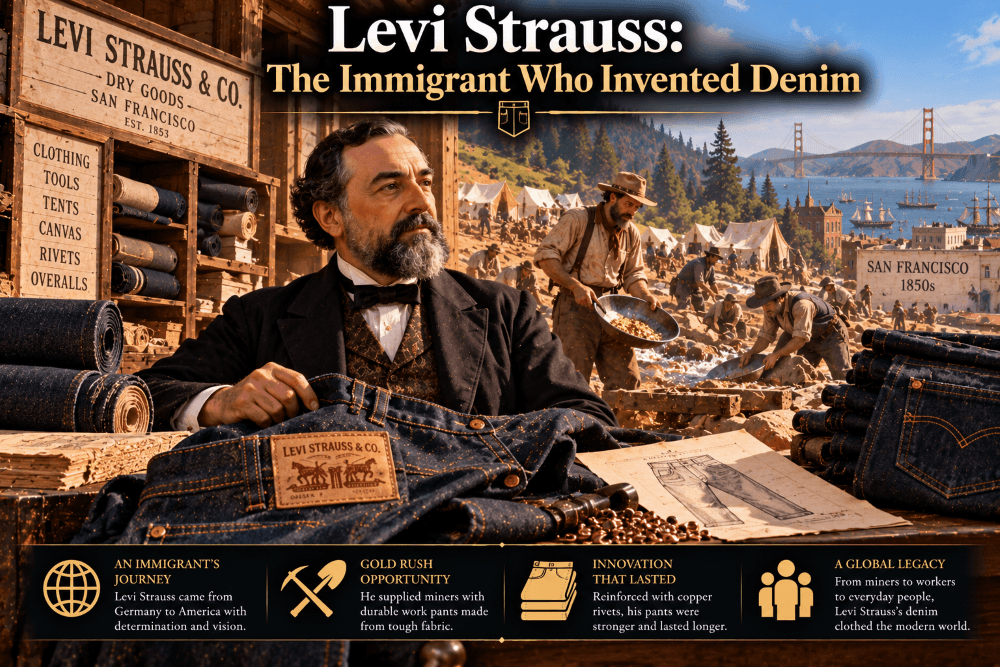
Levi Strauss spent over two decades running a steady, unremarkable dry goods business before the product that would make him famous even existed. His story isn’t really about a single flash of inventive genius. It’s about a patient immigrant merchant who recognized a good idea when a customer brought one to him, and who built one of history’s most durable brands almost by accident.
From Bavaria to San Francisco
An Immigrant’s Early Path
Levi Strauss was born Löb Strauss in 1829 in Bavaria, part of what is now Germany, into a Jewish family involved in the dry goods trade.
- He immigrated to the United States in 1847, following family members who had already established themselves in the dry goods business in New York.
- He worked for several years learning the trade within the family’s existing business operations.
- In 1853, drawn by the economic opportunity created by the California Gold Rush, Strauss relocated to San Francisco to establish his own dry goods operation.
This move placed him directly within one of the most explosive business environments in American history, though not in the way most people associate with the Gold Rush era.
Building a Steady Wholesale Business
Rather than mining for gold himself, Strauss built a conventional, if successful, wholesale dry goods business serving California’s rapidly growing population.
- His company supplied clothing, fabric, and various dry goods to smaller retailers throughout the American West.
- This business model proved durable precisely because it served the broader economy surrounding the Gold Rush rather than depending on mining success directly.
- For roughly two decades, Levi Strauss & Co. operated as a solid but relatively unremarkable wholesale supplier, well before the product that would define his legacy ever appeared.
The Partnership That Changed Everything
Jacob Davis and the Riveted Pants
The invention most associated with Levi Strauss actually originated with one of his customers, a tailor named Jacob Davis.
- Davis, based in Reno, Nevada, had developed a technique using metal rivets to reinforce the stress points on work pants, areas like pocket corners that frequently tore under heavy use.
- His customers, often miners and laborers, needed durable clothing that could withstand extremely demanding physical conditions.
- Davis recognized the commercial potential of his innovation but lacked the capital needed to secure a patent on his own.
Davis purchased his fabric from Levi Strauss & Co., giving him a direct connection to a supplier capable of helping him pursue his idea further.
Securing the Patent Together
In 1872, Jacob Davis wrote to Levi Strauss proposing a partnership to patent and commercially produce the riveted pants design.
- Strauss recognized the commercial value of Davis’s innovation and agreed to fund the patent application.
- The two men were jointly granted U.S. Patent No. 139,121 in 1873, covering the use of metal rivets to reinforce work pants.
- This partnership transformed a practical tailor’s fix into a protected, commercially scalable product.
This collaboration illustrates an important entrepreneurial pattern: Strauss’s major contribution wasn’t the invention itself, but recognizing its value and providing the capital and business infrastructure needed to bring it to market.
Levi Strauss and the Birth of an Industry
From Workwear to Icon
Once patented, the riveted pants became a genuine commercial product manufactured and distributed through Levi Strauss & Co.’s existing business infrastructure.
- The pants were initially marketed specifically toward miners, laborers, and others needing genuinely durable workwear.
- Manufacturing scaled steadily as demand grew beyond the original mining and laboring customer base.
- Over subsequent decades, denim work pants gradually transformed from purely functional workwear into a broader cultural garment eventually known worldwide as blue jeans.
Building a Lasting Company Culture
Levi Strauss’s approach to business extended beyond the product itself into how he treated his growing company and community.
- He became known for philanthropic involvement in San Francisco, supporting local charitable causes and educational institutions.
- He never married or had children, and upon his death in 1902, he left his thriving business to his nephews, ensuring its continuation.
- The company he built has continued operating under his name for well over 150 years since the original patent was granted.
Why Levi Strauss’s Story Still Resonates
Patience Over a Single Breakthrough
Unlike entrepreneurs defined by one dramatic invention, Levi Strauss’s story highlights the value of sustained, reliable business building.
- He operated a conventional wholesale business successfully for roughly twenty years before the product now associated with his name even existed.
- This patience and established infrastructure positioned him perfectly to recognize and capitalize on Davis’s innovation when the opportunity arrived.
- His story suggests that building reliable business fundamentals can position an entrepreneur to seize unexpected opportunities later.
Recognizing Value in Others’ Ideas
Levi Strauss’s willingness to partner with Jacob Davis, rather than developing a competing product independently, proved essential to the venture’s success.
- He provided capital and manufacturing infrastructure that Davis’s idea genuinely required to scale commercially.
- He shared credit and patent ownership rather than attempting to claim the innovation solely for himself.
- This collaborative approach helped ensure the partnership’s long-term success rather than creating conflict over ownership.
Lessons from Levi Strauss
- Sustainable businesses create future optionality. Strauss’s two decades of steady operation positioned him to act when real opportunity appeared.
- Recognizing value matters as much as creating it. His contribution was identifying Davis’s innovation’s potential and providing resources to scale it.
- Fair partnership strengthens long-term outcomes. Sharing credit and ownership with Davis helped establish a foundation built to last.
Frequently Asked Questions
Did Levi Strauss invent blue jeans? Not entirely alone. The riveted pants design was developed by tailor Jacob Davis, and Strauss partnered with him to fund and secure the 1873 patent that launched the product commercially.
What was Levi Strauss’s business before blue jeans existed? He ran a wholesale dry goods business in San Francisco for roughly two decades, supplying clothing and fabric to retailers throughout the American West.
Why did Levi Strauss move to San Francisco? He relocated in 1853 to take advantage of the economic opportunities created by the California Gold Rush, establishing a dry goods business serving the region’s rapidly growing population.
What happened to Levi Strauss & Co. after his death? Levi Strauss died in 1902 without children and left the company to his nephews, who continued operating the business, which remains active well over 150 years after the original patent.
Related Articles
- The California Gold Rush: Where Merchants Beat Miners
- Thomas Edison: Turning Invention Into Business
- John D. Rockefeller: Standard Oil and the Power of Consolidation
- Andrew Carnegie: Steel, Scale, and Vertical Integration
- The Panic of 1873: The Railway Bubble That Broke America
- The Railroad Revolution: How Railways Changed Entrepreneurship and Conquered Distance
- The Steam Revolution: How Power Rewrote Business
About The History of Entrepreneurship
This article is part of The History of Entrepreneurship, an ongoing series exploring how entrepreneurs, civilizations, technologies, financial institutions, and business innovations gradually created the modern economy.
Leave a Reply