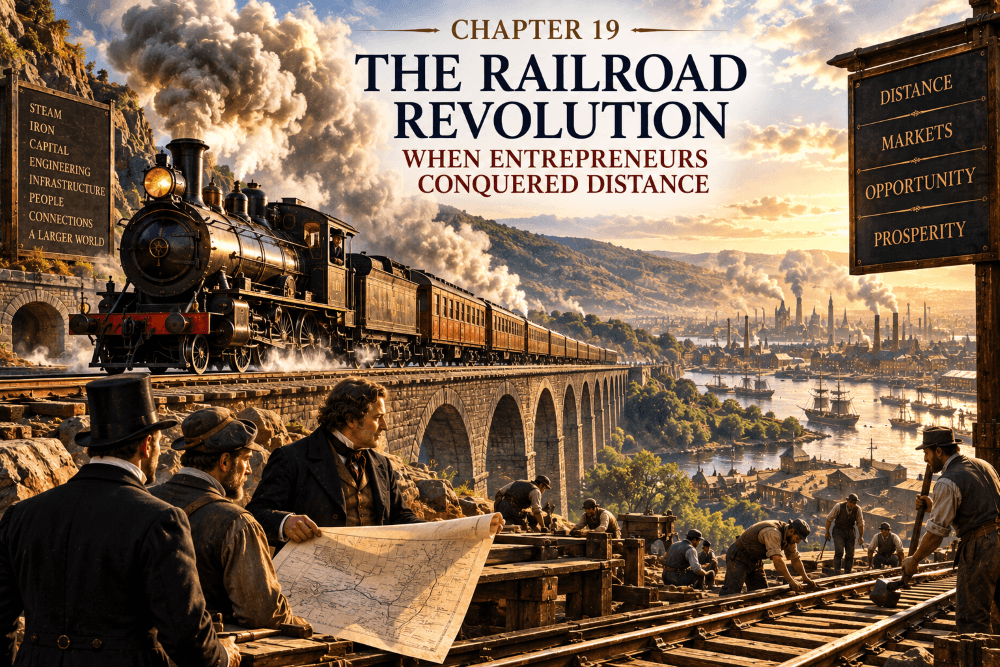
The Industrial Revolution gave entrepreneurs something extraordinary:
The ability to produce goods on a massive scale.
Factories filled with machinery could manufacture quantities that traditional workshops could never match.
But mass production created another problem.
What good is producing 100,000 products if your customers live hundreds of kilometers away?
Factories needed coal.
Manufacturers needed raw materials.
Cities needed food.
Businesses needed customers.
Industrialization had increased the speed of production.
Transportation now needed to catch up.
The solution was the railroad.
Railroads did much more than move passengers.
They connected factories with resources.
Farmers with cities.
Ports with inland markets.
Workers with jobs.
Businesses with customers.
The railroad changed the economic meaning of distance.
Its entrepreneurial contribution was:
Speed, connectivity, and infrastructure networks.
Transportation Before the Railroad
For most of human history, moving goods over land was slow and expensive.
People relied primarily on:
- Horses
- Wagons
- Carriages
- Walking
- Animal-drawn carts
Road quality varied enormously.
Rain created mud.
Snow stopped travel.
Animals became exhausted.
Moving heavy freight was particularly expensive.
Water transportation was generally more efficient.
Ships carried enormous quantities of cargo.
Rivers connected some regions.
Canals expanded inland transportation.
But waterways had an obvious limitation.
Nature decided where rivers flowed.
Entrepreneurs could not simply move them.
Railroads changed that.
Railroads Allowed Entrepreneurs to Create Economic Geography
A river exists because nature put it there.
A railway exists because people decide where it should go.
That difference transformed economic development.
Railways could connect:
Mines.
Factories.
Farms.
Ports.
Cities.
Markets.
A town connected to a railway could suddenly become commercially important.
A town bypassed by the railway might decline.
Factories increasingly considered transportation access when deciding where to locate.
Infrastructure did not simply connect existing economic activity.
Infrastructure began determining where economic activity occurred.
The Steam Engine Starts Moving
Steam engines had already transformed factories.
Then engineers asked another question:
Could steam power transportation?
Early steam locomotives appeared during the first decades of the nineteenth century.
Richard Trevithick demonstrated an early steam locomotive in 1804.
But experimental technology is not the same as a commercially useful transportation system.
Locomotives needed to become:
Reliable.
Powerful.
Affordable.
Safe.
And connected to functioning railway infrastructure.
One engineer became particularly important in making that transition.
George Stephenson.
Who Was George Stephenson?
George Stephenson was born in England in 1781.
He grew up around coal mining and steam machinery.
His family had little money, and Stephenson received limited formal education during childhood.
But he learned machines practically.
He operated them.
Repaired them.
Studied them.
Improved them.
Stephenson did not invent the steam locomotive.
His contribution was arguably more important to entrepreneurship:
He helped make locomotives commercially useful.
That distinction has appeared repeatedly throughout our history.
Successful entrepreneurs and innovators do not always invent something from scratch.
They improve existing technologies until those technologies become useful enough to scale.
The Stockton and Darlington Railway
In 1825, the Stockton and Darlington Railway opened in northeastern England.
The railway was developed primarily to transport coal.
Stephenson served as its engineer.
His locomotive Locomotion No. 1 hauled a train during the railway’s opening.
The project demonstrated that steam locomotives could move substantial loads along rails.
But another railway would demonstrate something even bigger.
The possibility of regular transportation between major cities.
The Liverpool and Manchester Railway
Liverpool and Manchester represented two crucial parts of Britain’s industrial economy.
Liverpool was one of Britain’s great ports.
Manchester was becoming one of the world’s most important textile manufacturing centers.
Cotton arrived through Liverpool.
Manchester’s factories needed cotton.
Finished textiles needed access to Liverpool and international markets.
Transportation between the cities therefore had enormous economic value.
In 1830, the Liverpool and Manchester Railway opened.
George Stephenson served as its chief engineer, and the successful Rainhill Trials of 1829 had demonstrated the potential of the famous Rocket, built by Robert Stephenson & Co.
The railway showed that steam locomotives could provide fast, reliable intercity transportation.
But the most important innovation was not simply the locomotive.
It was the system surrounding it.
A Locomotive Is an Invention. A Railway Is a Business System.
Building a successful railway required much more than an engine.
Entrepreneurs needed:
- Tracks
- Stations
- Bridges
- Tunnels
- Locomotives
- Rail cars
- Employees
- Maintenance facilities
- Tickets
- Freight terminals
- Schedules
- Accounting
- Financing
A locomotive could demonstrate technological possibility.
A railway transformed that technology into an economic network.
This distinction remains crucial today.
Inventing a technology is one achievement.
Building the infrastructure that allows millions of people to use it is another.
The Network Became the Product
A locomotive running along a few kilometers of track has limited usefulness.
Connect two cities and it becomes more valuable.
Connect another city.
Then another.
Then ports.
Mines.
Factories.
Farms.
Suddenly the network becomes extraordinarily valuable.
The important asset is no longer simply the train.
It is the connections between destinations.
This introduces one of modern entrepreneurship’s most powerful concepts:
Network effects.
A network can become more useful as more participants and destinations join it.
Railroads Created Markets
Imagine being a farmer before railroads.
Your practical market may be limited to nearby towns.
Transporting heavy or perishable products long distances is difficult.
Then a railway reaches your region.
Suddenly you can sell products much farther away.
Your potential market expands.
Now multiply that effect across thousands of farms and businesses.
Railways helped transform:
Local markets → regional markets → national markets.
Geographically, the world remained the same size.
Economically, it became much smaller.
Transportation Costs Act Like a Tax
Imagine coal costs $5 at the mine.
But transporting it to the customer costs another $10.
For that customer, the coal effectively costs $15.
Transportation therefore behaves like a hidden tax on economic activity.
Lower transportation costs and suddenly:
Coal becomes cheaper.
Food becomes cheaper.
Raw materials become cheaper.
Manufactured goods become cheaper.
Railroads increased productivity not simply by moving things faster.
They made thousands of other economic activities cheaper.
Speed Has Economic Value
Railroads dramatically reduced travel times.
That mattered for passengers.
But it mattered even more for business.
Faster transportation meant:
- Inventory arrived sooner
- Perishable products could travel farther
- Salespeople reached more customers
- Mail traveled faster
- Workers became more mobile
- Capital circulated faster
- Businesses could serve larger territories
Time has economic value.
Railroads reduced the cost of time.
Reliability Was Almost as Important as Speed
Businesses need more than fast transportation.
They need predictable transportation.
Suppose a shipment sometimes takes two days.
Sometimes five.
Sometimes twelve.
Planning becomes difficult.
Businesses must hold larger inventories.
Customers cannot predict delivery.
Production schedules become unreliable.
Railway timetables improved predictability.
Trains increasingly operated according to schedules.
Transportation became something businesses could plan around.
Modern logistics still depends on the same principle.
Reliability can be as valuable as speed.
Railroads Changed Time Itself
Before railways, towns commonly operated according to local solar time.
Noon occurred when the sun reached its highest point locally.
That worked when transportation was slow.
Railways created a problem.
Train schedules become extremely confusing if every town maintains a slightly different clock.
British railways increasingly adopted standardized railway time based on Greenwich Mean Time.
Eventually standardized time became normal.
The consequences are remarkable.
Transportation networks became so important that society reorganized time itself to accommodate them.
Railroads Required Enormous Amounts of Capital
Building a railway was extraordinarily expensive.
Before carrying a single passenger, a company might need to finance:
Land.
Track.
Stations.
Bridges.
Tunnels.
Locomotives.
Rail cars.
Workers.
Engineering.
Maintenance facilities.
A railway therefore required enormous amounts of capital before generating substantial revenue.
Fortunately, earlier generations of entrepreneurs had already created the necessary financial tools.
Banks.
Credit.
Bonds.
Joint-stock companies.
Tradable shares.
Capital markets.
The financial revolution helped make the railroad revolution possible.
Railroads Connected Finance With Industry
Railway companies became major users of capital markets.
Investors purchased shares.
Companies issued debt.
Banks provided financing.
Capital flowed from investors into enormous physical infrastructure projects.
Two parts of our story were now coming together.
The financial innovations of earlier centuries allowed capital to be pooled.
Industrialization created projects large enough to require that pooled capital.
Railroads connected finance with infrastructure.
Railway Mania: When a Great Technology Became a Bubble
Successful early railways generated enormous enthusiasm.
Investors recognized that railroads could transform transportation.
They were correct.
But enthusiasm eventually became speculation.
Britain experienced Railway Mania during the 1840s.
Railway companies multiplied.
New lines were proposed.
Investors poured money into railway shares.
Some projects were economically sensible.
Others were not.
The lesson should sound familiar from our chapter on Tulipmania:
A valuable asset can still become overpriced.
A Revolutionary Technology Can Still Be a Bad Investment
This is one of the most important lessons in the history of entrepreneurship.
Railroads genuinely transformed civilization.
Yet investors could still lose money buying railway shares at excessive prices or financing poorly conceived routes.
Both things can be true:
The technology is revolutionary.
The investment is overpriced.
We will see this pattern again.
Railways.
Automobiles.
Radio.
Internet companies.
Cryptocurrency.
Artificial intelligence.
A great technology does not automatically justify every valuation attached to it.
High Fixed Costs Changed Business Economics
Railroads required enormous upfront investment.
Once the tracks existed, however, carrying additional passengers or freight could be relatively inexpensive compared with building the network.
This produces an economic structure characterized by:
High fixed costs.
Lower marginal costs.
The more traffic the railway carries, the more efficiently its infrastructure can be used.
Similar economics appear today in:
- Telecommunications
- Electricity
- Airlines
- Software
- Cloud computing
- Data centers
- Digital platforms
Railroads helped pioneer the economics of modern infrastructure businesses.
Economies of Scale Created Enormous Companies
Large railway networks could often operate more efficiently than small disconnected lines.
Larger networks could:
Spread fixed costs.
Coordinate routes.
Increase traffic.
Connect more destinations.
Negotiate better financing.
Standardize equipment.
This encouraged consolidation.
Small railway companies merged.
Large networks emerged.
But scale created another problem.
Market power.
Railroads and Natural Monopolies
Imagine two companies building identical railway lines between the same small towns.
Both spend enormous amounts.
Then each competes for half the available traffic.
In some cases, duplication makes little economic sense.
This creates what economists call a natural monopoly tendency.
One infrastructure provider may be able to serve a market more efficiently than several competing providers.
But then another question appears:
What happens when one company controls essential transportation?
It can gain enormous power over customers.
This tension between efficiency and competition remains central to modern infrastructure businesses.
Railroads Were Early Business Platforms
Think about the railroad as a platform.
Farmers used it.
Factories used it.
Retailers used it.
Passengers used it.
Mining companies used it.
Postal services used it.
Thousands of entrepreneurs built businesses that depended upon railway infrastructure.
The railway therefore did more than serve existing markets.
It enabled new markets.
That makes the railroad surprisingly similar to modern technology platforms.
Infrastructure Creates Entrepreneurship Around It
When a railway arrived in a town, new business opportunities appeared.
Hotels.
Restaurants.
Warehouses.
Stores.
Factories.
Real estate.
Freight services.
Construction.
Tourism.
Financial services.
Infrastructure produces economic activity beyond the infrastructure company itself.
The railroad sold transportation.
But it also created possibility.
Railroads Changed Real Estate
Transportation access made land more valuable.
Property near railway stations became attractive for:
Commerce.
Housing.
Factories.
Warehouses.
Hotels.
Entire towns developed around railway junctions.
Entrepreneurs discovered a powerful relationship:
Transportation creates location value.
We later see the same pattern around:
Subway stations.
Highways.
Airports.
Transit hubs.
Infrastructure and real estate are deeply connected.
Railroads Transformed Agriculture
Farmers gained access to distant customers.
Grain could move farther.
Livestock could reach major cities.
Perishable goods could travel more quickly.
Regions increasingly specialized according to their economic strengths.
One area could concentrate on agriculture.
Another on manufacturing.
Another on mining.
Transportation expanded the division of labor across geography.
Railroads Transformed Manufacturing
Factories gained larger markets.
A manufacturer no longer needed to depend primarily on nearby customers.
Products could be distributed across entire countries.
That encouraged larger factories.
Larger factories created greater economies of scale.
Greater economies of scale reduced costs.
Lower costs expanded markets.
Railroads therefore did not simply transport industrial goods.
They accelerated industrialization itself.
Railroads Helped Create National Brands
Improved transportation allowed manufacturers to distribute standardized products across wider territories.
That eventually helped create:
National brands.
Mass advertising.
Department stores.
Mail-order businesses.
Large consumer markets.
A company could increasingly manufacture in one location and sell across an entire country.
Transportation made modern marketing possible.
Railroads Accelerated Information
Railways carried more than passengers and products.
They carried information.
Mail traveled faster.
Newspapers reached distant markets.
Business information spread.
Merchants learned about prices in other regions.
But entrepreneurs soon wanted information to travel even faster than trains.
The solution arrived alongside the railroad:
The telegraph.
The Telegraph Separated Information From Transportation
Before the telegraph, information could travel only as fast as something carrying it.
A person.
Horse.
Ship.
Train.
The telegraph broke that relationship.
Information could move almost instantaneously compared with physical transportation.
Businesses could communicate across enormous distances.
Railway dispatchers could coordinate trains.
Merchants could learn distant prices.
Bankers could communicate between offices.
Newspapers could report distant events.
Railroads moved goods.
Telegraphs moved information.
Together, they dramatically compressed economic distance.
Networks Require Standards
Railroads also revealed the importance of compatibility.
If one railway uses one track width and another uses something different, trains cannot move freely between networks.
Passengers must change trains.
Freight must be transferred.
Efficiency declines.
Standardization therefore became essential.
This should sound familiar.
Thousands of years earlier, the Indus Valley showed us the economic power of standardization.
The same entrepreneurial principle returned during the railroad revolution.
Networks become more valuable when their components can communicate and connect.
Today, the same principle governs:
Internet protocols.
Electrical standards.
Shipping containers.
Payment networks.
Software.
USB connectors.
Standards make networks scalable.
Railroads Demonstrated Network Effects
Connect City A with City B.
The network has value.
Add City C.
Now each city gains additional possible connections.
Add City D.
The usefulness increases again.
As networks grow, their value can increase because participants gain access to more destinations.
This is the basic logic of network effects.
Modern examples include:
Social networks.
Credit cards.
Online marketplaces.
Communication platforms.
Operating systems.
Railroads were physical network businesses long before digital networks existed.
Railroads Helped Create Modern Corporate Management
Railway companies became some of the largest organizations of the nineteenth century.
Managing them was extraordinarily complicated.
Thousands of employees.
Hundreds of kilometers of track.
Stations.
Schedules.
Maintenance.
Ticketing.
Freight.
Locomotives.
Accounting.
Safety.
A founder could not personally manage everything.
Railways therefore developed sophisticated management hierarchies.
Regional managers.
Departments.
Supervisors.
Reporting systems.
Accounting controls.
Large-scale corporate management became increasingly necessary.
Information Became a Management Problem
As companies grew, executives could no longer personally observe everything.
Information had to move through the organization.
Managers needed reports.
Headquarters needed numbers.
Instructions needed to travel downward.
Performance data needed to travel upward.
This created an internal information network.
The railway company therefore contained two networks:
The physical network connecting markets.
And:
The managerial network coordinating the company.
Modern corporations still depend on both.
Railroads Made Accounting More Important
Railways owned enormous quantities of assets.
Tracks.
Land.
Bridges.
Stations.
Locomotives.
Equipment.
Managers needed to measure:
Revenue.
Construction costs.
Maintenance expenses.
Debt.
Depreciation.
Route profitability.
Capital investment.
Accounting became increasingly sophisticated.
The recordkeeping systems that began thousands of years earlier were evolving into modern corporate accounting.
Again, entrepreneurial tools stack.
Safety Became Part of Scaling
Railroads were dangerous.
Collisions.
Derailments.
Mechanical failures.
Boiler explosions.
Human error.
As transportation became faster, accidents became more destructive.
Railway companies needed:
Signals.
Maintenance procedures.
Inspection systems.
Training.
Operating rules.
Safety standards.
This introduces another important entrepreneurial principle:
Scaling technology requires scaling safety.
A system that works with 10 customers may become dangerous with 10 million.
Regulation Followed the Railroad
Railways eventually became too important for governments to ignore.
Businesses depended on them.
Farmers depended on them.
Cities depended on them.
Passengers depended on them.
Governments confronted difficult questions.
Could railway companies charge whatever they wanted?
Could they discriminate between customers?
Who was responsible for safety?
Could railways force landowners to sell property?
Should governments subsidize construction?
Should monopolistic routes be regulated?
Entrepreneurship often creates markets faster than governments create rules.
Eventually, regulation follows innovation.
Railroads Transformed the United States
The railroad became particularly important in the United States.
The country was enormous.
Distances were vast.
Railways connected previously fragmented markets.
Eastern factories gained access to western agriculture.
Farmers gained access to eastern cities.
Resources flowed toward industrial centers.
People moved inland.
National markets expanded.
The American economy became increasingly integrated.
The Transcontinental Railroad
In 1869, the first transcontinental railroad was completed in the United States.
Rail connections now linked the eastern railway system with the Pacific coast.
Journeys that once required months could be completed far more quickly.
The project demonstrated the extraordinary possibilities of infrastructure.
But it also revealed industrialization’s darker side.
Construction depended heavily on government support and land grants.
Workers endured dangerous conditions.
Chinese laborers performed much of the difficult western construction while facing severe discrimination.
Railroad expansion also accelerated settlement across Native American lands, contributing to displacement and destruction of Indigenous communities.
Infrastructure creates value.
But responsible history must ask:
Who receives the benefits, and who bears the costs?
The Railroad Barons
American railroads created enormous fortunes.
Entrepreneurs and financiers competed for control of transportation networks.
Names such as:
Cornelius Vanderbilt
Jay Gould
Leland Stanford
became synonymous with railway capitalism.
These entrepreneurs demonstrated both the extraordinary productive potential and the concentration of power that infrastructure could create.
The railroad entrepreneur became something new:
The network builder.
Cornelius Vanderbilt Understood Networks
Cornelius Vanderbilt began his career in water transportation.
Ferries.
Then steamboats.
Eventually railroads.
He understood that transportation becomes more valuable when routes connect.
Traffic feeds additional traffic.
Scale creates advantages.
Integration improves efficiency.
Vanderbilt built one of America’s great transportation empires.
His story illustrates a new entrepreneurial strategy:
Control the network, not merely one route.
Infrastructure Creates a Flywheel
Railroads reveal a powerful economic cycle.
Build infrastructure.
Transportation becomes cheaper.
Markets expand.
Businesses grow.
Traffic increases.
The railway becomes more valuable.
More capital becomes available.
The network expands.
Transportation becomes cheaper again.
This is an infrastructure flywheel.
Modern infrastructure businesses often follow similar patterns.
Broadband.
Cloud computing.
Payment systems.
Ports.
Data centers.
Electric grids.
Infrastructure enables entrepreneurship.
Entrepreneurship creates demand for more infrastructure.
Sometimes the Best Business Enables Other Businesses
A railroad does not manufacture steel products.
It transports them.
It does not grow wheat.
It transports wheat.
It does not mine coal.
It transports coal.
Yet because thousands of businesses depend on the network, the infrastructure provider can become enormously valuable.
This gives entrepreneurs an important strategic question:
Instead of competing to make the final product, could you build the infrastructure everyone else needs?
That question remains extraordinarily relevant today.
Railroads Were the Operating System of Industrialization
Think of railroads as an operating system for the industrial economy.
Factories connected to them.
Farms connected to them.
Mines connected to them.
Ports connected to them.
Cities connected to them.
Retailers depended on them.
The stronger the network became, the more economic activity it supported.
Modern equivalents include:
Electric grids.
Telecommunications.
Payment networks.
Cloud computing.
The internet.
Infrastructure is entrepreneurship beneath entrepreneurship.
The Entrepreneur’s Toolbox
Speed, Connectivity, and Infrastructure Networks
The railroad adds another powerful tool to our history of entrepreneurship:
Connectivity.
Railroads linked:
Producers with customers.
Factories with resources.
Farmers with cities.
Workers with jobs.
Ports with inland economies.
But their deepest contribution was even larger.
Railroads created markets that previously could not exist.
They demonstrated that infrastructure can generate economic opportunity far beyond the company that owns the infrastructure.
Five Lessons Modern Entrepreneurs Can Learn From the Railroad Revolution
1. Reduce Friction
Railroads made transactions across distance easier and cheaper.
Ask:
What friction prevents my customers from doing what they want to do?
2. Build Networks, Not Just Products
A product creates value.
A network can allow thousands of other products and businesses to create value.
3. Infrastructure Enables Entrepreneurship
Sometimes the greatest opportunity is building the platform other entrepreneurs need.
4. Great Technology Can Still Become Overpriced
Railroads transformed civilization.
Railway investors could still lose money.
Technological importance and investment value are not the same thing.
5. Scale Requires Systems
As businesses grow, management, accounting, standards, safety, and communication become increasingly important.
Frequently Asked Questions
What was the Railroad Revolution?
The Railroad Revolution was the nineteenth-century expansion of steam-powered railways that dramatically reduced transportation times and costs while connecting cities, factories, farms, mines, and ports.
Who invented the steam locomotive?
No single person invented the modern steam locomotive. Several engineers contributed to its development. Richard Trevithick demonstrated an early steam locomotive, while George Stephenson and others helped make locomotive railways commercially practical.
Why was George Stephenson important?
George Stephenson helped develop practical railway locomotives and served as engineer for pioneering projects including the Stockton and Darlington Railway and the Liverpool and Manchester Railway.
Why was the Liverpool and Manchester Railway important?
Opened in 1830, it demonstrated the commercial potential of regular steam-powered intercity transportation for passengers and freight.
What was Railway Mania?
Railway Mania was a period of intense British investment and speculation in railway companies during the 1840s. Large amounts of capital flowed into existing and proposed railway projects before railway share prices experienced a major downturn.
How did railroads help the Industrial Revolution?
Railroads reduced transportation costs, expanded markets, moved raw materials more efficiently, connected factories with customers, and encouraged larger-scale production.
What are network effects?
Network effects occur when a product or network becomes more useful as additional participants or connections join it. Railway networks demonstrated this principle physically by becoming more useful as they connected more destinations.
What can modern entrepreneurs learn from railroads?
Railroads demonstrate the value of reducing friction, building networks, creating infrastructure, standardizing systems, and recognizing that transformative technologies can still attract excessive investment.
The Entrepreneur’s Toolkit So Far
| Chapter | Entrepreneurial Contribution |
|---|---|
| Chapter 1 | Exchange |
| Chapter 2 | Surplus |
| Chapter 3 | Accounting |
| Chapter 4 | Professional Merchants |
| Chapter 5 | Money |
| Chapter 6 | Standardization |
| Chapter 7 | Continuous Improvement |
| Chapter 8 | Networks |
| Chapter 9 | Competition |
| Chapter 10 | Scale |
| Chapter 11 | Knowledge & Financial Innovation |
| Chapter 12 | Risk-Sharing & Commercial Institutions |
| Chapter 13 | Organizational Scale |
| Chapter 14 | Portable Trust |
| Chapter 15 | Pooled Capital |
| Chapter 16 | Tradable Ownership & Permanent Capital |
| Chapter 17 | Market Psychology & Price Discovery |
| Chapter 18 | Mechanization & Productivity |
| Chapter 19 | Speed, Connectivity & Infrastructure Networks |
Look at what our entrepreneur can now do.
Raise capital.
Hire workers.
Insure risk.
Build factories.
Power machines.
Produce at scale.
Sell shares.
And distribute products across enormous distances.
The foundations of the modern economy are now firmly in place.
Continue the Journey: Andrew Carnegie and the Steel Revolution
Railroads created another problem.
They needed enormous quantities of metal.
Tracks.
Bridges.
Locomotives.
Stations.
Industrial machinery.
Traditional iron production could only go so far.
The industrial economy needed something stronger.
Steel.
Steel had existed for centuries.
But producing high-quality steel cheaply and in enormous quantities remained difficult.
New industrial processes changed that.
Steel production exploded.
Railroads became stronger.
Bridges became larger.
Buildings became taller.
Factories became more powerful.
And one entrepreneur would understand the economics of steel better than almost anyone.
Andrew Carnegie.
A poor Scottish immigrant who began working in America as a teenager would eventually build one of history’s greatest industrial fortunes.
His great entrepreneurial insight was not simply making steel.
It was controlling the system that made steel cheap.
Raw materials.
Transportation.
Production.
Technology.
Management.
Costs.
In Chapter 20:
Andrew Carnegie: Steel, Scale, and Vertical Integration
The next entrepreneurial contribution will be:
Vertical Integration and Relentless Cost Reduction.
Related Articles
- The Steam Revolution: How Power Rewrote Business
- The Rothschilds: How Information Built a Banking Empire
- Robert Owen: The Factory Owner Who Chose Workers
- Josiah Wedgwood: The Man Who Invented Branding
- Matthew Boulton: The Industrialist Who Scaled Genius
- James Watt: The Steam Engine That Powered Industry
- Richard Arkwright: The Father of the Factory System
- Andrew Carnegie: Steel, Scale, and Vertical Integration (Coming Soon)
About The History of Entrepreneurship
This article is part of The History of Entrepreneurship, an ongoing series exploring how civilizations, technologies, entrepreneurs, investors, and institutions gradually created the foundations of modern business.
Each chapter asks:
What entrepreneurial tool did this period add to the world?
For the Railroad Revolution, the answer is:
Speed, connectivity, and infrastructure networks.
Railroads did not simply make transportation faster.
They created connections.
Those connections created markets.
And those markets created opportunities for millions of other people.
North Star
The Railroad Revolution changed entrepreneurship by changing the economic meaning of distance. Railways connected producers with customers, factories with resources, farms with cities, and local markets with national economies. Their greatest contribution was not simply speed—it was connectivity. By building infrastructure networks, entrepreneurs created markets that previously could not exist and demonstrated that sometimes the most powerful business is the one that enables thousands of other businesses to grow.
Leave a Reply