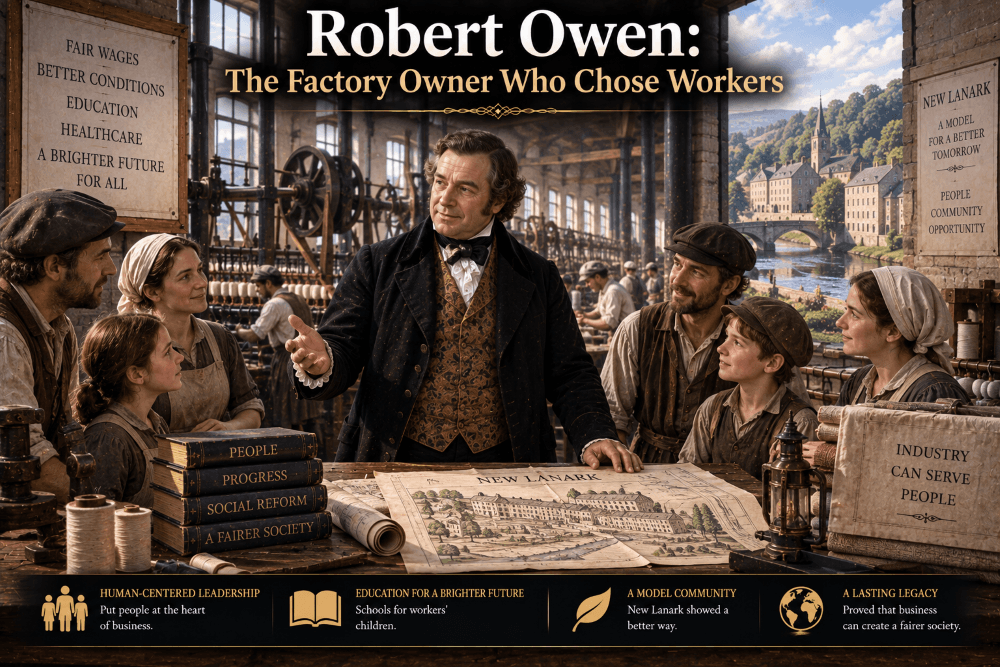
While most Industrial Revolution factory owners competed by cutting costs and extending hours, Robert Owen ran a profitable mill by doing the opposite. At New Lanark in Scotland, he shortened working hours, banned young children from the factory floor, built schools, and improved housing, all while keeping the business commercially successful. His experiment challenged the prevailing assumption that industrial profit required worker misery, and it makes him one of the most unusual figures in business history.
Who Was Robert Owen?
Robert Owen was born in 1771 in Newtown, Wales, into a modest family, and left formal schooling behind at around age ten to begin working.
- He started as an apprentice in the textile trade, learning the industry from the ground up.
- By his late teens he was managing a Manchester cotton mill, demonstrating unusual competence at a young age.
- In 1799, he and business partners purchased the New Lanark mills in Scotland, giving him the opportunity to run operations according to his own principles.
His rapid rise from apprentice to mill owner gave him direct, practical knowledge of how factories actually operated, including the conditions workers endured.
Robert Owen’s Reforms at New Lanark
What He Found and What He Changed
When Owen took over New Lanark, it operated much like other mills of the era, relying heavily on child labor and long working hours.
- He raised the minimum working age at the mill, removing the youngest children from factory work entirely.
- He reduced working hours substantially compared to typical factory schedules of the period.
- He improved worker housing, sanitation, and access to affordable goods through a company store that sold at near cost rather than inflated prices.
These changes directly contradicted the common assumption that squeezing workers harder was the only path to industrial profitability.
Education as Infrastructure
Perhaps Owen’s most distinctive contribution was his investment in education, particularly for the children of his workers.
- He established the Institute for the Formation of Character at New Lanark, providing schooling for workers’ children.
- His school emphasized learning through encouragement rather than the harsh discipline typical of the era.
- This approach reflected his core belief that people’s character and capability were shaped primarily by their environment and circumstances.
Owen argued that investing in workers’ wellbeing and education produced better, more reliable labor, making his reforms a business argument as much as a moral one.
Why Robert Owen’s Approach Mattered
Profitability Alongside Reform
The most commercially significant aspect of Owen’s experiment was that New Lanark remained profitable throughout his reforms.
- The mills continued generating returns for investors despite shorter hours and higher spending on worker welfare.
- Owen argued that healthier, better-educated, more motivated workers were simply more productive.
- New Lanark attracted thousands of visitors, including reformers, industrialists, and foreign dignitaries curious to see whether his claims held up.
This demonstration mattered enormously, because it undercut the standard defense that harsh conditions were an unavoidable requirement of industrial competitiveness.
Influencing Labor Legislation
Owen didn’t limit himself to reforming his own business. He campaigned actively for broader legal change.
- He lobbied Parliament for factory legislation restricting child labor and limiting working hours across the industry.
- His advocacy contributed to the growing momentum behind early British factory reform laws.
- He argued publicly that conditions acceptable at New Lanark should become the industry standard rather than an exception.
Owen’s Broader Social Ambitions
The Cooperative Movement
Robert Owen’s ideas extended well beyond factory reform into broader visions for reorganizing economic life.
- He promoted cooperative ownership models where workers shared in both the operation and rewards of enterprise.
- His ideas became foundational to the cooperative movement, which continues in various forms worldwide today.
- He envisioned self-sustaining communities organized around shared labor and mutual benefit rather than pure wage employment.
The New Harmony Experiment
Owen attempted to put his most ambitious ideas into practice by founding an experimental community in the United States.
- In 1825, he purchased land in Indiana and established New Harmony, intended as a model cooperative community.
- The experiment struggled with internal disagreements, unclear governance, and practical difficulties, and it dissolved within a few years.
- Its failure cost Owen a substantial portion of his personal fortune and demonstrated the gap between his theoretical vision and practical implementation.
This failure is an important part of his story. Owen’s success at New Lanark came partly from operating within a functioning commercial business, something New Harmony lacked.
Lessons from Robert Owen
- Worker welfare and profitability aren’t necessarily opposed. New Lanark demonstrated that better conditions could coexist with commercial success.
- Demonstration is persuasive. Owen’s working example proved more compelling to visitors than argument alone would have been.
- Vision needs practical structure. New Harmony’s collapse showed that ambitious social ideals still require workable governance and economics.
Frequently Asked Questions
What did Robert Owen do at New Lanark? He raised the minimum working age, reduced working hours, improved housing and sanitation, and built schools for workers’ children, while keeping the mill commercially profitable.
Was Robert Owen’s factory actually profitable? Yes, New Lanark remained profitable throughout his reforms, which was central to his argument that better working conditions and business success could coexist.
What was New Harmony? New Harmony was an experimental cooperative community Owen founded in Indiana in 1825, which dissolved within a few years due to internal conflicts and practical difficulties.
How did Robert Owen influence the cooperative movement? His advocacy for shared worker ownership and mutual benefit became foundational to the cooperative movement, which continues in various forms around the world today.
Related Articles
- Josiah Wedgwood: The Man Who Invented Branding
- Matthew Boulton: The Industrialist Who Scaled Genius
- James Watt: The Steam Engine That Powered Industry
- Richard Arkwright: The Father of the Factory System
- The Industrial Revolution: How Machines Multiplied Human Productivity
- Johannes Gutenberg: The Entrepreneur Who Printed a Revolution
- The Antwerp Exchange: Europe’s First Finance Hub
About The History of Entrepreneurship
This article is part of The History of Entrepreneurship, an ongoing series exploring how civilizations, technologies, entrepreneurs, investors, institutions, and markets gradually created the foundations of modern business.
Leave a Reply