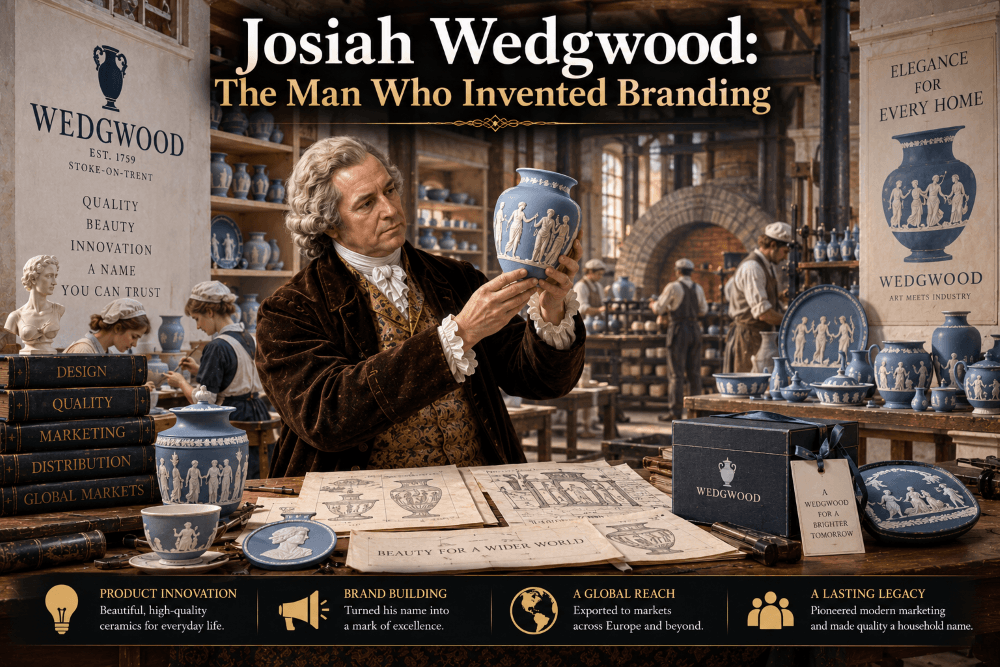
Josiah Wedgwood built one of history’s most successful pottery businesses, but his real innovation wasn’t ceramics. It was marketing. Long before “branding” became a recognized business concept, Wedgwood was already using celebrity endorsements, showrooms, and clever pricing psychology to turn ordinary tableware into a status symbol. His career offers one of the clearest early blueprints for how modern consumer marketing actually works.
Who Was Josiah Wedgwood?
Josiah Wedgwood was born in 1730 in Staffordshire, England, into a family already involved in pottery production. He began working in the family trade at a young age.
- He apprenticed in pottery making, developing hands-on technical skill in ceramics production.
- A childhood illness left him with a permanent leg impairment, which some historians believe pushed him toward focusing more on design and business strategy rather than physical production work.
- By his mid-twenties, he had begun experimenting with new pottery techniques and glazes, seeking ways to differentiate his products from competitors.
This combination of technical curiosity and strategic thinking would define his approach to business throughout his career.
Josiah Wedgwood’s Manufacturing Innovations
Improving the Product Itself
Before Wedgwood could market his pottery successfully, he first had to build genuinely superior products worth marketing.
- He developed new glazing techniques and ceramic formulas, including his famous creamware and later jasperware lines.
- He invested heavily in experimentation, systematically testing different materials and firing methods to improve quality and consistency.
- He established organized, efficient production methods at his Etruria factory, applying many of the same systematic principles seen elsewhere during the Industrial Revolution.
This focus on genuine product quality gave Wedgwood a strong foundation before he turned his attention toward marketing and brand building.
Applying Factory Principles to Pottery
Wedgwood organized his pottery production with a level of efficiency and specialization unusual for the industry at the time.
- He divided labor into specialized tasks, improving both consistency and output compared to traditional craft-based pottery production.
- He implemented quality control standards, famously destroying pieces that didn’t meet his exacting requirements.
- This operational discipline allowed him to scale production while maintaining the consistent quality his brand increasingly depended on.
The Marketing Genius of Josiah Wedgwood
Celebrity Endorsement as Strategy
One of Wedgwood’s most influential innovations was his deliberate use of royal and aristocratic endorsement to build his brand’s prestige.
- He created a dinner service for Queen Charlotte in 1765, then successfully secured permission to market his products afterward as “Queen’s Ware.”
- This royal association immediately elevated his products’ perceived status among wealthy customers eager to emulate royal taste.
- He continued cultivating relationships with aristocratic patrons throughout his career, using their association to reinforce his brand’s exclusivity.
Showrooms and the Shopping Experience
Wedgwood pioneered retail concepts that wouldn’t become common practice for other businesses until much later.
- He established dedicated showrooms in London, allowing customers to browse and experience his products directly rather than relying solely on catalogs or traveling salesmen.
- These showrooms were designed to create an appealing, aspirational shopping experience for wealthy clientele.
- This approach to retail presentation reflected an early understanding of how environment and experience influence purchasing decisions.
Pricing Psychology and Exclusivity
Josiah Wedgwood also demonstrated a sophisticated understanding of pricing strategy well ahead of his time.
- He often priced his higher-end products deliberately high, using price itself as a signal of quality and exclusivity.
- He simultaneously developed more affordable product lines, allowing his brand to reach a broader middle-class market without diluting his luxury positioning.
- This dual strategy let Wedgwood capture both prestige-driven and value-driven customers under the same overall brand.
The Broader Impact of Wedgwood’s Approach
Building a Lasting Brand
The marketing strategies Josiah Wedgwood pioneered had an impact extending far beyond the pottery industry itself.
- His techniques demonstrated that perceived value could be actively created and shaped, not just determined by raw production cost.
- Many of his marketing principles, including celebrity endorsement and tiered product lines, remain standard practice across countless industries today.
- His company continued producing pottery for centuries after his death, a testament to the lasting strength of the brand he built.
A Broader Legacy Beyond Business
Wedgwood was also known for his involvement in broader social and scientific causes of his era.
- He was an active member of the Lunar Society, connecting him with other prominent innovators and industrialists of the period.
- He was a vocal supporter of the movement to abolish the slave trade, using his pottery business to produce and distribute anti-slavery medallions that became widely recognized symbols of the cause.
- This willingness to use his commercial platform for broader social causes remains a notable part of his historical legacy.
Lessons from Josiah Wedgwood
- Perceived value can be deliberately created. Wedgwood showed that marketing and positioning could meaningfully shape how customers valued a product.
- Endorsement builds credibility quickly. Royal association gave his brand immediate prestige that would have taken far longer to build organically.
- Product quality and marketing must work together. Wedgwood’s genuine manufacturing excellence gave his marketing claims real substance.
Frequently Asked Questions
What made Josiah Wedgwood’s pottery business successful? A combination of genuine product innovation, disciplined manufacturing quality, and pioneering marketing strategies, including celebrity endorsement and dedicated showrooms, drove his success.
What was Queen’s Ware? Queen’s Ware was Wedgwood’s creamware pottery line, named after Queen Charlotte following a dinner service he created for her in 1765, which became a major marketing asset.
Did Josiah Wedgwood invent modern branding? While branding evolved over time through many contributors, Wedgwood is widely credited as one of the earliest and most influential figures to systematically use marketing techniques still recognized in branding today.
What social causes was Josiah Wedgwood involved in? He was a prominent supporter of the movement to abolish the slave trade, notably producing anti-slavery medallions that became widely recognized symbols of the abolitionist cause.
Related Articles
- Matthew Boulton: The Industrialist Who Scaled Genius
- James Watt: The Steam Engine That Powered Industry
- Richard Arkwright: The Father of the Factory System
- The Industrial Revolution: How Machines Multiplied Human Productivity
- Johannes Gutenberg: The Entrepreneur Who Printed a Revolution
- The Antwerp Exchange: Europe’s First Finance Hub
- Spanish Silver: How Mines Built the First Global Currency
About The History of Entrepreneurship
This article is part of The History of Entrepreneurship, an ongoing series exploring how civilizations, technologies, entrepreneurs, investors, institutions, and markets gradually created the foundations of modern business.
Leave a Reply