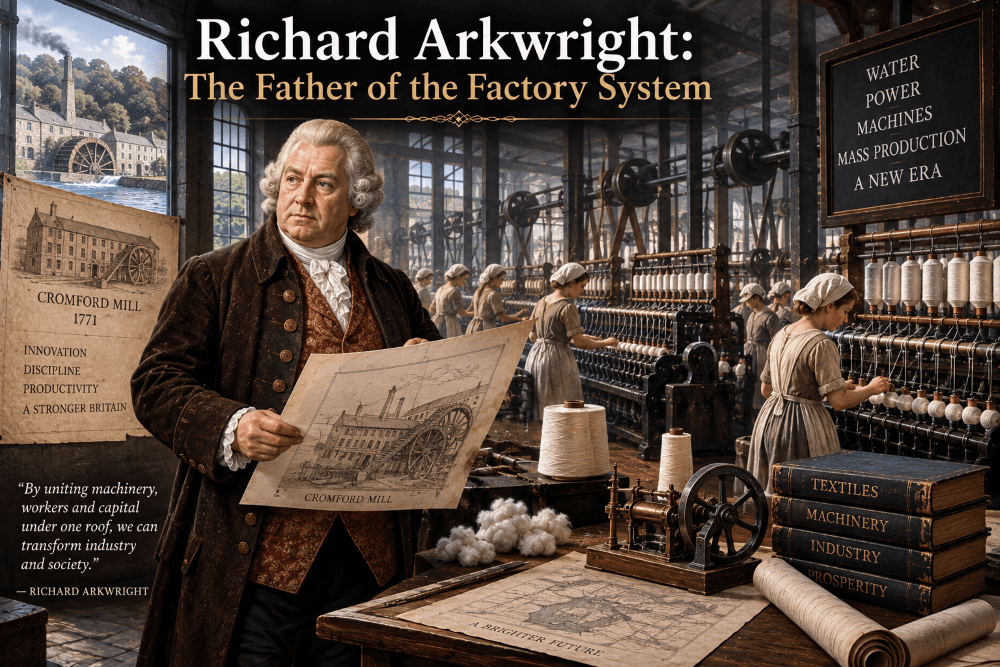
Richard Arkwright didn’t just invent a machine. He invented an entirely new way of organizing production, one that would define manufacturing for the next two centuries. Through his water-powered spinning frame and the factory system he built around it, this English entrepreneur transformed textile production from scattered home-based work into centralized, mechanized industry. His story marks one of the clearest turning points between craft-based economies and the industrial world that followed.
Who Was Richard Arkwright?
Richard Arkwright was born in 1732 in Preston, England, into a working-class family with limited formal education. His early career had little to do with textiles at all.
- He initially trained and worked as a barber and wigmaker, developing skills in business and customer relationships rather than mechanics.
- He became interested in textile technology relatively later in life, motivated partly by the growing demand for cotton thread.
- By the early 1760s, he began working on mechanical solutions to the persistent bottleneck of spinning enough thread to keep pace with weaving demand.
His background outside textiles didn’t stop him from becoming one of the industry’s most consequential innovators.
Richard Arkwright’s Key Innovation
The Water Frame
In 1769, Richard Arkwright patented a spinning machine known as the water frame, a device that would fundamentally reshape textile production.
- The machine used water power to drive multiple spinning spindles simultaneously, dramatically increasing thread output compared to manual spinning.
- It produced stronger, more consistent thread than earlier methods, improving the quality of finished textiles.
- Because of its size and power requirements, the water frame couldn’t realistically operate in individual homes, unlike earlier spinning technology.
This last point turned out to be one of the most historically significant aspects of his invention.
From Machine to System
Arkwright recognized that his invention required an entirely new production model to work effectively.
- Water frames needed to be housed in large facilities located near reliable water sources for power.
- Multiple machines needed coordinated operation, requiring organized labor rather than independent home-based workers.
- This need directly led Arkwright to establish some of the first true factories in industrial history.
Building the Factory System
Cromford Mill and Centralized Production
In 1771, Richard Arkwright opened his mill at Cromford, England, widely regarded as one of the first modern factories.
- The mill centralized dozens of water frames under one roof, powered by a single water source.
- Workers were employed directly by Arkwright rather than working independently from their own homes.
- Production schedules, shift work, and centralized management became defining features of his operation.
This centralized structure allowed for far greater output and consistency than the scattered, home-based production methods it replaced.
Organizing Labor at Scale
Arkwright’s factory system required entirely new approaches to managing workers, some of which carried serious human costs.
- His factories employed large numbers of workers, including significant numbers of children, in long shifts under strict supervision.
- Working conditions were often harsh, with long hours and demanding physical labor becoming standard practice.
- This model of centralized, closely supervised industrial labor would become a defining, and often criticized, feature of the broader Industrial Revolution.
The Business Empire Arkwright Built
Licensing and Expansion
Beyond his own mills, Arkwright built a broader business empire by licensing his technology and methods to other manufacturers.
- He charged licensing fees to other textile producers seeking to use his patented spinning technology.
- This approach allowed him to profit from the broader spread of his innovation, not just his own factories.
- His licensing model helped spread the factory system rapidly across England’s growing textile industry.
Legal Battles Over Innovation
Arkwright’s success also brought significant legal challenges, as competitors and rivals contested his patents.
- Other manufacturers argued that Arkwright’s patented innovations weren’t entirely original, drawing partly on existing ideas from other inventors.
- Legal disputes eventually led to his patents being overturned later in his career.
- Despite these legal setbacks, Arkwright had already accumulated substantial wealth and had permanently reshaped how textile production operated.
The Broader Impact of Arkwright’s Factory System
A Template for Industrial Production
Arkwright’s factory model extended far beyond textiles, influencing how manufacturing was organized across numerous industries.
- Centralized production, coordinated labor, and mechanized processes became standard features across the broader Industrial Revolution.
- His approach demonstrated how organizing production systematically could dramatically increase output and efficiency.
- Many later industrialists explicitly modeled their own operations on principles Arkwright had pioneered.
Lessons from Richard Arkwright
- Systems matter as much as inventions. Arkwright’s true innovation was organizing production around his machine, not just the machine itself.
- Scale creates new challenges. Centralizing production introduced serious labor questions that continue to shape manufacturing debates today.
- Innovation invites competition and legal conflict. Arkwright’s patents faced ongoing challenges, even as his broader business model succeeded.
Frequently Asked Questions
What did Richard Arkwright invent? Arkwright patented the water frame in 1769, a water-powered spinning machine that dramatically increased thread production and required centralized factory operation.
Why is Richard Arkwright called the father of the factory system? He established Cromford Mill in 1771, one of the first true factories, centralizing machinery and organized labor under one roof, a model that became standard across the Industrial Revolution.
Did Richard Arkwright’s factories use child labor? Yes, his factories employed significant numbers of children, often under harsh working conditions, reflecting broader labor practices common during the early Industrial Revolution.
What happened to Richard Arkwright’s patents? His patents faced legal challenges from competitors claiming his innovations weren’t entirely original, and they were eventually overturned later in his career.
Related Articles
- The Industrial Revolution: How Machines Multiplied Human Productivity
- Johannes Gutenberg: The Entrepreneur Who Printed a Revolution
- The Antwerp Exchange: Europe’s First Finance Hub
- Spanish Silver: How Mines Built the First Global Currency
- The Atlantic Trade Triangle: Commerce’s Darkest Chapter
- Marine Insurance: How Lloyd’s Coffee House Priced Risk
- Joint-Stock Companies: The Structure That Scaled Business
About The History of Entrepreneurship
This article is part of The History of Entrepreneurship, an ongoing series exploring how civilizations, technologies, entrepreneurs, investors, institutions, and markets gradually created the foundations of modern business.