For most of my investing life, I have maintained a 100% stock portfolio. Now that I am approaching retirement age, conventional financial advice suggests that I should be moving a significant portion of my money into bonds.
I’m not doing that.
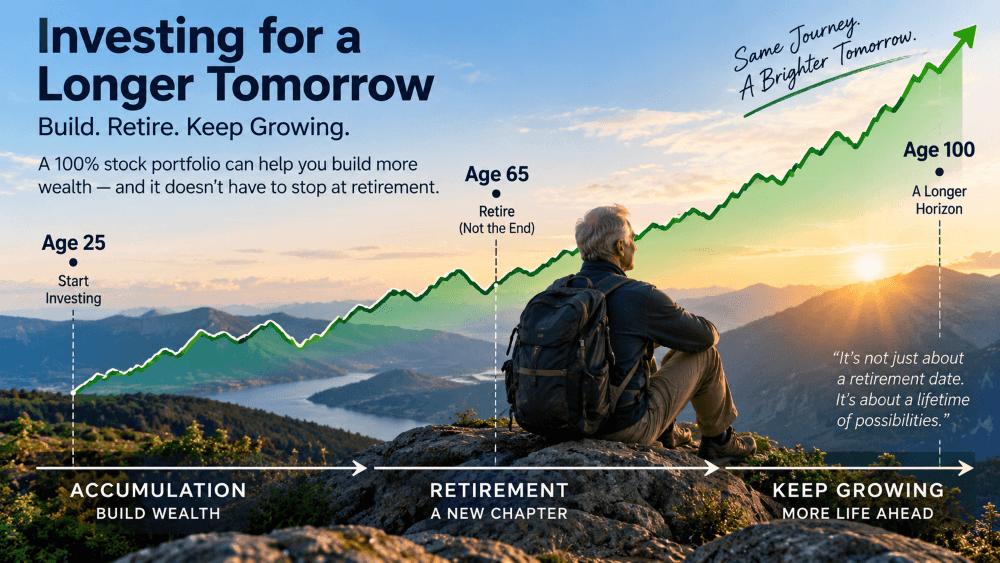
My portfolio remains 100% invested in stocks because retirement doesn’t mean my investing life is over. If I live to age 100, I still have more than three decades ahead of me.
That’s a very long investment horizon.
We Spend Decades Accumulating Wealth
Imagine two 25-year-olds beginning their investment journeys at exactly the same time.
They earn similar incomes and contribute exactly the same amount every month for 40 years.
Investor A maintains a 100% stock portfolio.
Investor B follows the traditional 60% stocks and 40% bonds portfolio.
Both continue investing until age 65.
Stocks have historically produced higher long-term returns than bonds, although there is no guarantee that this relationship will continue during any particular period.
The difference between seemingly small annual returns becomes enormous when compounded for four decades.
That’s the part of the 60/40 discussion I think deserves more attention.
The 100% Stock Portfolio Has a Compounding Advantage
Suppose, purely for illustration, that Investor A earns an average 9% annual return while Investor B earns 7%.
Both invest $1,000 every month from age 25 through age 65.
After 40 years, approximately:
- Investor A at 9%: $4.68 million
- Investor B at 7%: $2.62 million
Both contributed the same $480,000.
The enormous difference came from compounding.
Of course, actual market returns won’t arrive smoothly at 9% or 7%, and future returns could be very different. But the example illustrates an important principle: sacrificing some expected return every year for 40 years can have a very large cumulative cost.
But What If Stocks Crash Right Before Retirement?
This is the obvious objection.
Imagine Investor A reaches age 65 with $4.68 million—and immediately experiences a horrible 40% stock market crash.
His portfolio falls to approximately:
$2.81 million.
Investor B enters retirement with $2.62 million.
And Investor B isn’t immune from the crash.
If the balanced portfolio falls 20%, for example, its value becomes approximately:
$2.10 million.
Despite experiencing a catastrophic 40% stock decline immediately before retirement, Investor A still has considerably more money.
Why?
Because he entered the crash with much more money.
When someone says, “Stocks can fall 40%,” my response is that we also need to ask:
Forty percent of what?
Losing 40% of a portfolio that has benefited from four decades of higher compounding can potentially leave an investor with more wealth than someone who experienced a smaller decline on a much smaller portfolio.
That doesn’t make stocks safe. It does mean that measuring risk solely by the percentage decline can hide an important part of the story.
A 60/40 Portfolio Can Fall Too
There’s sometimes an implicit assumption that when stocks crash, the bond portion of a 60/40 portfolio will protect the investor.
Historically, that has often been one of the strongest arguments for owning bonds.
Stocks and high-quality bonds have frequently behaved differently during periods of market stress. When stocks fell, bonds could provide stability or even appreciate.
But that relationship isn’t guaranteed.
The 2022 market provided a painful reminder when stocks and bonds suffered substantial losses simultaneously as inflation surged and interest rates rose.
When stock-bond correlations become positive, the diversification benefit investors expect from the traditional 60/40 portfolio becomes weaker.
This doesn’t mean bonds no longer have a place in a portfolio. They provide income, lower expected volatility and can still play an important diversification role.
But I don’t think we should automatically assume that bonds will always protect stocks simply because they did so during certain historical periods.
100% Stock Portfolio Volatility Looks Different Over Decades
One reason people fear stocks is that we constantly see their annual—or even daily—movements.
A market index can gain 20% one year, lose 20% another year and then gain 15% the following year.
That looks frightening.
But my investment horizon isn’t one year.
It’s decades.
Looking at rolling 10-year annualized returns removes much of the visual noise created by individual calendar years and focuses attention on the investor’s actual long-term experience.
That doesn’t mean stocks become risk-free over ten years. Far from it. There have been poor 10-year periods, and Vanguard’s historical research shows rolling 10-year U.S. stock returns have varied substantially.
The important distinction is that I don’t have to make my investment decisions based on what happens during any individual year.
My money has decades to compound.
Retirement Isn’t the Finish Line
This may be the biggest disagreement I have with conventional retirement thinking.
We’re often taught to think of age 65 as the end of our investment journey.
I don’t see it that way.
If someone retires at 65 and lives until 100, retirement lasts 35 years.
That’s almost as long as the 40-year accumulation period from age 25 to 65.
Why would my investment horizon suddenly become short simply because I stopped working?
At 65, some of the money in my portfolio might be spent next year.
But some of it might not be spent until I’m 75, 85, 95 or even 100.
Those dollars still have extremely long investment horizons.
My Own 100% Stock Portfolio
This isn’t merely theoretical for me.
My own portfolio is essentially 100% stocks, and as I approach retirement age, I haven’t made the traditional shift toward a large bond allocation.
I recognize what comes with that decision.
There could be another 2008.
There could be another pandemic crash.
My portfolio could temporarily lose 30%, 40% or perhaps even more.
I’m willing to accept that volatility because I expect to have many more years of life during which I want my assets to continue growing.
More importantly, my current situation is unusual in a favorable way:
My portfolio has been growing faster than my expenses.
I withdraw money to finance my lifestyle, but so far those withdrawals have not caused my portfolio to shrink over time.
My investments have generated enough growth that my net worth has continued increasing despite my spending.
That dramatically changes the way I think about retirement.
I’m not trying to convert my entire portfolio into a stable pot of money and slowly consume it.
I want to continue owning productive businesses while selling only the small portion necessary to finance my life.
What Happens Between 65 and 100?
Return to our hypothetical investors.
Both retire at 65 and both live until 100.
Investor A still owns a 100% stock portfolio.
Investor B owns the traditional 60/40 portfolio.
Assuming equities continue to deliver a higher long-term return than bonds, Investor A has another 35 years of potential compounding.
Even if a major crash occurs at retirement, Investor A doesn’t sell the entire portfolio on his 65th birthday.
Most of his assets remain invested.
If markets recover, as they historically have after major downturns, the stock-heavy portfolio has greater exposure to that recovery.
Of course, there is an important risk here: sequence-of-returns risk.
A retiree who must sell substantial amounts of stock during a prolonged bear market can permanently damage a portfolio. That’s one reason this strategy won’t be appropriate for everyone.
But a retiree whose withdrawals represent a relatively small percentage of the portfolio is in a very different situation from someone who needs every dollar in the account to pay next month’s bills.
Some Academic Research Challenges Traditional Retirement Advice
Interestingly, recent academic research has questioned the conventional idea that investors should automatically reduce their stock allocation as they get older.
Researchers Aizhan Anarkulova, Scott Cederburg and Michael O’Doherty analyzed lifecycle investing using a broad international dataset.
Their model produced an unconventional result: an internationally diversified all-equity portfolio, split between domestic and international stocks, performed better in their simulations than conventional stock-and-bond lifecycle strategies across measures including wealth accumulation, retirement income and bequests.
That doesn’t prove everyone should own 100% stocks.
But it does suggest that the traditional advice to automatically increase bond exposure with age deserves scrutiny.
The Real Risk May Not Be Volatility
This brings me to a larger philosophical question.
What exactly is risk?
If risk means:
“How much can my portfolio fall this year?”
then a 100% stock portfolio is unquestionably riskier than 60/40.
But that’s not the only definition that matters to me.
I also care about:
“How much wealth will I probably have 20, 30 or 40 years from now?”
A less volatile portfolio that compounds more slowly carries another kind of risk: the risk of having substantially less purchasing power later in life.
I’m willing to tolerate short-term volatility in exchange for the possibility of greater long-term wealth.
The Psychological Test
There’s one enormous condition attached to everything I’ve written.
An investor cannot benefit from a 100% stock portfolio if he panics and sells during a crash.
Imagine watching:
$1,000,000 become $600,000.
Or:
$2 million become $1.2 million.
Could you leave the portfolio alone?
If the answer is no, a 100% stock portfolio probably isn’t appropriate.
A 60/40 portfolio that you can hold through every crisis is far better than a theoretically superior all-stock portfolio that you abandon at the worst possible moment.
I’m Investing for My Lifetime, Not My Retirement Date
I don’t know what stocks will return next year.
Neither does anyone else.
And I certainly don’t know whether stocks will outperform bonds over the next five or ten years.
What I do know is that my financial horizon doesn’t end when I reach retirement age.
If I’m fortunate enough to live until 100, I still have decades of investing ahead of me.
That’s why I’m comfortable maintaining my 100% stock portfolio.
My objective isn’t to eliminate volatility.
My objective is to finance my life while allowing my capital to continue compounding for as long as possible.
For me, retirement isn’t the moment when investing ends.
It’s simply the beginning of the spending phase of a very long investment journey.
Frequently Asked Questions
Is a 100% stock portfolio safe for retirement?
A 100% stock portfolio can experience severe declines and isn’t appropriate for every retiree. Its suitability depends on spending needs, other income, portfolio size, diversification, time horizon and the investor’s ability to tolerate large market declines without panic-selling.
Is a 60/40 portfolio safer than 100% stocks?
A 60/40 portfolio generally has lower short-term volatility because bonds can reduce portfolio fluctuations. However, the trade-off is lower expected long-term growth. Investors should consider both short-term volatility and long-term purchasing-power risk.
Should investors reduce stocks when they reach age 65?
Not necessarily. Age is only one consideration. A 65-year-old who expects to live another 30 or 35 years still has a long investment horizon, although withdrawals during retirement introduce sequence-of-returns risk that should be considered carefully.
Can stocks and bonds fall at the same time?
Yes. Although stocks and bonds have often provided diversification benefits, their correlation changes over time. In 2022, for example, rising inflation and interest rates contributed to significant simultaneous declines in both stocks and bonds.
Other personal finance blog posts