| 📊 Alain’s Holdings — September 9, 2026 | ||||
|---|---|---|---|---|
| Symbol | Name | Price | Change | Change % |
| VOO | Vanguard S&P 500 ETF | 700.87 | -3.20 | -0.45% |
| QQQ | Invesco QQQ Trust | 716.31 | -2.05 | -0.29% |
| XIU.TO | iShares S&P/TSX 60 ETF | 53.00 | -0.43 | -0.80% |
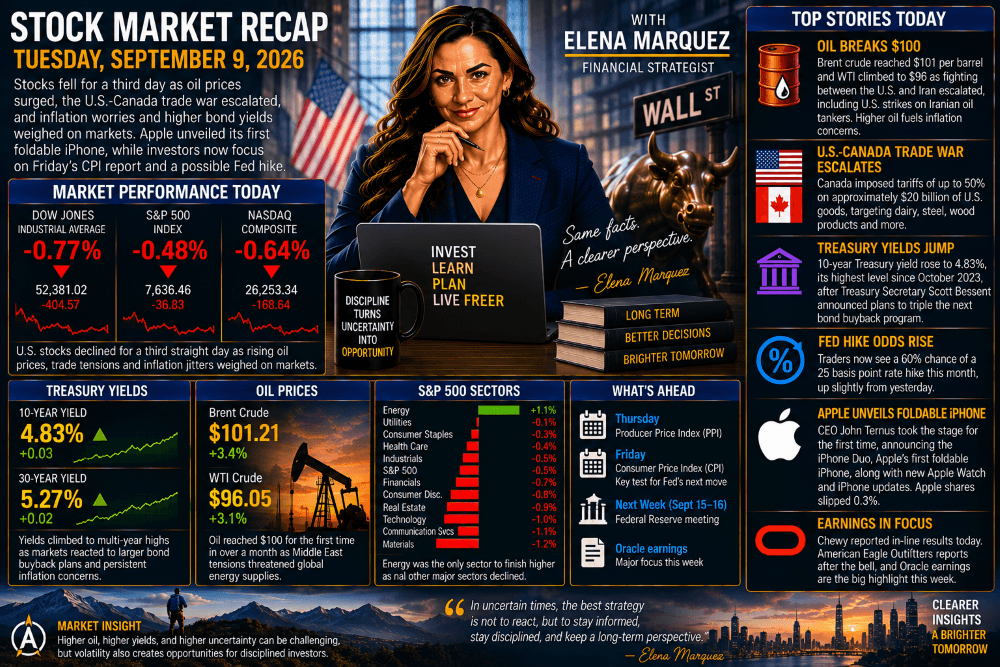
Wall Street fell for a third consecutive session Wednesday as oil broke through $100 per barrel, Treasury yields climbed, and investors grew increasingly concerned that persistent inflation could push the Federal Reserve toward another interest-rate hike next week.
Market Performance
📉 Dow Jones Industrial Average: -0.77%
📉 S&P 500: -0.48%
📉 Nasdaq Composite: -0.64%
The Dow closed at 52,381.02, the S&P 500 at 7,636.46, and the Nasdaq at 26,253.34.
The declines weren’t dramatic, but the underlying story is becoming increasingly difficult for investors to ignore:
Oil is once again becoming an inflation problem.
Oil Breaks $100
The biggest market story Wednesday happened outside the stock market.
Brent crude surged 3.4% to $101.21 per barrel, while U.S. benchmark WTI climbed to roughly $96.05.
That’s the highest level for oil since May.
The latest surge followed another escalation in the Middle East conflict, including U.S. attacks on Iranian oil tankers and Iranian strikes against ships and American military interests in the region.
Oil has now risen roughly 25% over the past month.
The problem goes beyond what drivers pay at the gasoline pump.
Energy feeds into transportation, manufacturing, agriculture and countless other parts of the economy.
If businesses pay more to move goods, manufacture products and operate facilities, some of those costs eventually reach consumers.
That makes the Federal Reserve’s inflation fight considerably more complicated.
The Bond Market Sends Another Warning
The other important number Wednesday was 4.84%.
That’s approximately where the 10-year Treasury yield finished the day.
Treasury Secretary Scott Bessent announced that the government would triple the size of its upcoming long-dated bond buyback operation to as much as $6 billion.
The idea is to provide additional liquidity to the Treasury market.
But investors weren’t particularly reassured.
Long-term yields remained elevated as markets continued to wrestle with inflation, enormous government borrowing requirements and uncertainty over future monetary policy.
That’s important for stocks.
A Treasury yield approaching 5% gives investors a relatively attractive alternative to equities.
It also raises borrowing costs throughout the economy—from mortgages and corporate debt to the enormous data-center projects being built for artificial intelligence.
The Fed Is Back in the Spotlight
Just a few months ago, Wall Street was debating when the Federal Reserve might lower interest rates.
Now we’re debating another rate hike.
What changed?
Two things in particular.
First, last week’s surprisingly strong jobs report showed the U.S. economy added 162,000 jobs in August.
Second, oil has climbed above $100.
A strong labor market gives the Fed more freedom to fight inflation, while expensive energy creates another source of inflationary pressure.
Investors are now assigning roughly a 60% probability of a quarter-point rate hike this month.
That makes Friday’s Consumer Price Index report extremely important.
If inflation comes in hotter than expected, the case for another hike becomes considerably stronger.
Energy Was Wednesday’s Winner
There’s an interesting consequence to $100 oil.
It’s bad news for consumers and potentially bad news for inflation.
But it’s good news for energy companies.
Energy was the only S&P 500 sector to finish Wednesday higher, gaining approximately 1.1%.
Every other major sector declined.
That’s a striking reversal from much of the past few years, when technology and AI dominated market leadership.
If oil remains above $100, energy companies could once again become an important source of earnings growth.
Apple Enters the Foldable Era
Wednesday also marked an important day for Apple.
New CEO John Ternus took the stage for his first major product launch since succeeding Tim Cook.
And Apple unveiled something the company had resisted for years:
A foldable iPhone.
The new iPhone Duo features a 7.6-inch inner display and a 5.4-inch exterior display, along with Apple’s new A20 Pro processor.
It is Apple’s first foldable smartphone and arguably the company’s most significant hardware redesign in years.
But there’s another important element.
Apple is positioning the device around Apple Intelligence and Siri AI, signaling Ternus’s attempt to push Apple more aggressively into the AI race.
The market’s initial reaction was restrained.
Apple shares slipped approximately 0.3% Wednesday.
That’s probably understandable.
One product launch won’t answer Wall Street’s bigger question:
Can Apple regain its position at the forefront of technological innovation?
The iPhone Duo is an interesting first move under Ternus. What matters now is whether consumers actually want it.
Meta Bucks the Market
While most technology stocks declined, Meta went sharply in the opposite direction.
Shares surged approximately 6% following the launch of a new AI assistant.
That provides another reminder of just how important AI expectations remain to stock valuations.
Investors are no longer rewarding companies merely for saying they’re investing in artificial intelligence.
Increasingly, they want to see products, adoption and eventually profits.
That’s probably a healthy development.
The Market’s New Equation
The investment environment is becoming increasingly interconnected.
The equation currently looks something like this:
Middle East conflict → higher oil → higher inflation → higher Fed expectations → higher Treasury yields → pressure on stocks.
And there’s another factor worth adding:
Higher Treasury yields → more expensive AI infrastructure.
Technology companies are spending hundreds of billions of dollars building data centers.
Much of that expansion ultimately depends on access to capital.
The longer borrowing costs remain elevated, the more investors will question whether every AI infrastructure project can generate adequate returns.
What Comes Next
The market now turns toward inflation.
Friday’s CPI report could be one of the most consequential economic releases ahead of next week’s Federal Reserve meeting.
Investors need to answer a simple question:
Is inflation continuing to cool despite $100 oil?
If the answer is yes, the Fed may still have room to wait.
If inflation surprises to the upside, the combination of a strong labor market and expensive energy could make another rate increase increasingly difficult to avoid.
The Bottom Line
Three consecutive losing sessions aren’t necessarily alarming.
The S&P 500 remains up roughly 12% in 2026 and only about 2% below its August record.
But the investment environment has clearly changed.
Oil is above $100.
The 10-year Treasury yield is approaching 5%.
The Fed is once again considering higher rates.
And geopolitical risk is feeding directly into inflation expectations.
Meanwhile, Apple is entering a new era with its first foldable iPhone, and AI continues reshaping both corporate strategy and stock-market leadership.
For investors, Friday’s CPI report now becomes the next major test.
Because at the moment, the most important number on Wall Street may not be the S&P 500.
It may be $101 oil.
Other Stock Market blog posts