| 📊 Alain’s Holdings — September 8, 2026 | ||||
|---|---|---|---|---|
| Symbol | Name | Price | Change | Change % |
| VOO | Vanguard S&P 500 ETF | 704.07 | -3.98 | -0.56% |
| QQQ | Invesco QQQ Trust | 718.36 | -0.60 | -0.08% |
| XIU.TO | iShares S&P/TSX 60 ETF | 53.43 | -0.68 | -1.26% |
Wall Street returned from the Labor Day weekend Tuesday—and investors found plenty to worry about.
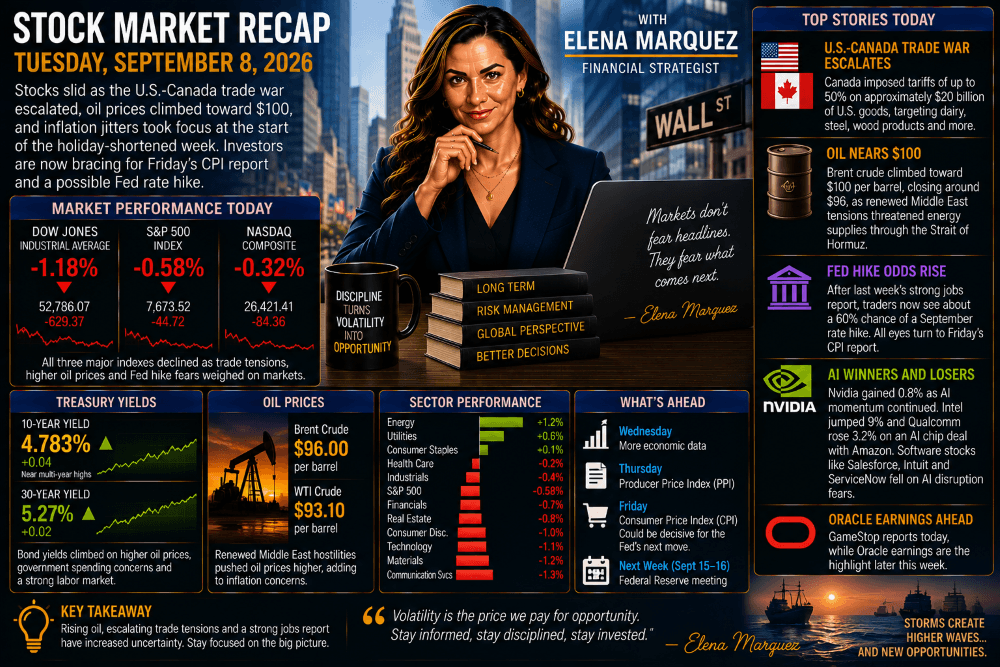
U.S. stocks fell as oil approached $100 per barrel, the U.S.-Canada trade war escalated, and investors prepared for crucial inflation data that could determine whether the Federal Reserve raises interest rates next week.
The final losses were somewhat steeper than the figures available earlier in the day: the Dow fell 1.18%, the S&P 500 lost 0.58%, and the Nasdaq declined 0.32%.
Market Performance
- 📉 Dow Jones Industrial Average: -1.18%
- 📉 S&P 500: -0.58%
- 📉 Nasdaq Composite: -0.32%
The Dow suffered the biggest decline, losing more than 600 points to finish at 52,786.07. The S&P 500 closed at 7,673.52, while the Nasdaq finished at 26,421.41.
The market’s message was straightforward:
Inflation risk is back—and oil is a major reason why.
Oil Comes Within Striking Distance of $100
Oil was once again at the center of Tuesday’s market action.
Brent crude reached as high as roughly $99 per barrel during the session before retreating, while WTI traded above $90. Renewed fighting in the Middle East—including attacks on Saudi energy facilities—added to fears that the conflict could further disrupt global energy supplies.
That’s an extraordinary change.
Brent was trading around $72 only about two months ago.
For investors, $100 oil isn’t simply a psychological milestone.
It could have consequences throughout the economy.
Higher oil means more expensive gasoline, transportation and manufacturing. Businesses eventually have to absorb those costs or pass them along to consumers.
Either way, the inflation problem becomes harder to solve.
The Fed’s Problem Gets More Complicated
Last Friday’s surprisingly strong employment report already gave the Federal Reserve something to think about.
The U.S. added 162,000 jobs in August, far exceeding expectations.
Now add expensive oil.
The combination of a resilient labor market and renewed inflation pressure has increased expectations that the Fed could raise rates at its September 15–16 meeting.
By Tuesday, traders were pricing approximately a 60% probability of another rate increase.
That makes this week’s inflation reports particularly important.
Producer-price data arrives Thursday.
Then comes the big one:
Friday’s Consumer Price Index.
If inflation comes in hotter than expected, another Fed hike could become considerably more likely.
The 10-Year Treasury Is Back Around 4.8%
Bond investors aren’t waiting for the CPI report.
The 10-year Treasury yield was around 4.8% Tuesday, remaining close to multi-year highs.
That’s another headwind for stocks.
When investors can earn close to 5% from relatively safe government bonds, they naturally become more demanding about the price they’re willing to pay for stocks.
High yields are particularly important for technology companies because much of their valuation depends on profits expected far into the future.
But today’s market reaction was interesting.
The Nasdaq actually held up better than the Dow.
There was another AI story behind that resilience.
A New Divide Emerges in AI
Artificial intelligence is increasingly creating winners and losers within technology itself.
Salesforce and Intuit fell about 4% Tuesday, while ServiceNow dropped approximately 5%.
The catalyst was renewed concern that OpenAI’s newest AI model could compete with services traditionally provided by specialized software companies.
That’s an important development.
For the past few years, investors have largely thought about AI as a technology-sector tailwind.
But AI doesn’t benefit every technology company equally.
Chipmakers, data-center companies and infrastructure providers can benefit from enormous AI capital spending.
Traditional software companies could face the opposite problem:
What happens when AI can perform tasks previously requiring specialized software?
We’re beginning to see Wall Street price that risk.
Intel and Qualcomm Go the Other Direction
While software stocks struggled, Intel jumped 9% and Qualcomm gained 3.2% after reaching an agreement with Amazon to develop custom AI chips.
That perfectly illustrates the split.
The AI boom isn’t disappearing.
Capital is moving toward different parts of the technology ecosystem.
Companies supplying chips, networking and data-center infrastructure continue attracting enormous investment.
Companies whose software could potentially be disrupted by increasingly capable AI models face more questions.
The AI trade is becoming more selective.
Canada Retaliates
Tuesday also brought another major development much closer to home.
Canada’s retaliatory tariffs against U.S. goods officially took effect.
The measures cover approximately $20 billion of American products, with tariffs ranging from 15% to 50%.
Targets include products from politically sensitive U.S. industries, including steel, furniture and electronics.
The tariffs are Canada’s response to 50% U.S. duties imposed on roughly $20 billion of Canadian goods after negotiations between the two countries collapsed.
The economic relationship between Canada and the United States is extraordinarily integrated.
That’s why an extended trade war could create problems on both sides of the border.
Businesses face higher costs.
Consumers face higher prices.
And supply chains built over decades may have to adjust.
Once again, that brings us back to the market’s favorite problem:
Inflation.
An Interesting Twist for the Canadian Dollar
Despite the escalating trade dispute, the Canadian dollar actually strengthened Tuesday.
The loonie reached its highest level in almost three weeks, trading around 72.5 U.S. cents.
Why?
Oil.
Canada is a major energy exporter, so higher oil prices can support the Canadian dollar even while trade tensions hurt the broader economic outlook.
It’s a good illustration of how interconnected today’s market forces have become.
The same $100 oil that worries U.S. investors about inflation can simultaneously support Canada’s currency.
Oracle Is the Big Earnings Test
Earnings season is largely over, but there’s still one particularly important report coming this week:
Oracle.
The company has become another useful gauge of the enormous AI infrastructure buildout.
Investors will be watching its cloud growth, data-center demand and—perhaps most importantly—the amount of capital Oracle expects to spend supporting AI workloads.
That’s especially important in today’s bond environment.
Wall Street still loves AI growth.
But investors are increasingly asking:
How much will all this infrastructure cost, and how will companies finance it?
With the 10-year Treasury around 4.8%, those questions matter more than they did when money was cheap.
GameStop reports Tuesday as well, but Oracle is likely to provide the more important signal for the broader market.
September Is Living Up to Its Reputation
We’re only one trading day into the second week of September, but the month is already proving challenging.
Investors are simultaneously dealing with:
$97–$100 oil.
A 4.8% 10-year Treasury yield.
A 60% probability of another Fed hike.
A U.S.-Canada trade war.
Renewed Middle East fighting.
And increasingly expensive stock valuations.
Yet there’s another side to the story.
The S&P 500 remains up roughly 12% this year, and stronger corporate earnings have actually pushed its forward valuation down from around 21 times expected earnings in June to roughly 19 times today.
That’s important.
Stocks aren’t simply rising because investors are willing to pay more.
Corporate profits have been improving too.
The Bottom Line
Tuesday’s decline wasn’t caused by one event.
It was the convergence of several risks.
War is keeping oil expensive.
Expensive oil threatens inflation.
Strong employment gives the Fed more room to fight that inflation.
Higher rates keep Treasury yields elevated.
And high Treasury yields create tougher competition for stocks.
Meanwhile, the U.S.-Canada trade war adds another potential source of higher prices.
That’s why Friday’s CPI report could be one of September’s most important market events.
If inflation is cooling despite $90-plus oil, the Fed may still have room to wait.
If inflation comes in hot, however, Friday’s strong employment report means policymakers have considerably less reason to hold back.
And that could push the market toward something investors hoped was already behind them:
Other Stock Market blog posts
Comments
One response to “Stock Market Recap — September 8, 2026”
[…] 오른 쪽의 공통점은 ‘연산을 팔거나 만드는 회사’입니다. 인텔과 퀄컴은 아마존과 맞춤형 AI 칩 개발 계약을 맺었고, 브로드컴은 커스텀 칩 수요의 대표 종목입니다. 내린 쪽의 공통점은 ‘소프트웨어로 업무를 대신해 주는 회사’입니다. 오픈AI의 GPT-6 아스트라 공개 뒤 S&P 500 소프트웨어·서비스 지수는 1.5% 내려 이틀 연속 하락했습니다. 아전트 캐피털의 제드 엘러브록은 “아스트라가 소프트웨어 대체 공포를 다시 불렀고, 반도체·데이터센터 투자 수혜주는 오르고 소프트웨어는 내리는 옛 흐름이 재개됐다”고 평가했습니다. 엔비디아와 마이크론이 함께 내린 것은 이 흐름의 예외인데, 두 종목은 최근 급등 뒤 차익실현이라는 별도 사정이 있습니다. (알랭 기요, 시장 정리) […]