| 📊 Alain’s Holdings — September 3, 2026 | ||||
|---|---|---|---|---|
| Symbol | Name | Price | Change | Change % |
| VOO | Vanguard S&P 500 ETF | 710.72 | +7.31 | +1.04% |
| QQQ | Invesco QQQ Trust | 717.67 | +8.43 | +1.19% |
| XIU.TO | iShares S&P/TSX 60 ETF | 54.31 | +0.84 | +1.57% |
Wall Street finally got the message it wanted to hear from the Federal Reserve.
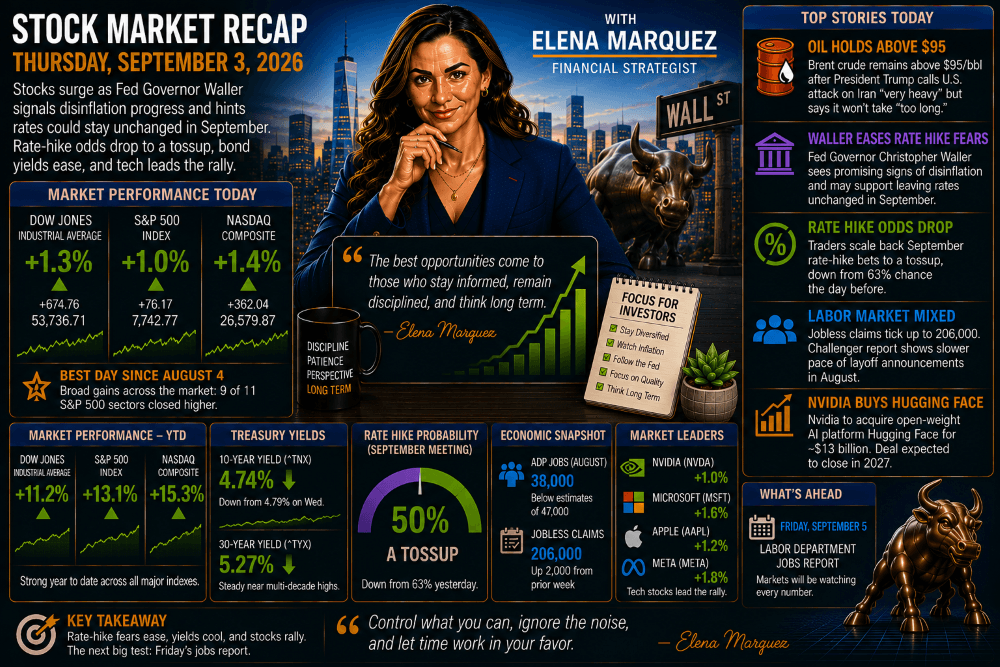
U.S. stocks surged Thursday after Fed Governor Christopher Waller said inflation is showing encouraging signs of cooling and suggested he could support keeping interest rates unchanged at the Fed’s September meeting if the upcoming inflation data confirms that progress.
The comments triggered exactly the combination stock investors have been waiting for: rate-hike expectations fell, Treasury yields eased, and stocks rallied.
Market Performance
- 📈 Dow Jones Industrial Average: +1.3%
- 📈 S&P 500: +1.0%
- 📈 Nasdaq Composite: +1.4%
The Dow and S&P 500 posted their strongest sessions since August 4.
Technology stocks led the advance, helped by falling bond yields and another major development in the artificial-intelligence arms race.
Christopher Waller Gives Wall Street Hope
The most important person on Wall Street Thursday wasn’t a CEO.
It was Fed Governor Christopher Waller.
His message could be summarized in three words:
Give disinflation a chance.
Waller said that if upcoming inflation data demonstrates continued progress toward the Fed’s 2% target, he would be willing to support leaving the federal-funds rate unchanged at its current 3.50%–3.75% range.
That’s a significant change in tone from the anxiety that dominated markets earlier this week.
After Fed Chair Kevin Warsh’s hawkish Jackson Hole speech and another surge in oil prices, investors had increasingly expected the Fed to raise rates again in September.
On Wednesday, markets were pricing roughly a 63% probability of a hike.
After Waller’s remarks Thursday, those odds dropped to approximately 50%.
In other words, the September decision is essentially back to a coin toss.
The 10-Year Treasury Yield Retreats
The bond market responded immediately.
The 10-year Treasury yield fell toward 4.74%–4.76%, after reaching as high as 4.818% Wednesday.
That decline may appear small.
But for stock valuations—particularly technology stocks—it matters enormously.
When Treasury yields fall, the relative attractiveness of bonds declines and the present value investors assign to future corporate profits increases.
That’s particularly beneficial for high-growth companies whose valuations depend heavily on profits expected years into the future.
Hence Thursday’s 1.4% Nasdaq rally.
Nvidia Buys Hugging Face for $13 Billion
The other major story Thursday came from Nvidia.
The world’s most valuable company announced an agreement to acquire Hugging Face for approximately $12.93 billion, with the transaction expected to close in 2027. Nvidia shares rose about 1%.
This is a fascinating acquisition.
Hugging Face has become one of the most important platforms in the open-source and open-weight AI ecosystem, providing developers with access to models, datasets and tools.
Nvidia already dominates the hardware required to train and run many of those models.
Buying Hugging Face pushes Nvidia further up the AI stack.
Nvidia isn’t content simply to manufacture the picks and shovels of the AI gold rush.
Increasingly, it wants to own more of the infrastructure surrounding the entire ecosystem.
Nvidia Is Building an AI Empire
The Hugging Face acquisition also reinforces something we’ve been seeing throughout 2026.
Nvidia’s extraordinary cash generation is giving the company another competitive advantage:
It can use its balance sheet to strengthen the ecosystem that buys its chips.
That creates a powerful cycle.
More AI developers create more models.
More models require more computing power.
More computing requires more Nvidia GPUs.
And the resulting profits give Nvidia even more money to invest throughout the AI ecosystem.
The risk, of course, is that Nvidia becomes increasingly financially exposed to the very AI boom from which it benefits.
For now, investors appear comfortable with that trade-off.
$95 Oil Is Still the Elephant in the Room
Waller’s comments provided relief.
But the inflation problem hasn’t disappeared.
Brent crude remained above $95 per barrel Thursday as the war between the United States and Iran continued.
President Trump said the U.S. carried out a “very heavy attack” against Iran while also suggesting the military campaign wouldn’t take too long.
Oil therefore remains one of the biggest wild cards facing the Federal Reserve.
If energy prices remain elevated—or climb substantially higher—the disinflation Waller wants to see could prove temporary.
That’s why Thursday’s rally shouldn’t be interpreted as the Fed declaring victory.
It hasn’t.
Waller explicitly said his decision will depend heavily on upcoming inflation data.
The Labor Market Is Becoming More Important
The Fed isn’t watching inflation alone.
Employment is becoming increasingly important.
Thursday’s economic data painted a picture of what economists have described as a “low hire, low fire” labor market.
Initial unemployment claims increased slightly to 206,000, up 2,000 from the previous week.
That’s still relatively low historically and suggests companies aren’t conducting widespread layoffs.
At the same time, hiring has clearly slowed.
Wednesday’s ADP report showed private employers added only 38,000 jobs in August.
Companies aren’t firing aggressively.
But they aren’t hiring aggressively either.
That’s a very different labor market from the one investors saw a few years ago.
Friday’s Jobs Report Is Now Huge
All of this sets up Friday’s official employment report.
Wall Street currently expects payroll growth of around 56,000 jobs for August, according to Reuters’ survey of economists.
And once again, the market may prefer a Goldilocks number.
Too strong?
Investors may worry that the economy remains hot enough to justify another rate hike.
Too weak?
Wall Street could begin worrying about recession.
Somewhere in the middle could give the Fed exactly what it needs:
A gradually cooling labor market without a collapse in employment.
Broadcom: Good Earnings Aren’t Always Enough
Broadcom provided another example of how demanding investors have become toward AI stocks.
The company reported fiscal third-quarter adjusted earnings of $3.32 per share, beating expectations of $3.22.
Revenue reached $29.59 billion, also exceeding expectations.
Broadcom projected approximately $34.8 billion of fourth-quarter revenue.
Yet the stock struggled.
That’s becoming a recurring theme across the AI trade.
When expectations are extraordinary, merely delivering excellent results may not be enough.
Investors increasingly want spectacular.
Lululemon and DocuSign Are Next
Earnings season has largely wound down, but several notable companies report after Thursday’s closing bell.
Lululemon offers another window into consumer discretionary spending.
DocuSign provides insight into corporate software spending.
Neither carries Nvidia’s market-moving weight.
But together they can provide additional evidence about two important areas of the economy:
How much consumers are willing to spend and how much businesses are willing to invest.
The Fed Debate Has Changed Again
Perhaps the most interesting development this week is how rapidly expectations have shifted.
Last Friday:
Kevin Warsh told investors inflation remained too high.
Monday and Tuesday:
Iran tensions escalated, oil surged and Treasury yields jumped.
Wednesday:
New York Fed President John Williams said a September hike wasn’t necessarily required.
Thursday:
Christopher Waller went further, suggesting improving inflation could justify leaving rates unchanged.
Within days, Wall Street went from worrying that another hike was increasingly inevitable to seeing the September decision as roughly 50/50.
That’s why markets have been so volatile.
The fundamental outlook isn’t changing every 24 hours.
Expectations are.
The Bottom Line
Thursday was an excellent day for investors.
The Dow gained 1.3%.
The S&P 500 rose 1%.
And the Nasdaq jumped 1.4%.
But the most important number wasn’t any of those percentages.
It was the probability of another Fed rate hike.
That probability fell from roughly 63% to around 50% after Christopher Waller suggested inflation may finally be moving in the right direction.
Meanwhile, Nvidia’s $13 billion acquisition of Hugging Face demonstrates that the AI arms race isn’t slowing down.
So Wall Street heads into Friday caught between two powerful narratives.
AI investment remains extraordinarily strong.
The Fed may finally be able to wait.
Now Friday’s jobs report gets the next vote.
If employment is cooling without collapsing, investors may have reason to believe in a particularly attractive scenario:
Strong corporate growth, a resilient economy—and a Federal Reserve that doesn’t need to raise rates again just yet.
Other Stock Market blog posts