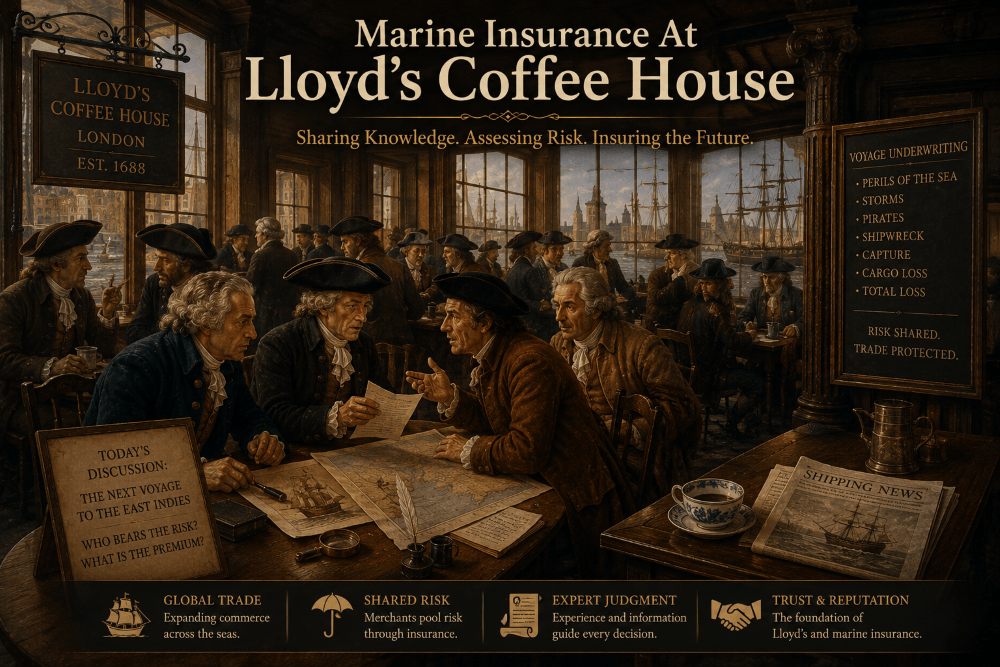
Long before actuaries and spreadsheets, marine insurance was priced over coffee, conversation, and a shared willingness to bet on the safe return of a ship. In the late 17th century, a modest coffee house in London became the unlikely birthplace of one of history’s most important financial innovations: the formal pricing of risk. What started as informal side bets among merchants evolved into Lloyd’s of London, a global institution that still shapes how risk is measured and managed today.
What Was Marine Insurance Solving?
Long-distance sea trade during the Age of Exploration and beyond carried enormous financial risk. Ships regularly faced storms, piracy, navigational errors, and outright loss.
- A single lost ship could financially devastate a merchant or investor who had funded the voyage.
- Earlier trade models, including joint-stock companies, helped spread ownership risk but didn’t eliminate the underlying danger of losing cargo or vessels entirely.
- Merchants needed a way to protect themselves against catastrophic, unpredictable losses without abandoning risky but potentially lucrative trade routes.
Marine insurance offered a direct solution: paying a smaller, predictable cost upfront in exchange for protection against a much larger potential loss.
The Birth of Lloyd’s Coffee House
A Meeting Place for Merchants
Edward Lloyd opened his coffee house in London around 1688, and it quickly became a popular gathering spot for sailors, ship owners, and merchants involved in maritime trade.
- Lloyd’s provided shipping news, schedules, and trade information that merchants found valuable.
- This naturally attracted people directly involved in financing and insuring maritime ventures.
- Over time, the coffee house evolved into an informal marketplace where individuals could underwrite portions of a ship’s insurance risk.
What began as a casual meeting place for shipping-related conversation gradually became a functioning risk marketplace.
How Early Marine Insurance Worked
The system that developed at Lloyd’s was refreshingly direct, relying on individual underwriters rather than a single large company.
- A ship owner or merchant seeking coverage would present details of a voyage to interested parties at the coffee house.
- Individual underwriters would agree to cover a portion of the potential loss in exchange for a premium payment.
- Multiple underwriters often shared risk on a single voyage, spreading exposure much like joint-stock companies spread ownership.
This system meant no single underwriter bore catastrophic risk alone, while ship owners gained meaningful protection against total loss.
How Marine Insurance Pricing Evolved
From Guesswork to Genuine Risk Assessment
Early marine insurance pricing at Lloyd’s relied heavily on personal judgment, reputation, and accumulated experience rather than formal mathematical models.
- Underwriters considered factors like the ship’s condition, the captain’s reputation, the cargo type, and the specific route’s known dangers.
- Premiums varied significantly based on perceived risk, with more dangerous routes or seasons commanding higher rates.
- Over time, patterns in successful and failed voyages helped underwriters refine their pricing judgment.
This process represented one of history’s earliest systematic attempts to translate real-world risk into a concrete financial price.
Building Toward Modern Insurance Practices
As Lloyd’s grew more established, its informal practices gradually became more structured and standardized.
- Standardized policy documents began replacing purely verbal or handshake agreements.
- Underwriters developed increasingly sophisticated methods for evaluating and comparing risk across different voyages.
- This evolution laid essential groundwork for the actuarial science and formal risk modeling used throughout the modern insurance industry.
From Coffee House to Global Institution
Lloyd’s of London Emerges
By the 18th century, Lloyd’s had evolved well beyond a simple coffee house into a formal and increasingly influential institution within London’s financial world.
- It developed formal membership structures for underwriters participating in the marketplace.
- It expanded well beyond marine insurance into other forms of risk coverage over the following centuries.
- It eventually became Lloyd’s of London, one of the world’s most significant insurance and reinsurance markets.
A Lasting Model for Risk Management
The core principles pioneered at Lloyd’s remain foundational to how insurance and risk management function today.
- Spreading risk across multiple underwriters remains a standard practice in complex or high-value insurance arrangements.
- The basic exchange, a smaller certain cost in return for protection against a larger uncertain loss, still defines how insurance works globally.
- Lloyd’s itself remains an active and significant institution centuries after its coffee house origins.
Lessons from Marine Insurance and Lloyd’s Coffee House
- Uncertainty has a price. Lloyd’s underwriters proved that even unpredictable risks could be reasonably priced and traded.
- Informal networks can formalize into institutions. A casual coffee house gathering evolved into one of the world’s leading financial institutions.
- Shared risk enables greater ambition. Spreading exposure across multiple underwriters made insuring genuinely risky ventures financially sustainable.
Frequently Asked Questions
What was Lloyd’s Coffee House? Lloyd’s Coffee House was a London establishment opened around 1688 that became a popular gathering place for merchants and sailors, eventually evolving into an informal marketplace for marine insurance.
How did early marine insurance pricing work? Underwriters at Lloyd’s assessed factors like ship condition, cargo, route, and captain reputation, relying on judgment and experience rather than formal mathematical models to set premiums.
Why was marine insurance important for trade? It allowed merchants and ship owners to protect themselves against catastrophic financial loss from shipwrecks, piracy, or other maritime disasters, encouraging continued investment in risky trade routes.
Is Lloyd’s of London still around today? Yes, Lloyd’s of London remains a major global insurance and reinsurance market, directly tracing its origins back to the informal underwriting practices at Edward Lloyd’s coffee house.
Related Articles
- Joint-Stock Companies: The Structure That Scaled Business
- The British East India Company: Trade Turned Empire
- Tulipmania: What the Famous Bubble Really Teaches About Markets
- The Amsterdam Stock Exchange: Where Shares Were Born
- The Dutch East India Company: How the VOC Helped Create the Modern Corporation