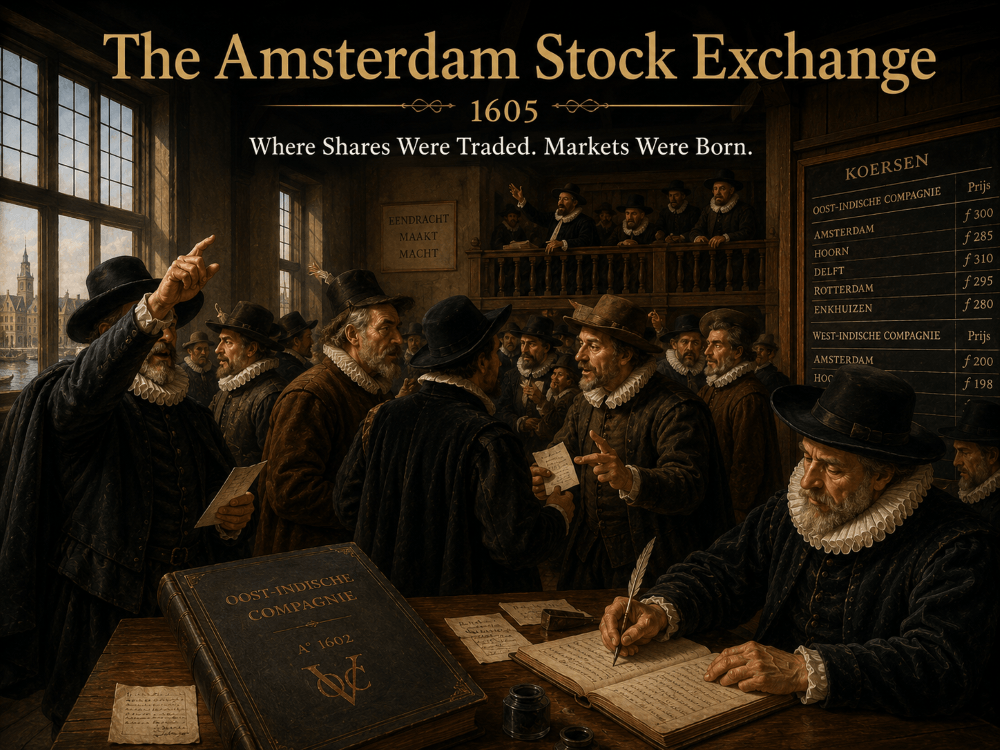
The Amsterdam Stock Exchange didn’t just help merchants raise money — it invented an entirely new way of thinking about ownership, risk, and value. Founded in 1602 alongside the Dutch East India Company, it became the world’s first formal stock exchange, allowing shares to be bought, sold, and traded freely among the public. What started as a practical funding solution for risky overseas voyages evolved into the foundation of modern financial markets.
What Was the Amsterdam Stock Exchange?
The Amsterdam Stock Exchange emerged directly from the founding of the Dutch East India Company, commonly known as the VOC, in 1602.
- The VOC needed enormous amounts of capital to fund long, dangerous voyages to Asia in pursuit of the spice trade.
- Rather than relying on a small group of wealthy backers, the company sold shares to the general public.
- These shares could then be freely bought and sold, creating the need for an organized marketplace to facilitate trading.
This combination of public share ownership and an organized trading venue made the Amsterdam Stock Exchange something genuinely new in commercial history.
Why the Amsterdam Stock Exchange Was Revolutionary
From Private Partnerships to Public Shares
Before the VOC and the Amsterdam Stock Exchange, most large commercial ventures relied on private partnerships or one-off funding arrangements tied to a single voyage.
- Earlier trading ventures typically dissolved and redistributed profits after each individual voyage was completed.
- The VOC instead created permanent, ongoing shares that didn’t expire after a single trip.
- This structure allowed investors to hold long-term ownership stakes rather than repeatedly negotiating new funding arrangements.
This shift from temporary partnerships to permanent, tradable ownership fundamentally changed how large ventures could be financed.
Introducing Real Liquidity
Perhaps the most important innovation of the Amsterdam Stock Exchange was liquidity — the ability for investors to sell their shares whenever they wanted, rather than being locked into an investment until a venture concluded.
- Investors no longer needed to wait years for a voyage to return before accessing their capital.
- Shares could be sold to other investors at whatever price the market determined.
- This flexibility made investing in large, risky ventures far more attractive to a broader range of people.
Liquidity transformed investment from a rigid, long-term commitment into something closer to how modern investors think about buying and selling stock today.
Speculation and Financial Innovation
The Birth of Modern Trading Behavior
Once shares could be freely traded, human behavior around buying and selling quickly grew more sophisticated, and sometimes more reckless.
- Traders began speculating on future price movements rather than simply investing based on a company’s underlying value.
- Techniques resembling modern short selling emerged, allowing traders to profit from anticipated price declines.
- Price fluctuations based on rumors, expectations, and market sentiment became a regular feature of trading.
These behaviors, while sometimes destabilizing, laid essential groundwork for the trading strategies used in financial markets today.
Early Financial Instruments
Dutch traders at the Amsterdam Stock Exchange developed increasingly sophisticated financial tools well beyond simple share ownership.
- Options contracts allowed traders to secure the right to buy or sell shares at a set price in the future.
- Futures-like agreements let merchants lock in prices for goods or shares ahead of time.
- These innovations show how quickly financial creativity expanded once a functioning public market existed.
The Broader Economic Impact
Fueling the Dutch Golden Age
The Amsterdam Stock Exchange played a central role in funding the extraordinary economic expansion known as the Dutch Golden Age.
- Easy access to capital allowed Dutch companies to fund ambitious, large-scale trading ventures.
- Amsterdam became one of the wealthiest and most commercially significant cities in the world during this period.
- The exchange helped establish Amsterdam as Europe’s leading financial center for much of the 17th century.
A Template for Modern Markets
The structures pioneered in Amsterdam eventually spread across Europe and beyond, shaping how stock exchanges operate today.
- London, and eventually markets around the world, adopted similar systems of public share trading.
- Basic concepts like liquidity, speculation, and tradable ownership remain foundational to modern finance.
- Regulatory challenges first encountered in Amsterdam, including market manipulation and speculative bubbles, remain relevant financial concerns today.
Lessons from the Amsterdam Stock Exchange
- Liquidity attracts capital. The ability to sell shares whenever needed made large, risky ventures far more appealing to investors.
- Public ownership scales differently than private partnerships. Spreading ownership across many investors allowed for far larger fundraising than earlier models.
- Financial innovation moves quickly once incentives align. Options, speculation, and complex trading strategies emerged rapidly once a functioning public market existed.
Frequently Asked Questions
Why is the Amsterdam Stock Exchange considered the first modern stock exchange? It was the first exchange to facilitate ongoing public trading of permanent company shares, rather than temporary partnerships tied to a single venture.
What company was connected to the founding of the Amsterdam Stock Exchange? The Dutch East India Company, or VOC, was directly connected to its founding in 1602, as the exchange developed to facilitate trading of the company’s publicly issued shares.
What financial innovations came from the Amsterdam Stock Exchange? Traders developed early versions of options contracts, short selling, and speculative trading strategies that remain foundational to modern financial markets.
How did the Amsterdam Stock Exchange impact the Dutch economy? It provided crucial access to capital that helped fund the Dutch Golden Age, establishing Amsterdam as one of Europe’s leading financial and commercial centers.
Related Articles
- The Dutch East India Company: How the VOC Helped Create the Modern Corporation
- The Fall of Constantinople: The Trade Shock That Built Empires
- Vasco da Gama: Building the Portuguese Spice Monopoly
- Christopher Columbus: Exploration as a Business Pitch
- Prince Henry the Navigator: The First Venture Capitalist
- The Age of Exploration: When Entrepreneurship Went Global
About The History of Entrepreneurship
This article is part of The History of Entrepreneurship, an ongoing series exploring how civilizations, entrepreneurs, merchants, technologies, and institutions gradually created the foundations of modern business.