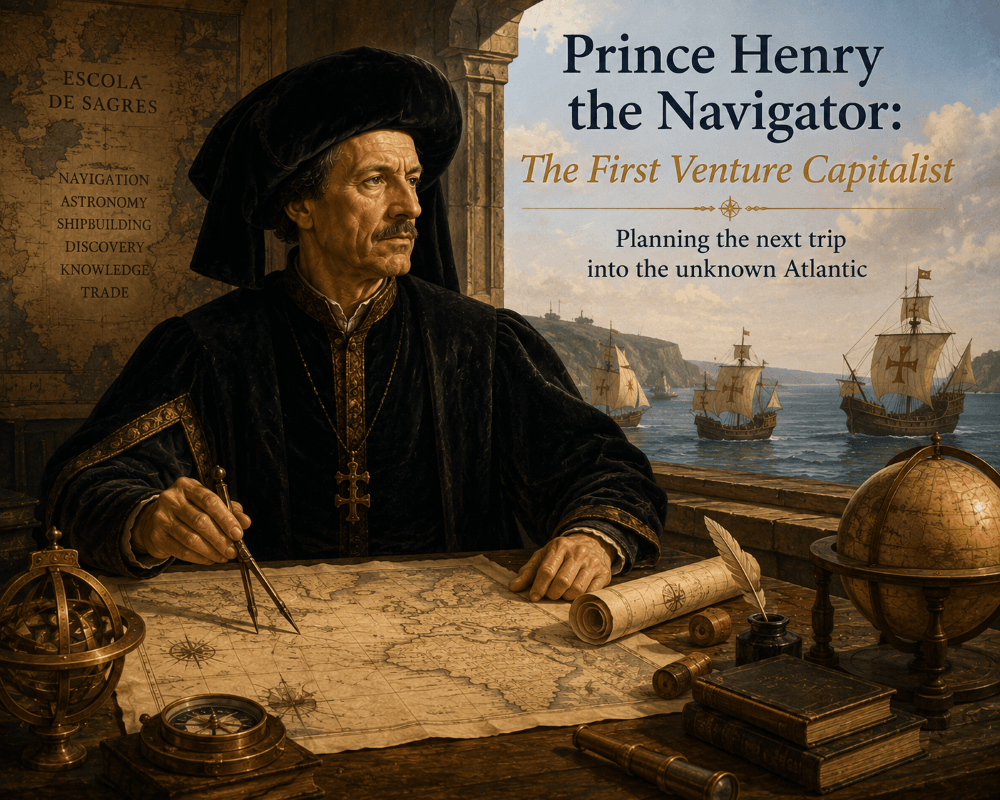
Prince Henry the Navigator never captained a single major voyage himself, yet he became one of history’s most consequential entrepreneurs by funding, organizing, and systematizing Portugal’s push into the unknown Atlantic. Operating through most of the early 15th century, Henry built something the world hadn’t quite seen before: an organized institution dedicated to researching, financing, and scaling exploration as a repeatable venture. His approach laid the groundwork for the Age of Exploration and offers an early blueprint for what modern investors would later call risk capital.
Who Was Prince Henry the Navigator?
Prince Henry was born in 1394, the third son of King John I of Portugal. Despite his royal title and famous nickname, he spent very little time actually sailing.
- His interest in exploration reportedly grew after participating in Portugal’s capture of Ceuta in North Africa in 1415.
- That campaign exposed him to accounts of African gold, trade routes, and resources further south along the coast.
- Rather than personally leading expeditions, Henry chose to direct and finance them from a position of organizational leadership.
His nickname, added centuries later by admiring historians, reflects his role as the architect behind Portuguese exploration rather than a literal description of his career at sea.
How Prince Henry the Navigator Organized Exploration
Building an Institution for Discovery
Henry’s most important innovation wasn’t a single voyage but a system. He established a base at Sagres, on Portugal’s southwestern coast, that functioned as a hub for maritime research and planning.
- He gathered cartographers, astronomers, and shipbuilders to advance navigational knowledge.
- He supported the development of the caravel, a faster and more maneuverable ship suited to exploring unfamiliar coastlines.
- He systematically funded repeated voyages down the West African coast, treating exploration as an ongoing program rather than isolated trips.
This organized approach let Portugal build cumulative knowledge and capability over decades, rather than relying on scattered, one-off expeditions.
Risk Capital for Uncertain Returns
Much like early modern investors, Henry committed significant resources to ventures with uncertain and often distant payoffs.
- Many early voyages returned little immediate profit, particularly before explorers passed the psychologically significant barrier of Cape Bojador.
- Henry continued funding expeditions despite repeated failures and setbacks.
- His persistence eventually paid off as expeditions successfully rounded Cape Bojador in 1434, opening the way for further exploration southward.
This willingness to absorb early losses in pursuit of long-term strategic and commercial gain mirrors how modern venture capital operates today.
The Commercial Motivations Behind Exploration
Gold, Trade, and New Markets
Prince Henry the Navigator’s expeditions weren’t driven purely by curiosity. Clear commercial incentives shaped his strategy.
- Portugal sought direct access to West African gold, reducing dependence on trans-Saharan trade routes controlled by others.
- Expeditions also aimed to establish new trading posts along the African coast.
- Later voyages under Henry’s sponsorship began the deeply troubling practice of transporting enslaved people back to Portugal, a dark and undeniable part of this expansion’s economic history.
Strategic and Religious Motivations
Alongside commercial goals, Henry pursued several other objectives that combined with economic ambition.
- He hoped to locate a legendary Christian kingdom in Africa believed capable of allying against Muslim powers.
- He sought to expand Portuguese influence and territory along the African coast.
- He aimed to bypass established Mediterranean trade routes, most of which were dominated by Italian and Muslim merchants.
The Long-Term Impact of Henry’s Program
Setting the Stage for Later Explorers
Henry died in 1460, decades before Vasco da Gama’s famous voyage to India, but his organizational groundwork made later achievements possible.
- Improved ship design, navigational tools, and accumulated coastal knowledge all stemmed from his sponsored programs.
- Portuguese sailors trained and developed expertise under his sustained investment in exploration.
- His systematic approach to funding and organizing voyages became a model other European powers would eventually imitate.
An Early Model for Systematic Innovation
Henry’s approach demonstrates several principles that remain relevant to entrepreneurship today.
- Sustained investment matters. Long-term funding allowed capability to compound over decades rather than resetting with each new expedition.
- Institutions outperform individual efforts. Sagres functioned much like a research and development center, pooling expertise systematically.
- Early failures can precede major breakthroughs. Years of limited returns preceded the pivotal success of rounding Cape Bojador.
Lessons from Prince Henry the Navigator
- Fund the system, not just the voyage. Henry’s investment in ships, tools, and expertise paid off repeatedly across many expeditions.
- Tolerate early losses for long-term gain. Persistent funding despite setbacks eventually unlocked major breakthroughs.
- Combine motivations strategically. Commercial, religious, and political goals reinforced each other throughout his exploration program.
Frequently Asked Questions
Did Prince Henry the Navigator actually sail on voyages himself? No, Prince Henry rarely sailed personally. He primarily organized, funded, and directed exploration efforts rather than leading expeditions at sea.
Why is Prince Henry the Navigator important to entrepreneurship history? He pioneered a systematic, institution-based approach to funding risky, long-term ventures, closely resembling how modern venture capital supports uncertain but potentially high-reward projects.
What was the significance of Cape Bojador? Cape Bojador was long considered an impassable barrier by European sailors. Successfully rounding it in 1434 under Henry’s sponsorship opened the way for further African exploration.
What role did Prince Henry the Navigator play in the transatlantic slave trade? Voyages sponsored under Henry began transporting enslaved people from Africa to Portugal, marking a troubling early chapter in what would become the transatlantic slave trade.
Related Articles
- The Age of Exploration: When Entrepreneurship Went Global
- Double-Entry Bookkeeping: The Idea That Built Modern Business
- Jakob Fugger: The Banker Who Financed Emperors
- Marco Polo: The Merchant Who Reopened East-West Trade
- Jewish Merchants: Diaspora Networks and the Power of Portable Trust
- The Islamic Golden Age: How Knowledge, Finance, and Global Trade Transformed Entrepreneurship
- Venice: How Merchant Capitalism Built a Commercial Empire
- The Medici Bank: How Banking Became an International Business
- The Phoenicians: How Maritime Trade Connected the Ancient World
About The History of Entrepreneurship
This article is part of The History of Entrepreneurship, an ongoing series exploring how civilizations, merchants, technologies, institutions, and individual entrepreneurs gradually created the foundations of modern business.