What if the greatest entrepreneurial innovation wasn’t a product—but a network?
The Phoenicians answered that question more than 3,000 years ago.
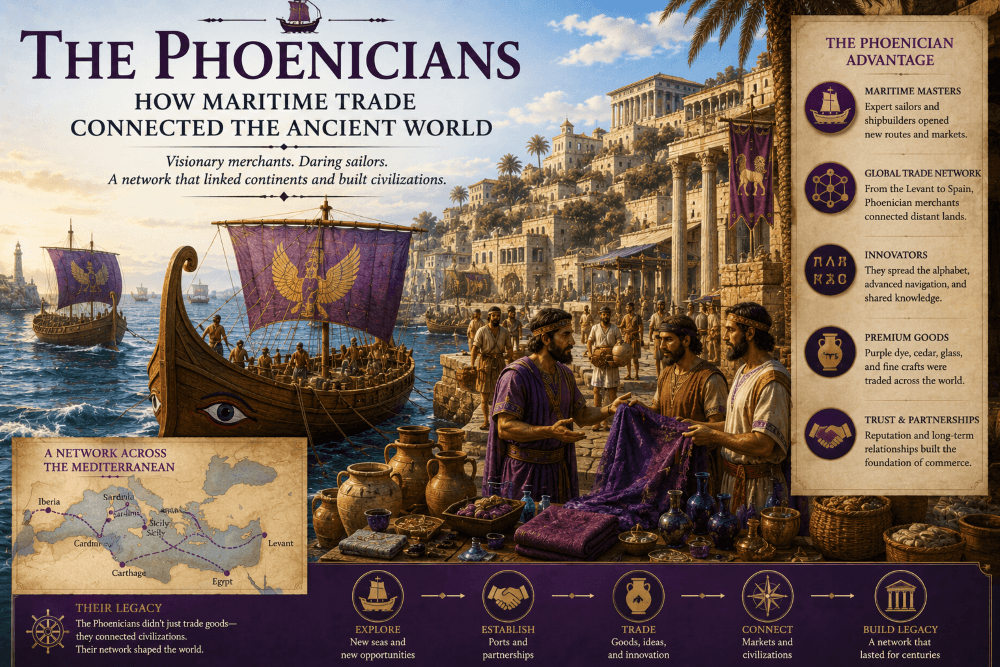
Living along the eastern Mediterranean coast, Phoenician merchants transformed maritime trade by connecting dozens of ports across Europe, North Africa, and the Near East.
They did not build a vast empire through military conquest.
Instead, they built something even more enduring:
A commercial network.
Their success demonstrates one of history’s most important entrepreneurial lessons.
Connections create value.

Who Were the Phoenicians?
The Phoenicians lived along the eastern Mediterranean coast in what is now Lebanon and parts of Syria and northern Israel.
Unlike Egypt or Mesopotamia, they possessed relatively little farmland.
Their greatest natural resource was access to the sea.
Independent city-states such as:
- Tyre
- Sidon
- Byblos
- Arwad
became thriving commercial centers.
Rather than conquering neighboring civilizations, the Phoenicians specialized in trade.
Commerce became their competitive advantage.
Phoenician Trade Changed the Mediterranean
The Phoenicians developed one of history’s earliest international trading networks.
Their ships connected ports throughout the Mediterranean.
They established trading colonies across:
- Cyprus
- Sicily
- Sardinia
- Malta
- North Africa
- Southern Spain
- The western Mediterranean
Their most famous colony was Carthage, which eventually became one of the ancient world’s greatest commercial powers.
Each new settlement expanded the network.
Each additional trading partner created new opportunities.
Their business model resembles many modern global companies.
What Did the Phoenicians Trade?
Phoenician merchants exported many highly valued products.
Among their most famous exports were:
- Cedar timber
- Purple dye
- Glassware
- Fine textiles
- Wine
- Olive oil
- Metal products
The legendary Tyrian purple dye became one of the ancient world’s most prestigious luxury goods.
Because extracting the dye from murex sea snails required enormous labor, purple garments became symbols of wealth and political power.
The Phoenicians understood an important business principle.
Premium products command premium prices.
The World’s First Commercial Network
The Phoenicians created much more than shipping routes.
They built relationships.
A merchant sailing from Tyre to Carthage might exchange products, gather market information, establish new partnerships, and discover entirely new business opportunities.
Each successful voyage strengthened the overall network.
Modern economists describe similar phenomena as network effects.
As networks grow, they become increasingly valuable to every participant.
The Phoenicians demonstrated this principle thousands of years before the internet.
Information Was as Valuable as Cargo
Phoenician ships transported more than goods.
They carried information.
Merchants learned:
- Current prices
- Political developments
- Weather conditions
- Safe harbors
- Navigation techniques
- Customer preferences
- New technologies
Often this information proved just as valuable as the cargo itself.
Successful entrepreneurs continue relying on market intelligence today.
Navigation Created Competitive Advantage
Phoenician sailors became famous for their maritime skills.
They mastered:
- Coastal navigation
- Seasonal winds
- Celestial navigation
- Shipbuilding
- Long-distance voyages
Superior navigation reduced transportation costs and expanded commercial opportunities.
Knowledge became a competitive advantage.
Modern entrepreneurs compete in much the same way.
The Phoenician Alphabet Changed Business
Although earlier writing systems already existed, the Phoenicians helped spread a simpler alphabet based on a relatively small number of symbols representing sounds.
Compared with many earlier writing systems, it was easier to learn and adapt.
As Phoenician merchants traveled throughout the Mediterranean, the alphabet spread with them.
The Greeks later modified it.
The Romans eventually adapted it.
Many modern alphabets trace part of their history to this development.
Better communication reduced the cost of commerce.
That remains true today.
Trust Built International Commerce
Long-distance trade depends upon trust.
Phoenician merchants often conducted business far from home.
Their success depended upon:
- Honest dealing
- Reliable deliveries
- Strong partnerships
- Repeat customers
- Long-term relationships
A trusted merchant gained access to better opportunities.
Reputation became a valuable business asset.
Even today, trust remains one of the entrepreneur’s strongest competitive advantages.
Carthage: A Startup That Became an Empire
Perhaps the greatest example of Phoenician entrepreneurship was Carthage.
Founded as a trading colony, Carthage eventually grew into one of the Mediterranean’s most powerful commercial cities.
Its merchants expanded trade throughout North Africa, Spain, and beyond.
This illustrates a familiar entrepreneurial story.
Sometimes a successful branch office eventually becomes more influential than its parent organization.
Networks create unexpected opportunities.
Why the Phoenicians Still Matter
Modern entrepreneurs often think globally.
The Phoenicians pioneered that mindset.
They recognized that prosperity comes from connecting markets rather than remaining isolated.
Their legacy lives on in:
- International shipping
- Global supply chains
- Commercial partnerships
- Distribution networks
- International trade
- Logistics
- Maritime commerce
Every global business today follows principles the Phoenicians helped demonstrate thousands of years ago.
The Entrepreneur’s Toolbox
Networks
The most successful entrepreneurs rarely build businesses alone.
They create networks.
Customers.
Suppliers.
Partners.
Investors.
Employees.
Communities.
Each trusted relationship expands future opportunities.
Networks compound in value over time.
Five Lessons for Modern Entrepreneurs
1. Connections Create Value
Great businesses often succeed by bringing people and markets together.
2. Reputation Travels
Trust becomes increasingly valuable as businesses expand into new markets.
3. Premium Products Create Premium Opportunities
Quality and uniqueness allow businesses to compete on value rather than price alone.
4. Information Creates Competitive Advantage
Market knowledge helps entrepreneurs recognize opportunities before competitors.
5. Networks Grow Stronger with Time
Every successful relationship increases future possibilities.
Frequently Asked Questions
Who were the Phoenicians?
The Phoenicians were an ancient maritime civilization centered along the eastern Mediterranean coast, famous for trade, navigation, shipbuilding, and commerce.
Why was Phoenician trade important?
Phoenician merchants connected dozens of Mediterranean ports, creating one of history’s earliest international commercial networks.
What products did the Phoenicians trade?
They traded cedar timber, Tyrian purple dye, glassware, textiles, wine, olive oil, metals, and many luxury goods.
Why is Carthage important?
Originally founded as a Phoenician trading colony, Carthage became one of the Mediterranean’s greatest commercial and naval powers.
Did the Phoenicians invent the alphabet?
The Phoenicians did not invent writing, but they developed and spread a simplified alphabet that greatly influenced the Greek, Latin, and many later writing systems.
Continue the Journey
The Phoenicians demonstrated how maritime trade could connect civilizations.
Across the Aegean Sea, another civilization explored a different entrepreneurial idea.
The ancient Greeks believed competition, debate, private enterprise, and open markets encouraged innovation.
Their ideas continue influencing economics and entrepreneurship today.
In Chapter 9, we’ll explore Ancient Greece: Competition, Markets, and the Birth of Commercial Thinking.
Related Articles
- Related Articles
- The First Entrepreneur: When Did Entrepreneurship Begin?
- The Agricultural Revolution: How Farming Created the First Entrepreneurs
- How Writing Was Invented for Business: The First Accountants
- The First Merchants: How the Sumerians Created Professional Commerce
- The Birth of Money: How Currency Changed Entrepreneurship Forever
- The Indus Valley: Trade, Standardization, and the Mysterious Business Civilization
- Ancient China: Innovation, Markets, and Continuous Improvement
- Ancient Greece: Competition and Markets (Coming Soon)
About The History of Entrepreneurship
This article is part of The History of Entrepreneurship, an ongoing series by Alain Guillot exploring how civilizations, innovations, institutions, and remarkable entrepreneurs shaped the history of commerce.
Each chapter focuses on one major contribution to the entrepreneur’s toolkit, showing how thousands of years of human ingenuity built the foundations of modern business.
North Star
The Phoenicians proved that entrepreneurs create extraordinary value by connecting people, products, and markets. Their greatest achievement was not a single invention, but a commercial network that helped transform the Mediterranean into one of history’s first interconnected economies.