What makes a civilization entrepreneurial?
Some civilizations became famous for conquering territory.
Others became known for accumulating wealth through trade.
Ancient China followed a different path.
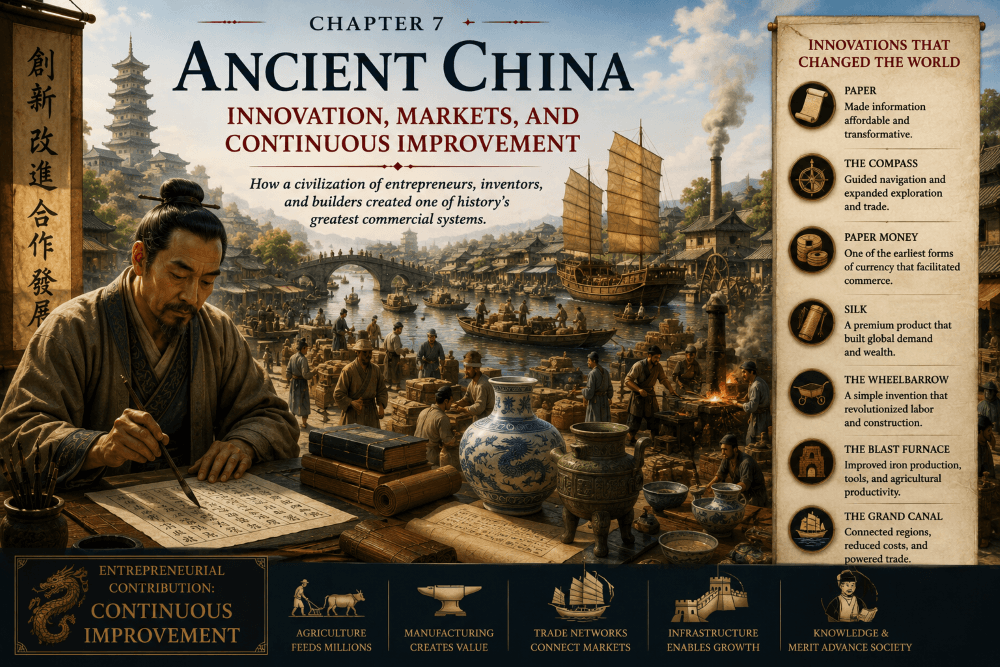
For thousands of years, Chinese farmers, engineers, artisans, merchants, and officials steadily improved agriculture, manufacturing, transportation, and administration. Instead of relying on one revolutionary invention, China demonstrated how continuous improvement could transform an economy.
Many of the ideas that drive modern business—efficient production, large domestic markets, infrastructure, and technological innovation—have deep roots in Chinese history.
A Civilization That Endured
Ancient China was one of the world’s longest-lasting civilizations.
Dynasties changed.
Wars came and went.
Governments rose and fell.
Yet Chinese agriculture, manufacturing, commerce, and technological development continued across centuries.
This continuity allowed entrepreneurs to build upon earlier discoveries instead of starting over.
Progress became cumulative.
Each generation inherited knowledge from the previous one.
That long-term perspective remains one of China’s greatest historical strengths.
Agriculture Created Expanding Markets
Every thriving commercial civilization begins with productive agriculture.
Chinese farmers developed increasingly efficient methods of irrigation, crop management, and land cultivation.
Regional specialization also emerged.
Rice dominated much of southern China.
Millet and wheat remained important farther north.
As agricultural productivity increased:
- Cities grew.
- Populations expanded.
- Markets became larger.
- New professions appeared.
- Entrepreneurs found new opportunities.
Agriculture remained the foundation of economic growth.
Manufacturing Became a Competitive Advantage
Ancient China became famous for producing goods admired across Asia and beyond.
Among its most important industries were:
- Silk
- Paper
- Iron tools
- Bronze goods
- Lacquerware
- Porcelain
- Ceramics
These products required highly skilled craftspeople and organized production.
Chinese manufacturers developed reputations for quality that helped create demand far beyond their own borders.
Today, manufacturing remains one of China’s defining economic strengths.
Its roots stretch back more than two thousand years.
Iron Improved Everyday Productivity
History often celebrates luxury goods.
Entrepreneurs appreciate productive tools.
Improved iron technology allowed Chinese farmers and craftspeople to work more efficiently.
Iron plows increased agricultural production.
Iron tools improved construction.
Iron equipment expanded manufacturing.
Instead of creating wealth through decoration, iron created wealth through productivity.
That lesson still applies today.
The most valuable innovations often help ordinary people accomplish everyday tasks more effectively.
Paper Changed Business Forever
One of China’s greatest inventions transformed entrepreneurship itself.
Paper.
Before paper became widely available, writing materials were expensive and cumbersome.
Paper made information far easier to record, transport, and preserve.
Merchants could keep better accounts.
Governments managed larger administrations.
Teachers spread knowledge more efficiently.
Business depends on information.
Paper dramatically lowered the cost of managing information.
The Silk Road Connected Civilizations
The Silk Road was not one highway but an extensive network of commercial routes linking China with Central Asia, India, Persia, the Middle East, and Europe.
Chinese merchants exported:
- Silk
- Paper
- Ceramics
- Iron products
- Tea (especially in later periods)
In return they received:
- Horses
- Precious stones
- Glassware
- Spices
- New technologies
- Religious ideas
Trade spread much more than products.
It also carried culture, science, and innovation across continents.
Infrastructure Made Commerce Possible
One of China’s greatest competitive advantages was infrastructure.
Roads connected regions.
Rivers carried goods.
Canals expanded trade.
Eventually, projects such as the Grand Canal linked major agricultural and commercial centers across vast distances.
Infrastructure reduced transportation costs.
Lower costs encouraged trade.
Greater trade created larger markets.
Even today, entrepreneurs depend on transportation and communication systems that make commerce more efficient.
Entrepreneurs and Government
Ancient China also illustrates an enduring question.
What role should governments play in the economy?
Different dynasties answered differently.
Some encouraged commerce.
Others imposed greater restrictions.
Public investments often improved transportation, irrigation, and flood control.
At the same time, taxes and regulations sometimes limited private enterprise.
The relationship between governments and entrepreneurs has always involved cooperation as well as tension.
Modern economies continue debating many of the same questions.
The Value of Continuous Improvement
Perhaps China’s greatest entrepreneurial lesson is surprisingly simple.
Improve continuously.
Innovation does not always arrive through dramatic breakthroughs.
Sometimes success comes from thousands of small improvements accumulated over generations.
Better tools.
Better roads.
Better manufacturing.
Better organization.
Small gains eventually transform entire economies.
Modern businesses often follow exactly the same strategy.
The Entrepreneur’s Toolbox
Continuous Improvement
The strongest businesses rarely depend on one brilliant invention.
Instead, they improve products, services, manufacturing, logistics, and customer experiences little by little.
These incremental improvements compound over time.
Continuous improvement often creates stronger long-term competitive advantages than dramatic but infrequent breakthroughs.
Five Lessons for Modern Entrepreneurs
1. Improvement Never Ends
Successful businesses constantly refine products, services, and operations.
2. Infrastructure Creates Opportunity
Transportation, communication, and logistics make markets more efficient.
3. Knowledge Compounds
Every innovation builds upon previous discoveries.
Learning is one of the entrepreneur’s greatest assets.
4. Large Markets Reward Efficiency
Businesses serving millions of customers depend on consistency and organization.
5. Entrepreneurs Thrive Within Systems
Private enterprise succeeds most effectively when supported by stable institutions, infrastructure, and the rule of law.
Frequently Asked Questions
Why is ancient China important to entrepreneurship?
Ancient China developed innovations in manufacturing, agriculture, transportation, administration, and technology that supported large-scale commerce and long-term economic growth.
What products made ancient China famous?
China became known for silk, paper, porcelain, iron tools, lacquerware, ceramics, and many other manufactured goods that were traded throughout Asia and beyond.
What was the Silk Road?
The Silk Road was a network of trade routes connecting China with Central Asia, India, Persia, the Middle East, and Europe, allowing goods, ideas, and technologies to spread across continents.
Why was paper important for business?
Paper made record-keeping, contracts, accounting, education, and communication far more affordable and efficient than earlier writing materials.
What entrepreneurial lesson does ancient China teach?
China demonstrates the power of continuous improvement. Many of history’s greatest commercial achievements resulted from steady refinement rather than one dramatic invention.
Continue the Journey
While China built one of history’s largest internal commercial systems, another civilization looked toward the sea.
The Phoenicians transformed maritime trade by connecting ports throughout the Mediterranean.
Their merchants established trading colonies, expanded international commerce, and spread technologies across continents.
In Chapter 8, we’ll explore The Phoenicians: How Maritime Trade Connected the Ancient World.
Related Articles
- The First Entrepreneur: When Did Entrepreneurship Begin?
- The Agricultural Revolution: How Farming Created the First Entrepreneurs
- How Writing Was Invented for Business: The First Accountants
- The First Merchants: How the Sumerians Created Professional Commerce
- The Birth of Money: How Currency Changed Entrepreneurship Forever
- The Indus Valley: Trade, Standardization, and the Mysterious Business Civilization
- The Phoenicians: Entrepreneurs of the Mediterranean (Coming Soon)
About The History of Entrepreneurship
This article is part of The History of Entrepreneurship, an ongoing series by Alain Guillot exploring how commerce, innovation, and enterprise have shaped civilization—from prehistoric exchange to today’s technology-driven economy.
Each chapter focuses on one civilization, innovation, or institution that fundamentally changed the way human beings create and exchange value.
North Star
Ancient China demonstrates that lasting entrepreneurial success is often built through continuous improvement. By refining agriculture, manufacturing, infrastructure, and knowledge over centuries, Chinese civilization showed that small innovations, repeated consistently, can transform an economy—and ultimately, the world.