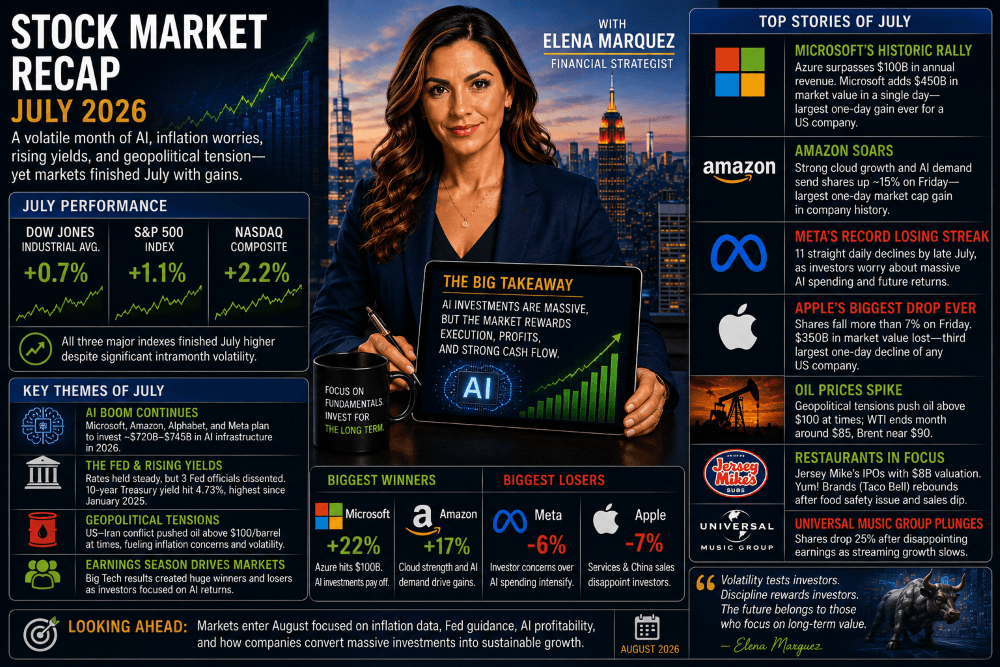
July was one of the most volatile months of the year.
Investors navigated shifting Federal Reserve expectations, rising Treasury yields, renewed conflict in the Middle East, dramatic swings in oil prices, and one of the most consequential earnings seasons in recent memory.
Despite several sharp selloffs during the month, Wall Street finished July with gains, driven by strong corporate earnings and renewed confidence that artificial intelligence continues to fuel long-term economic growth.
July Market Performance
- 📈 Dow Jones Industrial Average: +0.7%
- 📈 S&P 500: Finished the month modestly higher
- 📈 Nasdaq Composite: Finished the month higher, despite a late-month correction
Markets experienced significant volatility throughout the month, but buyers repeatedly stepped in following strong earnings from several of America’s largest technology companies.
Artificial Intelligence Dominated the Month
No story influenced markets more than artificial intelligence.
At the beginning of the month, investors questioned whether technology companies were spending too much on AI infrastructure.
Alphabet’s increased capital spending plans and Tesla’s disappointing earnings triggered concerns that the AI boom might be becoming too expensive.
By month’s end, Microsoft and Amazon helped restore confidence.
Microsoft’s Azure cloud business surpassed US$100 billion in annual revenue, proving that massive AI investments can generate real financial returns.
Amazon followed with another outstanding earnings report, sending its shares soaring after strong cloud growth and continued demand for AI infrastructure.
Together, Microsoft, Amazon, Alphabet, and Meta announced plans to invest roughly US$720–745 billion in AI infrastructure during 2026.
The message is unmistakable:
The AI race is accelerating—not slowing down.
Interest Rates Stayed in the Spotlight
The Federal Reserve held interest rates steady during its July meeting.
However, markets were surprised when three Federal Reserve officials voted in favor of another rate increase, highlighting continued concerns about inflation.
Treasury yields climbed sharply.
The 10-year Treasury yield reached 4.73%, its highest level since January 2025, reminding investors that borrowing costs are likely to remain elevated longer than many had expected.
Geopolitics Moved Markets
The conflict between the United States and Iran repeatedly influenced trading throughout July.
Oil prices surged above US$100 per barrel during periods of escalating military action before retreating as ceasefire hopes briefly emerged.
Higher energy prices fueled inflation concerns and contributed to increased volatility across financial markets.
The Winners and Losers
Some of the month’s biggest moves included:
Biggest Winners
- 📈 Microsoft – Historic rally after Azure surpassed US$100 billion in annual revenue.
- 📈 Amazon – Strong cloud growth and AI demand fueled one of its biggest gains ever.
- 📈 Energy companies – Benefited from higher oil prices during geopolitical tensions.
Biggest Losers
- 📉 Apple – Weaker Services revenue and slowing China sales disappointed investors.
- 📉 Meta – Extended its longest losing streak as Wall Street questioned returns on AI spending.
- 📉 Universal Music Group – Shares plunged after disappointing earnings and slowing streaming growth.
What July Taught Investors
July reinforced an important lesson.
Wall Street still believes artificial intelligence will reshape the global economy.
But investors have become far more disciplined.
Markets no longer reward ambitious spending alone.
They reward companies that demonstrate:
- Growing revenue
- Strong free cash flow
- Disciplined capital allocation
- Clear returns on AI investments
That evolution represents a healthier market.
Innovation attracts capital.
Execution earns lasting investor confidence.
As we move into August, attention will remain focused on inflation, Federal Reserve policy, corporate earnings, and whether AI leaders can continue converting extraordinary investment into extraordinary profits.
Other Stock Market blog posts