It was another volatile week on Wall Street.
Investors navigated shifting expectations for the Federal Reserve, renewed geopolitical tensions in the Middle East, rising Treasury yields, and another dramatic chapter in the artificial intelligence investment story.
Despite the turbulence, the market finished on a positive note.
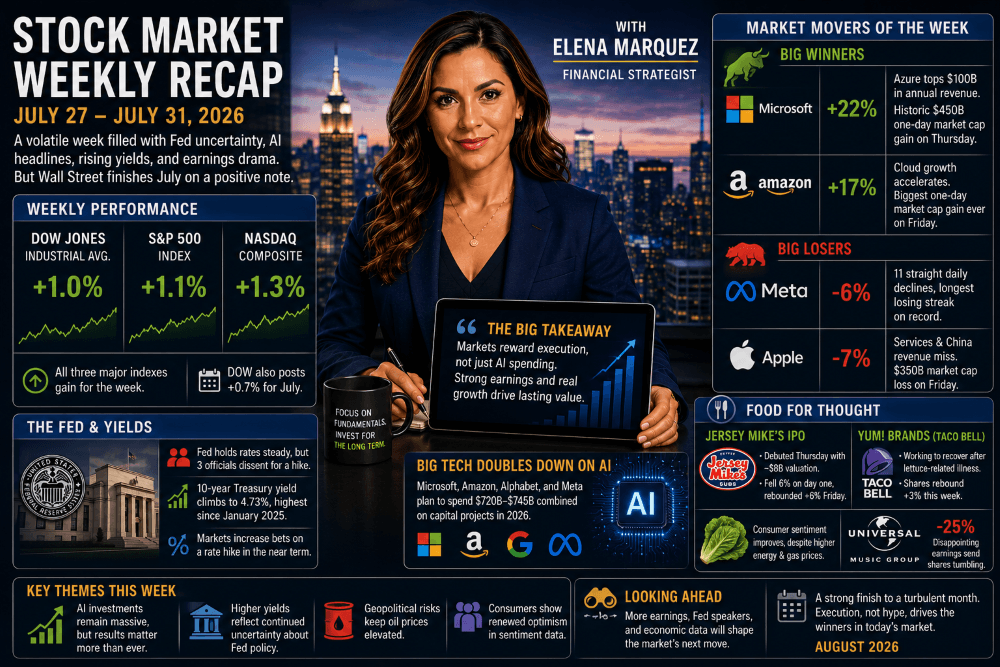
Weekly Performance
- 📈 Dow Jones Industrial Average: +1.0%
- 📈 S&P 500: +1.1%
- 📈 Nasdaq Composite: +1.3%
The gains masked enormous swings beneath the surface, especially among the world’s largest technology companies.
The Fed: Higher for Longer?
Perhaps the week’s biggest macroeconomic story came from the Federal Reserve.
The Fed held interest rates steady, but the meeting surprised investors when three policymakers dissented, arguing that rates should be increased further.
Later in the week, two of those officials explained their reasoning, reinforcing the view that inflation remains a concern.
Treasury yields responded immediately.
The 10-year Treasury yield climbed to 4.73%, its highest level since January 2025, while yields rose across the curve as investors increased the odds of another rate hike later this year.
The message from the bond market was clear:
The fight against inflation may not be over.
AI Creates Clear Winners—and Losers
This week may be remembered as one of the most dramatic earnings seasons ever for the technology sector.
Microsoft’s Historic Victory
Microsoft delivered one of the most impressive earnings reports in corporate history.
The company added roughly US$450 billion in market value in a single day—the largest one-day increase ever recorded by a publicly traded U.S. company.
Azure cloud revenue surpassed US$100 billion annually, proving to investors that Microsoft’s enormous AI investments are already producing measurable financial returns.
Microsoft finished the week up approximately 22%.
Amazon Impresses
Amazon also delivered outstanding results.
Strong cloud growth and continued AI momentum sent the shares soaring roughly 15% on Friday, marking the company’s largest one-day market-value increase on record.
The market rewarded execution.
Meta and Apple Pay the Price
The other side of the AI story looked very different.
Meta extended its longest losing streak since becoming a public company as investors questioned whether its massive AI spending will generate adequate returns.
Apple suffered one of the largest single-day market-value losses in U.S. corporate history after disappointing results from its Services division and weaker-than-expected sales in China.
For the week:
- 📈 Microsoft: +22%
- 📈 Amazon: +17%
- 📉 Meta: -6%
- 📉 Apple: -7%
The market is no longer rewarding every AI company equally.
It is rewarding execution.
Restaurants Return to Wall Street
Technology wasn’t the only sector making headlines.
Restaurant IPOs continue to arrive on public markets.
Jersey Mike’s debuted with a valuation near US$8 billion.
Its shares initially fell on the first day of trading before recovering the following session.
Meanwhile, Yum! Brands, parent company of Taco Bell, rebounded after recent weakness caused by a food safety incident involving contaminated lettuce.
Sometimes markets have short memories.
Even Music Hit a Sour Note
One surprise came from the entertainment industry.
Universal Music Group, home to artists such as Taylor Swift, Lady Gaga, and Bad Bunny, plunged roughly 25% after disappointing earnings.
Streaming growth continues to slow compared with the explosive expansion experienced during the pandemic.
The decline serves as another reminder that even dominant businesses can struggle when investor expectations become too optimistic.
The Bottom Line
This week’s market sent an unmistakable message.
Wall Street still believes artificial intelligence will reshape the global economy.
But investors have become far more selective.
Companies that demonstrate clear revenue growth and improving cash flow are being rewarded with record valuations.
Those that promise future returns without today’s financial results are being punished.
That distinction is likely to define the remainder of 2026.
Other Stock Market blog posts