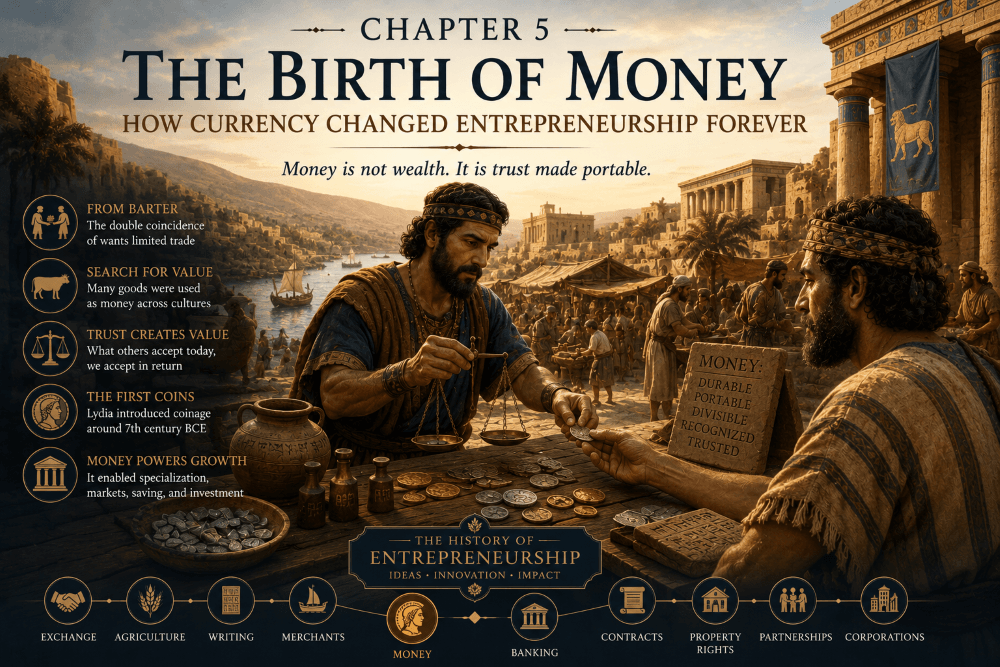
What is the greatest invention in the history of business?
Some might say the corporation.
Others might choose the steam engine, electricity, or the internet.
Yet one innovation made all of those possible.
Money.
Money transformed commerce by making trade faster, simpler, and more efficient. It allowed entrepreneurs to specialize, businesses to grow, and civilizations to expand beyond local markets.
Without money, modern entrepreneurship would be almost impossible.
The Problem with Barter
Before money existed, people exchanged goods through barter.
A farmer traded grain for pottery.
A shepherd exchanged wool for tools.
A fisherman swapped dried fish for vegetables.
Although barter worked in small communities, it became increasingly difficult as commerce expanded.
Imagine trying to buy a horse with baskets of wheat.
How much wheat equals one horse?
What if the horse owner wanted leather instead?
What if your wheat spoiled before finding a willing buyer?
Economists call this challenge the double coincidence of wants.
Both parties must want exactly what the other is offering at the same time.
As cities grew, this system became too inefficient.
Humanity’s Search for Money
Different civilizations experimented with many forms of money.
Throughout history, people have used:
- Grain
- Cattle
- Salt
- Cowrie shells
- Tea bricks
- Copper
- Silver
- Gold
- Bronze
Each served the same purpose.
They became widely accepted mediums of exchange.
Money was never valuable simply because of the material itself.
It became valuable because people trusted others would accept it.
Trust gave money its power.
Why Gold and Silver Became Money
Many ancient societies eventually favored precious metals.
Gold and silver possessed several qualities that made them excellent forms of money.
They were:
- Durable
- Portable
- Divisible
- Difficult to counterfeit
- Relatively scarce
- Easy to recognize
Most importantly, they retained value over time.
Merchants could confidently save them for future transactions.
The First Coins
Around the seventh century BCE, the ancient Kingdom of Lydia, located in what is now western Türkiye, introduced one of history’s greatest financial innovations.
Coins.
Instead of weighing irregular pieces of precious metal during every transaction, merchants could exchange standardized coins issued by the state.
Coins dramatically simplified commerce.
They:
- Reduced disputes.
- Increased trust.
- Simplified pricing.
- Accelerated trade.
- Expanded markets.
Entrepreneurs suddenly spent less time negotiating exchanges and more time building businesses.
Money Made Specialization Possible
Money solved a fundamental problem.
A carpenter no longer needed to find someone willing to trade furniture directly for food.
Instead, the carpenter sold furniture for money.
Later, that money could purchase grain, clothing, tools, or livestock from entirely different people.
Selling became independent from buying.
This simple change allowed specialization to flourish.
Businesses could focus on producing what they did best.
Customers could purchase what they actually needed.
Everyone benefited.
Prices Became Information
Money introduced another revolutionary concept.
Prices.
Prices are much more than numbers.
They communicate information.
When prices rise, entrepreneurs often recognize increasing demand or limited supply.
When prices fall, they may signal increased competition or reduced demand.
Markets coordinate millions of independent decisions through prices without requiring any central planner.
Successful entrepreneurs learn to read these signals.
Money Encouraged Saving and Investment
Money also changed how people thought about the future.
Grain spoiled.
Livestock could die.
Tools wore out.
Gold and silver stored value more effectively.
Savings became investment.
Investment financed workshops.
Workshops hired workers.
Workers produced more goods.
Economic growth accelerated.
Modern businesses continue operating according to this same principle.
Why Entrepreneurs Should Care About Money
Money is often misunderstood.
Many people view it simply as wealth.
Entrepreneurs understand something different.
Money is a tool.
It allows businesses to:
- Pay employees.
- Purchase inventory.
- Invest in equipment.
- Expand operations.
- Measure profits.
- Compare opportunities.
Money itself does not create prosperity.
Productive businesses create prosperity.
Money simply makes productive exchange easier.
Trust: The Invisible Foundation
Whether using ancient silver coins, paper banknotes, credit cards, or digital payments, every monetary system depends on one invisible ingredient.
Trust.
When you accept money, you believe someone else will accept it tomorrow.
Without confidence, money loses much of its usefulness.
This principle has remained remarkably consistent for thousands of years.
Technology evolves.
Trust remains essential.
The Entrepreneur’s Toolbox
Money
Money reduces the cost of exchange.
It allows entrepreneurs to spend less time overcoming the limitations of barter and more time solving customer problems.
Every successful business depends upon efficient exchange.
Money made that possible.
Five Lessons Modern Entrepreneurs Can Learn
1. Reduce Friction
Successful businesses remove obstacles for customers.
Money removed one of humanity’s greatest commercial obstacles.
2. Trust Creates Value
Customers buy from businesses they believe.
Trust remains the foundation of every successful transaction.
3. Prices Are Information
Markets constantly communicate through prices.
Entrepreneurs who listen make better decisions.
4. Liquidity Creates Opportunity
Access to money allows businesses to invest, adapt, and grow.
5. Simplicity Wins
The greatest innovations often simplify complicated processes.
Money dramatically simplified commerce.
Frequently Asked Questions
Why was money invented?
Money was developed to solve the limitations of barter by providing a widely accepted medium of exchange that simplified trade.
What was used as money before coins?
Many civilizations used cattle, grain, salt, shells, precious metals, tea bricks, and other valuable commodities before standardized coins became common.
Who invented the first coins?
The Kingdom of Lydia, in present-day western Türkiye, is generally credited with producing the first standardized coins around the seventh century BCE.
Why is money important for entrepreneurship?
Money allows entrepreneurs to specialize, invest, measure profits, hire employees, and expand businesses without relying on inefficient barter systems.
Continue the Journey
Money transformed trade.
But another challenge remained.
Successful merchants often carried enormous amounts of gold and silver across dangerous trade routes.
Robbery.
Loss.
Counterfeiting.
Transport costs.
Commerce needed another breakthrough.
Banking.
In the next chapter, we’ll explore how the first banks changed the history of entrepreneurship by making wealth safer, more portable, and easier to invest.
Related Articles
- The First Entrepreneur: When Did Entrepreneurship Begin?
- The Agricultural Revolution: How Farming Created the First Entrepreneurs
- How Writing Was Invented for Business: The First Accountants
- The First Merchants: How the Sumerians Created Professional Commerce
- The History of Banking (Coming Soon)
- The Evolution of Currency (Coming Soon)
About The History of Entrepreneurship
This article is part of The History of Entrepreneurship, an ongoing series by Alain Guillot exploring how commerce, innovation, and enterprise have shaped civilization—from prehistoric exchange to artificial intelligence.
Through history, biography, and economics, the series examines the ideas and institutions that made entrepreneurship one of humanity’s greatest creative forces.
North Star
Money is not wealth itself—it is a trusted tool that allows entrepreneurs, customers, and societies to exchange value more efficiently and build greater prosperity together.