Chapter 1
“Entrepreneurship began long before there were companies, currencies, governments, or even writing. It began the moment one human being discovered they could create value for another.”
A Trade That Changed the World
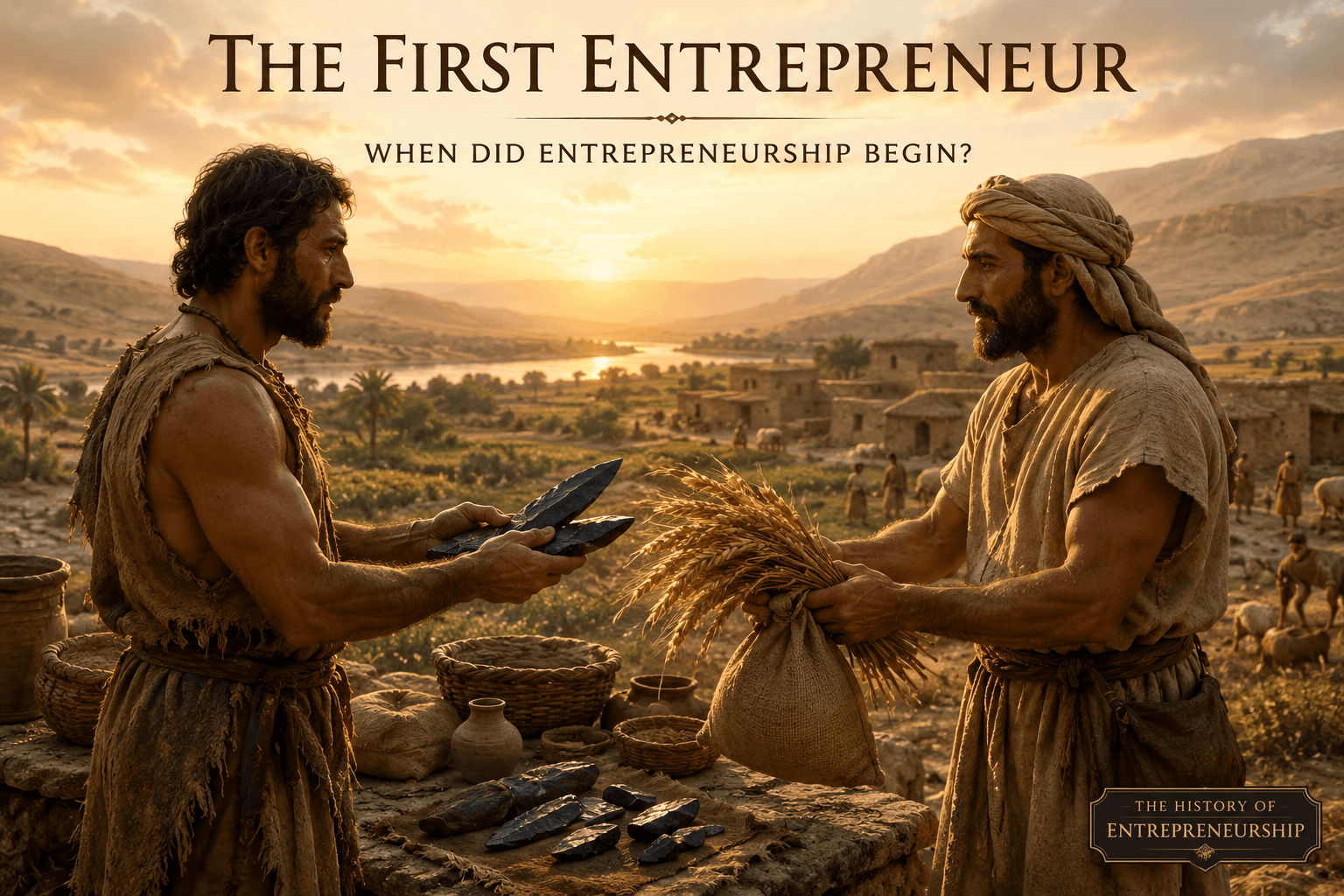
Ten thousand years ago, somewhere in the Fertile Crescent, two strangers met at the edge of a small settlement.
One carried finely crafted obsidian blades. The other had sacks of barley harvested from fertile fields. Neither needed more of what they already possessed. The farmer wanted sharper tools for the coming harvest. The toolmaker needed food to feed his family.
When they exchanged their goods, something remarkable happened.
No new wealth appeared from the earth. No king ordered the transaction. No tax collector recorded it. Yet both individuals walked away better off than before.
That simple exchange represented one of humanity’s greatest discoveries: value can be created through voluntary cooperation.
Long before stock markets, corporations, or banks, entrepreneurship had already been born.
What Is an Entrepreneur?
Most people imagine entrepreneurs as founders of companies like Apple, Amazon, or Tesla. Others picture factory owners from the Industrial Revolution or wealthy merchants sailing across the oceans.
These images are accurate—but incomplete.
At its heart, entrepreneurship is not about owning a company.
It is about recognizing an opportunity to create value where others see none.
An entrepreneur identifies a problem, imagines a better solution, accepts uncertainty, organizes resources, and exchanges that solution with others in a way that benefits both parties.
Whether selling stone tools in prehistoric villages or designing artificial intelligence in the twenty-first century, the underlying process is remarkably similar.
Technology changes.
Human nature does not.
Before Entrepreneurs
For most of human history, our ancestors lived as hunter-gatherers.
Small bands of people survived by hunting animals, fishing, and gathering edible plants. Nearly everyone performed similar tasks because survival demanded it. There was little specialization, few permanent possessions, and limited opportunity for trade.
If everyone gathered berries and hunted deer, there was little reason to exchange goods.
Entrepreneurship requires something more.
It requires specialization.
The Power of Specialization
Imagine one member of a prehistoric community who discovers an unusual talent for shaping stone into exceptionally sharp spearheads.
His neighbors notice that his tools last longer and perform better.
Instead of making his own clothing or gathering his own food, he spends most of his time crafting tools. Others provide him with hides, meat, or grain in exchange.
Without realizing it, this craftsperson has become one of history’s earliest entrepreneurs.
Economists call this specialization.
It remains one of the most powerful engines of prosperity ever discovered.
When people focus on what they do best and exchange their work with others, everyone becomes more productive.
Modern civilization—from restaurants to software companies—still depends on this ancient principle.
Agriculture Changed Everything
The Agricultural Revolution, beginning roughly 10,000 years ago, transformed entrepreneurship forever.
Farming created something hunter-gatherers rarely possessed: surplus.
When communities produced more food than they immediately needed, some individuals no longer had to spend every day growing crops.
Some became potters.
Others became weavers.
Others specialized in metalworking, construction, transportation, or trade.
Surplus created time.
Time created specialization.
Specialization created exchange.
Exchange created entrepreneurship.
This chain of events would eventually give rise to cities, markets, money, and civilization itself.
The First Markets
As villages expanded, people needed places to exchange goods.
Markets emerged naturally.
A potter might exchange jars for grain.
A shepherd might trade wool for tools.
A fisherman might barter dried fish for clothing.
Each transaction depended on trust, reputation, and mutual benefit.
The market was one of humanity’s earliest social technologies.
Unlike a palace or a temple, a market required no central planner. It emerged because individuals discovered that voluntary exchange improved their lives.
This simple insight remains one of the foundations of every modern economy.
Entrepreneurs Before Money
Money had not yet been invented.
Trade relied on barter.
Although barter could be cumbersome—finding someone who both possessed what you wanted and wanted what you offered—it nevertheless encouraged innovation.
People began producing goods not only for themselves but also for others.
They thought beyond survival.
They began thinking like entrepreneurs.
Money would eventually make commerce far more efficient, but entrepreneurship did not begin with coins.
It began with value creation.
Why Entrepreneurship Matters
History books often celebrate kings, generals, and political leaders.
Their achievements undoubtedly shaped nations.
Yet another group quietly transformed everyday life.
Entrepreneurs developed better tools.
They improved farming techniques.
They expanded trade routes.
They introduced new technologies.
They organized labor more efficiently.
They lowered costs.
They spread ideas across continents.
While rulers often determined who governed society, entrepreneurs frequently determined how people lived.
The history of civilization is, in many ways, also the history of entrepreneurship.
Who Was the First Entrepreneur?
We will never know the person’s name.
Perhaps it was a woman weaving stronger baskets than anyone else in her village.
Perhaps it was a shepherd breeding healthier livestock.
Perhaps it was a sailor carrying rare shells hundreds of miles inland.
Perhaps it was a trader connecting two communities that had never before exchanged goods.
Whoever that person was, they shared a timeless characteristic with today’s founders.
They recognized an opportunity that others had overlooked.
Every entrepreneur in this book—from Cosimo de’ Medici to Henry Ford, from Walt Disney to Steve Jobs, from Jeff Bezos to Jensen Huang—belongs to the same tradition begun thousands of years ago by anonymous innovators whose names have been lost to history.
The Entrepreneur’s Toolbox
Specialization
The first great entrepreneurial insight was simple:
People create more value when they concentrate on what they do best and exchange their work with others.
Specialization increases productivity.
Trade spreads prosperity.
Together they form the foundation of every successful economy.
Even today, every startup, family business, multinational corporation, and freelance professional depends on this ancient principle.
Five Lessons for Today’s Entrepreneurs
1. Entrepreneurship begins with solving problems.
Successful businesses exist because they improve someone’s life.
2. Specialization creates value.
Mastering one skill often produces greater results than attempting to do everything.
3. Voluntary exchange benefits both sides.
The best businesses create value for customers before they create profits for owners.
4. Innovation is older than technology.
The earliest entrepreneurs succeeded through creativity and organization, not computers or machinery.
5. Entrepreneurship is fundamentally human.
It is not confined to any country, era, or culture. Wherever people seek better ways to meet human needs, entrepreneurship emerges.
Looking Ahead
In the next chapter, we will explore one of the greatest turning points in human history: the Agricultural Revolution.
Without agriculture there would have been no permanent settlements.
Without permanent settlements there would have been no cities.
Without cities there would have been no markets.
And without markets, entrepreneurship might never have become the engine of civilization.
The story of entrepreneurship is, ultimately, the story of humanity learning not merely to survive—but to create, exchange, innovate, and prosper together.
North Star
Entrepreneurship began the moment someone created value for another person through voluntary exchange. Every entrepreneur since then has built upon that same timeless idea.
Recommended Reading
General History
- Sapiens: A Brief History of Humankind — Yuval Noah Harari
- The Dawn of Everything — David Graeber & David Wengrow
- Guns, Germs, and Steel — Jared Diamond
Economic History
- The Wealth and Poverty of Nations — David S. Landes
- The Worldly Philosophers — Robert L. Heilbroner
Classics
- The Wealth of Nations — Adam Smith
These works offer different perspectives on the origins of commerce, specialization, and economic development, providing useful context for the chapters that follow.
Previous History of Entrepreneurship posts