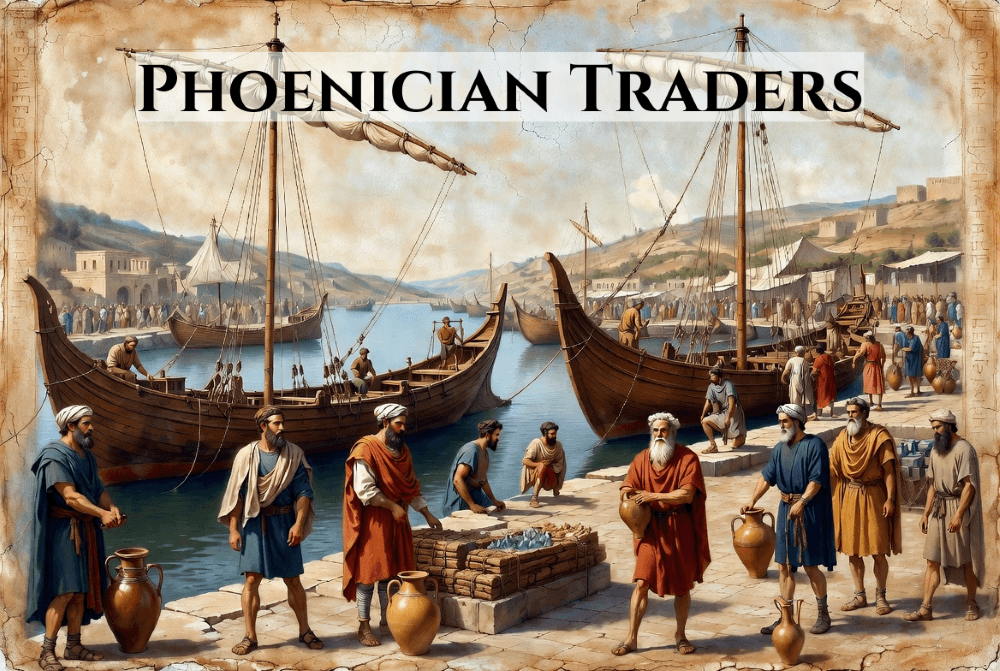
If Egypt showed the power of state-run trade, Phoenician traders showed what private enterprise could accomplish across an entire sea. Operating from city-states like Tyre, Sidon, and Byblos between roughly 1500 and 300 BC, the Phoenicians became the most skilled merchants and sailors of the ancient Mediterranean world.
This is the fourth article in our history of entrepreneurship series. Unlike Egypt’s centralized model, Phoenician traders operated more like independent, profit-driven businesses — arguably the closest thing the ancient world had to a true merchant economy.

Mediterranean Trade: Building a Business Empire by Sea
Phoenicia itself was small, squeezed along a narrow strip of coastline in modern-day Lebanon. With limited farmland, the Phoenicians had one clear path to wealth: trade.
Phoenician traders turned this geographic limitation into an advantage by dominating Mediterranean trade almost entirely.
1. A Network of Colonies and Trading Posts
Rather than relying only on their home ports, the Phoenicians expanded outward.
- They founded colonies across the Mediterranean, including Carthage in North Africa
- These colonies functioned as trading hubs, not just settlements
- Each outpost extended their reach into new markets and resources
2. Goods That Built Their Reputation
Phoenician traders became known for specific, high-value goods that were difficult to source elsewhere.
- Purple dye (Tyrian purple) – extracted from murex sea snails, extremely expensive and associated with royalty
- Cedar wood – harvested from Lebanon’s forests and sold across the region
- Glassware – Phoenicians were early pioneers in glassmaking techniques
- Metals – tin, silver, and copper sourced from as far away as modern Spain and Britain
3. A Truly International Marketplace
Phoenician ports became meeting points for goods and cultures from across the ancient world.
- Egyptian, Greek, and Mesopotamian goods all passed through Phoenician hands
- Merchants acted as middlemen, profiting from connecting distant markets
- This made Phoenicia less a single economy and more a trading network
The Alphabet: Commerce’s Most Underrated Invention
While Sumerians had cuneiform, the Phoenicians created something far simpler and more portable: an alphabet built for speed and practicality.
Why the Alphabet Mattered for Trade
Earlier writing systems, like cuneiform and hieroglyphics, required years to master. The Phoenician alphabet used around 22 simple characters representing sounds instead of ideas.
- Merchants could learn it quickly, without formal scribal training
- Trade records, contracts, and shipping logs became faster to produce
- It spread easily through trade contacts across the Mediterranean
From Phoenicia to the World
This alphabet didn’t just help Phoenician traders — it changed communication permanently.
- The Greeks adapted it into their own alphabet
- The Latin alphabet, used in English today, descends from that same root
- A tool built largely for business ended up shaping global literacy
Maritime Commerce: Mastering the Sea
None of this trade would have been possible without serious advances in ships and navigation. Phoenician traders were, above all, exceptional sailors.
1. Advanced Shipbuilding
Phoenician shipbuilders designed vessels specifically for long-distance trade.
- Sturdy merchant ships capable of carrying heavy cargo
- Faster galley ships for both trade and defense
- Techniques that influenced Greek and later Mediterranean shipbuilding
2. Navigation Without Modern Tools
Sailing far from shore required serious skill and courage.
- Phoenician sailors used star navigation, particularly the North Star
- They developed detailed knowledge of coastlines and currents
- Some accounts suggest Phoenician sailors ventured beyond the Mediterranean into the Atlantic
3. Risk and Reward on the Open Sea
Maritime trade was dangerous, but the rewards justified the risk.
- Ships carried valuable cargo across unpredictable waters
- Losses from storms or piracy were a constant business risk
- Successful voyages could bring enormous profit, funding further expansion
This willingness to take on real financial risk for potential reward is one of the clearest early parallels to modern entrepreneurship.
Why Phoenician Traders Matter in Entrepreneurship History
The Phoenicians combined nearly everything we associate with early business today.
- Private enterprise, largely independent of any single centralized state
- Innovation (the alphabet) that reduced friction in doing business
- Calculated risk-taking through maritime ventures
- Expansion into new markets through colonies and trading posts
In many ways, Phoenician traders looked more like a modern trading company than any civilization before them.
FAQ: Phoenician Traders and Ancient Commerce
What made Phoenician traders different from Egyptian or Sumerian merchants? Phoenician traders operated with more independence than Egypt’s state-controlled system, functioning closer to private enterprise while still building on Sumerian ideas of contracts and records.
Why is the Phoenician alphabet considered important to commerce? It was simple enough for merchants to learn quickly, making record-keeping and communication far more efficient than earlier writing systems, and it eventually became the basis for the Greek and Latin alphabets.
What were the most valuable goods traded by the Phoenicians? Tyrian purple dye, cedar wood, glassware, and metals like tin and silver were among their most valuable and sought-after trade goods.
Did the Phoenicians only trade within the Mediterranean? Mostly, yes, but some evidence suggests Phoenician sailors ventured beyond it, potentially reaching the Atlantic coast of Europe and Africa in search of resources like tin.
Previous History of Entrepreneurship posts