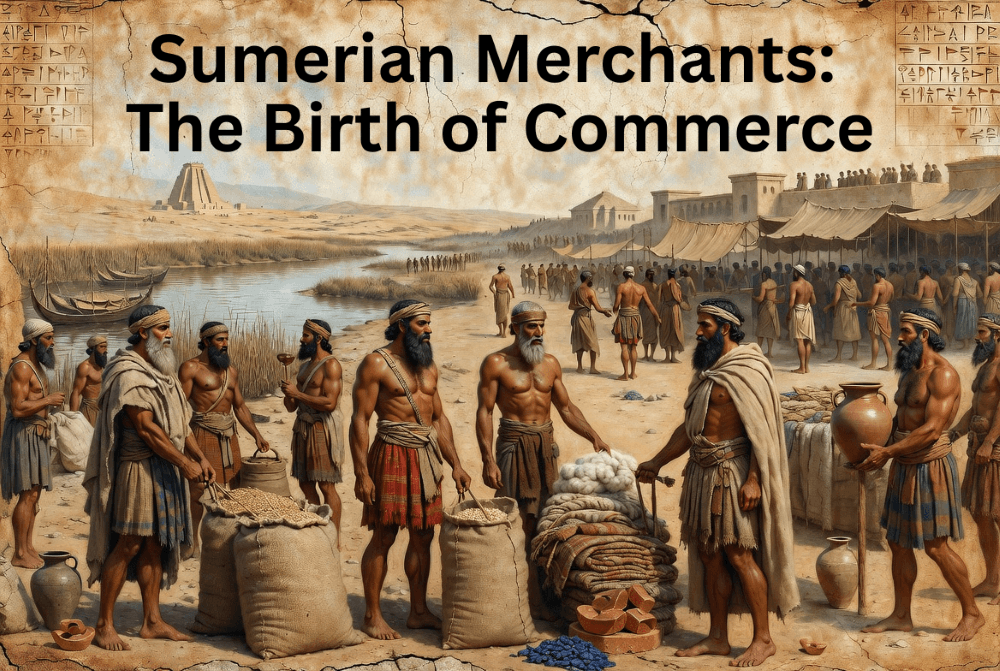
If prehistoric humans planted the seed of trade, Sumerian merchants were the ones who turned it into an actual system. Between roughly 3000 and 55 BC, the fertile land between the Tigris and Euphrates rivers gave rise to something the world had never seen: organized commerce.
This is the second article in our series on the history of entrepreneurship. Where our last piece explored barter and trust before writing existed, this one looks at the moment trade grew up — with contracts, credit, and professional traders working for profit.
Why Sumerian Merchants Changed Everything
Sumer, located in southern Mesopotamia, was home to some of the first cities on Earth, including Uruk, Ur, and Lagash. These cities needed resources they didn’t have — timber, metal, and stone — and Sumerian merchants were the ones who went out and got them.
Unlike earlier barter-based exchange, Sumerian trade was organized, recorded, and increasingly professional. This shift didn’t happen by accident. It was driven by three major innovations.
1. Writing Made Trade Trackable
Around 3200 BC, the Sumerians developed cuneiform, one of the earliest writing systems in the world. It wasn’t invented for literature or law — it was invented largely for business.
- Clay tablets recorded transactions, debts, and inventories
- Merchants could track shipments over long distances
- Disputes could be settled by referencing a written record instead of memory
2. Cities Created Surplus and Demand
Farming in the Fertile Crescent produced more grain than any single family needed. That surplus fed cities, and cities created specialized workers who no longer farmed at all.
- Potters, weavers, and metalworkers needed raw materials
- Temples and palaces needed luxury goods to display power
- None of these materials existed locally, so merchants filled the gap
3. Credit and Contracts Emerged
Perhaps the most important shift was financial. Sumerians developed early forms of credit, interest, and formal agreements — concepts still central to commerce today.
- Loans of silver or grain were recorded with repayment terms
- Interest rates were often standardized by custom or law
- Contracts specified quantities, prices, and delivery expectations
What Did Sumerian Merchants Actually Trade?
Mesopotamia was rich in farmland but poor in raw materials, which made trade a necessity, not a luxury.
- Grain and textiles – exported to neighboring regions
- Timber – imported from Lebanon and the Zagros mountains
- Copper and tin – imported from Anatolia and the Persian Gulf, essential for bronze
- Precious stones like lapis lazuli – imported from as far away as Afghanistan
- Silver – used increasingly as a measure of value, a precursor to money
How Sumerian Merchants Operated
Sumerian commerce wasn’t a free-for-all. It operated within a structured system involving temples, palaces, and independent traders.
- Temple and palace trade – large institutions financed expeditions and controlled major resources
- Independent merchants (damkar) – professional traders who bought, sold, and traveled on behalf of themselves or investors
- Long-distance trade routes – networks connected Mesopotamia to the Indus Valley, Anatolia, and the Persian Gulf
- Risk-sharing agreements – early forms of partnership, where investors funded a trip in exchange for a share of profit
This last point matters. A merchant fronting capital for a trading voyage, in exchange for a cut of the profits, is a direct ancestor of the modern business partnership.
The First Entrepreneurs?
It’s tempting to call Sumerian merchants the first entrepreneurs, and in many ways, that label fits. They took on risk, sought profit, negotiated deals, and operated within a system of contracts and accountability.
- They specialized in a trade rather than farming
- They financed ventures using borrowed capital
- They built reputations that affected their ability to do future business
The tools were clay tablets instead of spreadsheets, but the underlying logic of commerce was already in place.
FAQ: Sumerian Merchants and Ancient Commerce
What made Sumerian merchants different from earlier traders? Sumerian merchants operated within a written, legal, and financial system, using contracts, credit, and standardized records instead of informal barter and trust alone.
Did the Sumerians invent money? Not exactly. They didn’t use coined money, but they used silver by weight as a standard measure of value, which functioned similarly to currency in trade and loans.
What did Sumer import and export? Sumer exported grain and woven textiles, and imported materials it lacked, such as timber, copper, tin, and precious stones like lapis lazuli.
Why is writing connected to the history of commerce? Cuneiform writing developed largely to track business transactions, debts, and trade records, making it one of the earliest tools built specifically for commerce.
Previous History of Entrepreneurship posts