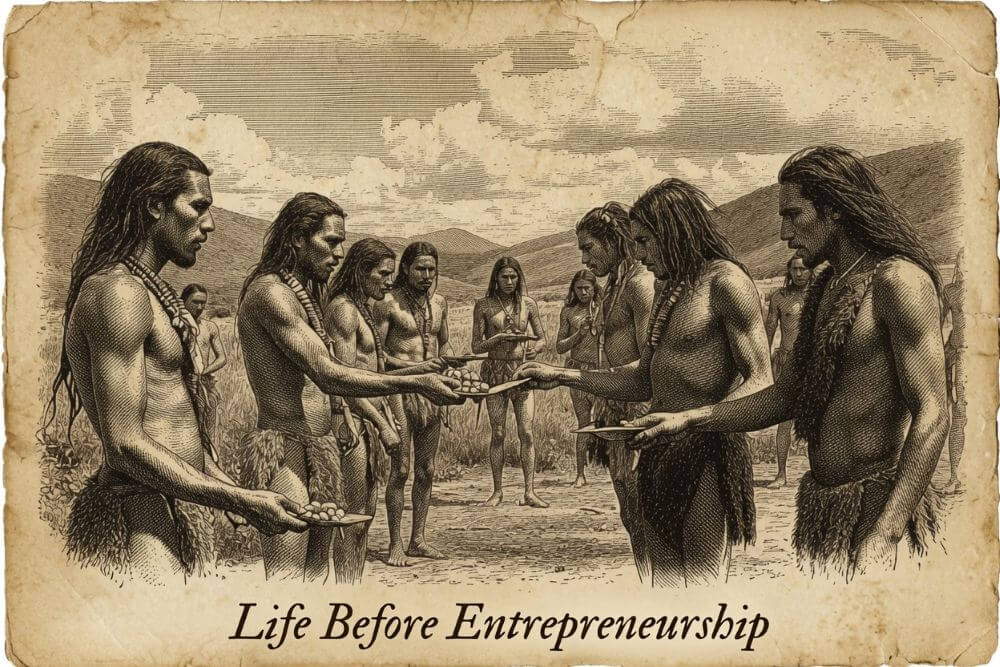
When we think of entrepreneurship, we picture startups, storefronts, and stock markets. But prehistoric trade existed thousands of years before any of that. Between 10,000 and 3000 BC, humans were already exchanging goods, ideas, and materials across vast distances — without money, contracts, or a single written record.
This period, stretching from the dawn of the Neolithic Revolution to the rise of the first cities, laid the groundwork for everything we now call “the economy.” Understanding it helps us see just how deep the human instinct to trade really runs.
Was There Trade Before Entrepreneurship Existed?
Yes — and it was more sophisticated than most people assume. Archaeological evidence shows that prehistoric trade networks stretched hundreds, even thousands, of miles.
There were no entrepreneurs in the modern sense. No businesses, no branding, no profit motive as we understand it today. But there was exchange, and exchange is the seed from which entrepreneurship eventually grew.
What People Actually Traded
Early humans didn’t have much, but what they had, they moved:
- Obsidian – a volcanic glass prized for sharp tools, traded from sources like Anatolia and the Greek island of Melos across the Mediterranean and Near East
- Flint – another toolmaking stone, exchanged between neighboring groups
- Seashells – found far inland, evidence that coastal communities traded with people who never saw the ocean
- Amber – carried from the Baltic region into Central Europe
- Salt – essential for preserving food, especially once agriculture took hold
- Livestock and grain – once farming spread after roughly 9000 BC
Life Before Entrepreneurship: A Different Kind of Economy
Before the concept of entrepreneurship, survival — not profit — drove every decision. People produced what their group needed, and surplus, when it existed, became the basis for exchange.
1. Hunter-Gatherer Exchange (10,000–8000 BC)
Small, mobile bands moved with the seasons. Trade was rare but real, often tied to:
- Gift-giving between allied groups to build trust
- Marriage alliances that came with material exchange
- Trading tools or materials not locally available
2. The Agricultural Shift (8000–5000 BC)
The Neolithic Revolution changed everything. Once people settled to farm, they produced more food than they could eat.
- Surplus grain could be stored and traded
- Villages specialized — some raised animals, others grew crops
- Barter became more structured, though still informal
3. Early Craft Specialization (5000–3000 BC)
By this stage, some people began focusing on a single skill: pottery, weaving, toolmaking, or metalworking.
- This is the closest thing to “proto-entrepreneurship” in the prehistoric world
- Skilled crafters could trade their goods for food or materials
- Trade routes became more established and predictable
How Did People Trade Without Money?
Money as we know it didn’t exist until roughly 3000–2000 BC, with early forms appearing in Mesopotamia. So how did prehistoric trade actually work?
- Direct barter – swapping one good for another
- Reciprocity – giving now with the expectation of receiving later
- Redistribution – a chief or elder collected goods and redistributed them within the community
- Trust networks – trade often happened between groups with existing social or family ties
There was no currency, no receipts, and no legal enforcement. Trust and reputation did the work that contracts do today.
Why This Matters for Understanding Entrepreneurship
Modern entrepreneurship didn’t appear out of nowhere. It evolved from this same basic human behavior: identify a need, find or make something to fill it, and exchange it for something else of value.
- Prehistoric humans practiced specialization — a core entrepreneurial principle
- They built trade networks — the ancestors of supply chains
- They relied on reputation and trust — still the foundation of business today
The tools changed. The instinct didn’t.
FAQ: Prehistoric Trade and Early Human Economy
Was there really trade before writing was invented? Yes. Writing didn’t appear until around 3200 BC in Mesopotamia, but trade goods like obsidian and shells have been found thousands of miles from their origin, dating back over 10,000 years.
What was the first thing humans traded? It’s hard to know for certain, but tool-grade stones like flint and obsidian are among the earliest confirmed trade goods, since they were essential for survival and not available everywhere.
Did prehistoric people use money? No. Early economies relied on barter, reciprocity, and redistribution. Recognizable forms of money didn’t emerge until around 3000–2000 BC.
When did trade start to resemble entrepreneurship? Craft specialization between roughly 5000 and 3000 BC is often seen as the closest early parallel, when individuals began producing goods specifically to exchange rather than only for personal use.