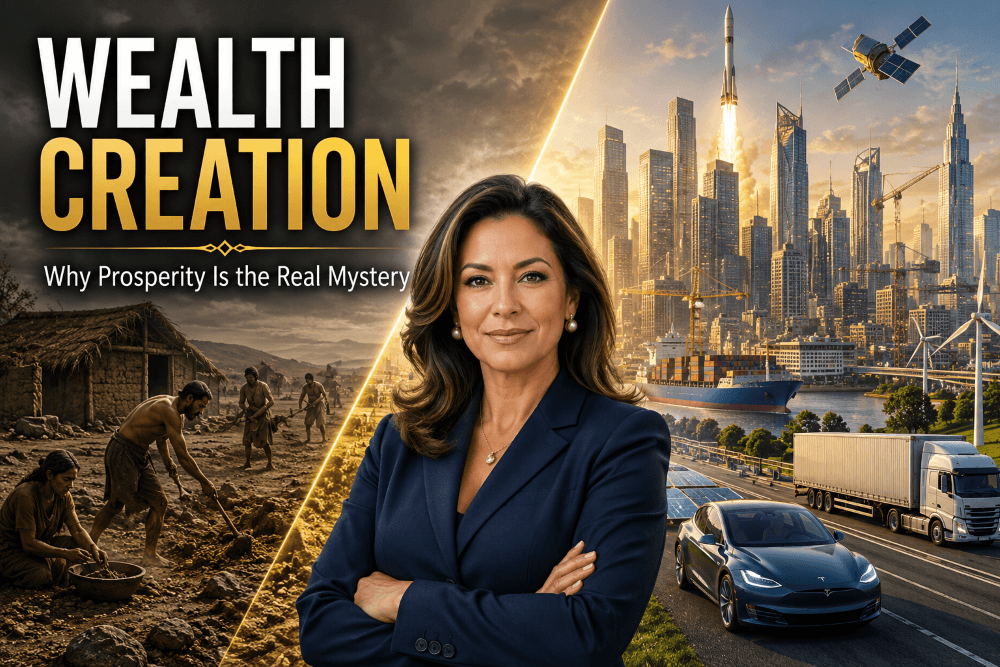
When people discuss economic inequality, they often begin with the assumption that wealth creation is easy and poverty is the great mystery that demands explanation. But history suggests exactly the opposite.
For nearly all of human history, poverty was the normal condition of mankind. Every civilization, every nation, and every family began with very little. The real puzzle is not why some people are poor. The real puzzle is why some societies—and some individuals—become prosperous.
Understanding wealth creation changes how we think about economics, public policy, and social progress.
Poverty Is Humanity’s Default Condition
Modern people often think of poverty as a problem created by society.
Historically, however, poverty existed long before governments, corporations, or modern economic systems. Early humans struggled simply to find enough food to survive. There were no billionaires because there was almost no wealth.
The question isn’t:
“Why are some people poor?”
The more interesting question is:
“How did anyone become wealthy in the first place?”
Every innovation, every business, every technological breakthrough has been part of the answer.
Wealth Creation Is the Real Economic Miracle
What creates prosperity?
Prosperity doesn’t appear by accident.
Throughout history, societies that became wealthy generally shared several characteristics:
- Strong protection of private property
- Respect for contracts and the rule of law
- Free markets and competition
- Entrepreneurship
- Innovation
- Investment
- Education and specialization
These factors allow people to create products and services that others voluntarily buy.
That is wealth creation.
It isn’t merely transferring money from one pocket to another. It is increasing the total amount of value available in society.
Why Intellectuals Often Focus on Distribution
Many intellectuals devote enormous attention to how wealth should be distributed.
Far less attention is given to understanding how wealth is created in the first place.
This distinction matters.
If society only debates how to divide wealth while ignoring the conditions that produce it, eventually there is less wealth available for everyone.
Economist Thomas Sowell has frequently argued that economics should begin by recognizing scarcity. Wealth is not nature’s default condition. It must continually be produced.
Without ongoing wealth creation, there is nothing to distribute.
Margaret Thatcher’s Famous Observation
One of the most memorable exchanges in modern political history came from former British Prime Minister Margaret Thatcher.
Responding to critics who emphasized income redistribution, she said:
“They would rather have the poor poorer, provided the rich were less rich.”
Her point was not that inequality is always desirable.
Her argument was that reducing wealth at the top does not automatically improve life at the bottom.
If policies discourage entrepreneurship, investment, and innovation, society may end up producing less wealth overall, leaving fewer resources for jobs, wages, healthcare, education, and social services.
The objective should not simply be to make successful people less successful.
The objective should be to help more people become successful.
The Elon Musk Debate
Few modern entrepreneurs generate as much debate as Elon Musk.
Critics frequently point to his enormous personal fortune as evidence of excessive inequality.
Supporters counter that his wealth largely reflects companies that millions of customers voluntarily support.
Whether one admires or dislikes Musk personally is almost beside the point.
The more important economic question is this:
Did his companies create value?
Tesla accelerated investment in electric vehicles.
SpaceX dramatically reduced launch costs and expanded access to space.
Neuralink, Starlink, and xAI continue attracting investment because people believe they may solve important problems.
These companies employ tens of thousands of workers directly and support many more through suppliers and contractors.
When critics say, “No one should have that much money,” they may be asking the wrong question.
A better question is:
Did that wealth result from creating products and services that improved other people’s lives?
If the answer is yes, then the existence of great wealth may simply be evidence that enormous value was created first.
Wealth Is Not a Fixed Pie
One of the biggest misconceptions in economics is that wealth is fixed.
It isn’t.
If wealth were fixed, every billionaire would necessarily make everyone else poorer.
History tells a different story.
Over the past two centuries:
- Global poverty has fallen dramatically.
- Average life expectancy has doubled.
- Child mortality has collapsed.
- Literacy has expanded worldwide.
- Access to technology has become nearly universal.
These improvements happened because economies became dramatically more productive.
More wealth was created.
Why Wealth Creation Benefits Everyone
Economic growth produces benefits that extend far beyond entrepreneurs.
Growing economies typically create:
- Better-paying jobs
- Lower-cost products
- Greater innovation
- Higher tax revenues
- Better funding for public services
- More opportunities for upward mobility
A society that encourages wealth creation is not simply helping investors.
It is creating the conditions under which millions of ordinary people can improve their standard of living.
Final Thoughts
Poverty does not require a complicated explanation.
It has been humanity’s natural condition for thousands of years.
Prosperity is the exception.
Instead of asking only how wealth should be distributed, we should spend far more time asking how wealth is created—and how public policies can encourage more of it.
A growing economy generates opportunities that redistribution alone cannot.
If we truly want fewer people living in poverty, understanding the principles of wealth creation may be one of the most important conversations we can have.
Frequently Asked Questions
What is wealth creation?
Wealth creation is the process of producing goods, services, technologies, and investments that increase economic value and improve living standards.
Why do economists say poverty is the default condition?
For most of human history, nearly everyone lived in extreme poverty. Modern prosperity is a relatively recent development made possible by innovation, trade, and economic growth.
Does wealth creation increase inequality?
It can. However, wealth creation can also raise living standards across society by creating jobs, improving products, and increasing productivity. Many economists argue that the key question is whether everyone is becoming better off, not whether incomes are perfectly equal.
Can governments encourage wealth creation?
Yes. Stable institutions, secure property rights, predictable regulations, sound legal systems, competitive markets, and investment in education all help create an environment where businesses and individuals can innovate and grow.