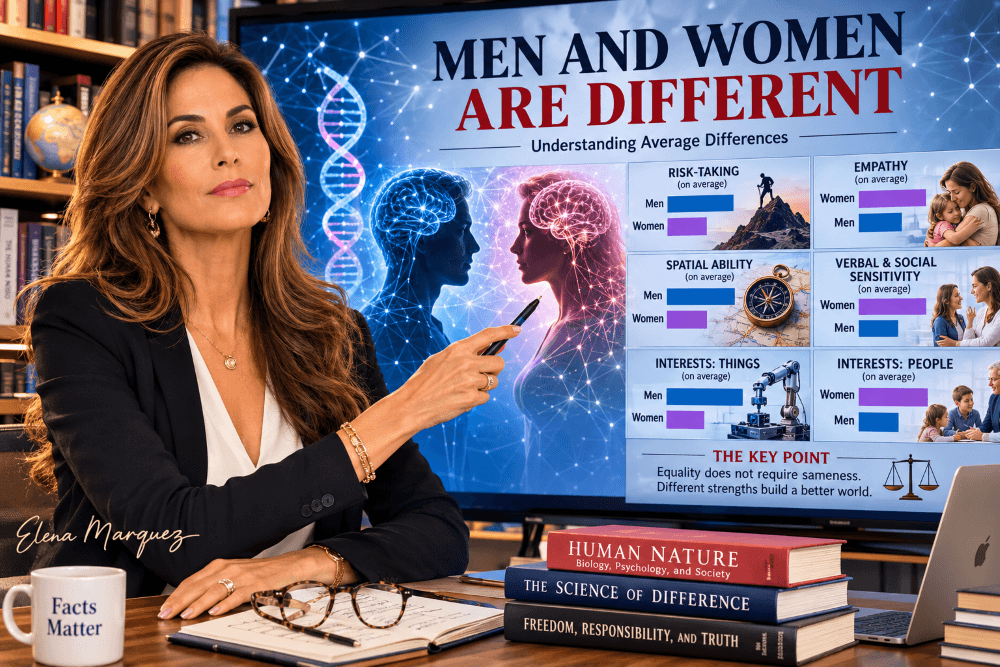
Men and women are different, not only physically but also, on average, in certain interests, emotional tendencies, personality traits, and patterns of behavior.
Saying this should not be controversial. It does not mean that every man behaves one way or every woman behaves another way. It certainly does not mean that one sex is more valuable than the other.
Men and women deserve equal dignity, equal legal rights, and equal opportunities. But equality does not require us to pretend that the sexes are psychologically or biologically interchangeable.
Men and Women Are Different on Average
Discussions about sex differences often become unnecessarily hostile because two separate ideas are confused.
The first is equality: men and women should have the same fundamental rights and should be judged as individuals.
The second is sameness: men and women supposedly possess identical interests, temperaments, and behavioral tendencies.
We should strongly defend the first idea without being required to accept the second.
Scientific research frequently deals in averages. An average difference does not tell us what a particular person can or cannot accomplish.
There are highly nurturing men, highly aggressive women, female engineers, male nurses, female founders, and stay-at-home fathers. Individual variation is enormous, and the distributions of male and female traits overlap considerably.
Nevertheless, overlap does not mean that average differences disappear.
Can Gender-Neutral Parenting Eliminate Sex Differences?
Some feminists and social theorists argue that boys and girls would behave almost identically if parents raised them in a completely gender-neutral environment.
Parents and culture unquestionably influence children. Adults may encourage rough play in boys while rewarding quiet or nurturing behavior in girls. Advertising, peer pressure, expectations, and role models also matter.
But it is difficult to explain every difference through socialization alone.
A systematic review and meta-analysis combining 75 studies found large average differences in boys’ and girls’ preferences for traditionally gendered toys. Boys showed greater interest in boy-associated toys, while girls showed greater interest in girl-associated toys.
Other research has reported signs of sex-linked visual preferences during infancy, although researchers continue to debate how biology, parental influence, and social learning interact.
In everyday life, many parents observe that boys are, on average, more attracted to:
- Rough-and-tumble play
- Climbing and physical challenges
- Vehicles, machines, and moving objects
- Competition and risk
- Play fighting
Girls are often more attracted to:
- Dolls and caregiving play
- Role-playing and social scenarios
- Communication-centered activities
- Relationships and interpersonal interaction
- Cooperative forms of play
These are tendencies, not rules. A girl who loves trucks is no less female, and a boy who enjoys caring for dolls is no less male.
Children should be free to explore their interests. But freedom also means accepting that, even without rigid pressure from adults, boys and girls may not choose identical things.
Do Women Read Feelings While Men Read Maps?
The familiar saying that “women read feelings and men read maps” is an oversimplification, but it points toward measurable average differences.
Women often perform somewhat better on tasks involving emotional recognition, verbal fluency, and interpersonal sensitivity. Men often perform better on certain spatial tasks, particularly mental rotation.
This does not mean that men lack empathy or that women cannot navigate. It means that slightly different averages may emerge when researchers study large populations.
One of the clearest findings concerns vocational interests. A major meta-analysis found that men were, on average, more interested in working with things, while women were more interested in working with people. The difference on the people-versus-things dimension was substantial.
This distinction may help explain why men remain more heavily represented in areas such as mechanical engineering and certain technology fields, while women are more heavily represented in education, health care, psychology, and other people-focused professions.
Discrimination can affect occupational outcomes. But preferences matter too, and treating every unequal outcome as proof of injustice prevents an honest investigation.
Risk, Aggression and the Male Distribution
Men are generally more willing to accept physical and financial risk. They also account for far more serious physical violence and dangerous behavior.
This male inclination has two very different sides.
At its best, it can produce:
- Exploration
- Invention
- Entrepreneurship
- Physical courage
- Competition
- Willingness to challenge existing systems
At its worst, the same disposition can produce:
- Recklessness
- Violence
- Crime
- Destructive competition
- Extremely foolish decisions
In other words, men are disproportionately represented at both positive and negative extremes.
The male who refuses to accept conventional limits may become an explorer, scientist, entrepreneur, or inventor. Another male with a similar appetite for excitement may take senseless risks and damage his own life.
Recognizing this pattern is not male worship. It is an acknowledgment that traits can produce benefits in one context and serious harm in another.
Men’s Role in Innovation and Civilization
Commentator Heather Mac Donald has made the provocative argument that it is not accidental that men have historically dominated exploration, invention, science, and political institution-building.
Men circumnavigated the globe, led much of the Scientific Revolution, developed machines, established companies, and spent generations trying to understand and control the physical world.
Men were also central to the development of constitutional government, due process, and modern political philosophy.
However, this history requires context.
For much of recorded history, women were excluded from universities, professional organizations, property ownership, voting, and political leadership. Therefore, the fact that most historically recognized scientists and political leaders were male cannot, by itself, prove that women lacked the capacity or desire to contribute.
A fair conclusion must recognize both realities:
- Men may be more strongly represented at the extremes of competitiveness, risk tolerance, and obsessive technical interest.
- Women’s historical opportunities were often severely restricted.
We should be capable of acknowledging male achievement without pretending women had always competed under equal conditions.
We should also recognize extraordinary women—from Marie Curie and Ada Lovelace to countless modern scientists, political leaders, and entrepreneurs—without using exceptional examples to deny population-level patterns. My favorite female politecal leader is Margaret Thatcher.
Are Men Naturally More Entrepreneurial?
Men continue to start businesses at higher rates globally, although the difference varies considerably by country.
Global Entrepreneurship Monitor data for 2024 showed that approximately one in eight men and one in ten women started new businesses. At the same time, women reached or exceeded parity among innovation-oriented startups in 18 of the 51 countries studied. Check out female entrepreneurs in this blog: Allison Ellsworth and Luana Lopes Lara.
Entrepreneurship demands qualities that are, on average, more common among men:
- Comfort with uncertainty
- High risk tolerance
- Intense competition
- Confidence that may exceed actual ability
- Willingness to sacrifice stability
- Obsessive focus on a single project
The stereotypical founder who stays awake until 3 a.m. writing code and eating cold pizza reflects a real type of obsessive commitment. Men may be disproportionately represented among people willing to structure their entire lives around such a gamble.
But we should not claim that absolutely no barriers confront female entrepreneurs.
Women can encounter smaller professional networks, family responsibilities, industry stereotypes, and difficulties obtaining investment in some markets. Those factors can coexist with average differences in risk preferences and career interests.
The credible position is not that biology explains everything or that discrimination explains everything.
Both individual preferences and social conditions influence who starts companies, what kinds of companies they build, and how those companies are financed.
Women also build businesses in fields that reflect their interests. Beauty, fashion, wellness, education, media, and social influence are legitimate industries, not inferior forms of entrepreneurship.
My own Self Made series has highlighted successful female entrepreneurs. Their accomplishments deserve recognition precisely because individuals should never be reduced to a statistical average.
Sex Differences and Political Values
In the United States, men currently lean more Republican, while women lean more Democratic. Pew Research Center’s surveys conducted from 2020 through 2025 found a 12-point gender gap in party affiliation: men were more likely to identify with Republicans and women with Democrats.
This gap may partly reflect differences in priorities.
Women, on average, may place greater emphasis on:
- Care and social protection
- Security
- Harm prevention
- Cooperation
- Community support
Men, on average, may place greater emphasis on:
- Competition
- Autonomy
- Hierarchy
- Individual liberty
- Resistance to control
These differences can also appear in debates over campus speech.
A 2019 Knight Foundation survey found that 71% of male college students prioritized protecting free speech, while 58% of female students prioritized an inclusive society. A more recent survey found that most male and female students supported free speech, although male students were more likely to express the strongest level of support.
This should not be turned into the crude claim that women oppose free speech. The evidence suggests a difference in how some men and women balance expression against inclusion and protection from harm.
That distinction deserves discussion rather than insult.
Equality Does Not Require Identical Outcomes
A free society should remove unjust barriers and allow people to pursue their abilities.
But once people are free to choose, we should not automatically expect every occupation, political party, academic field, or leadership position to contain equal numbers of men and women.
Different outcomes can result from several forces operating together:
- Biological predispositions
- Personality and temperament
- Cultural expectations
- Family responsibilities
- Economic incentives
- Individual interests
- Historical and present-day barriers
An unequal outcome is not automatic proof of discrimination. Neither is it automatic proof of biological destiny.
It is a question to investigate.
Difference Is Not Inferiority
The most important principle is simple: difference does not establish superiority.
Traits associated more frequently with men can produce invention, courage, and economic progress—but also violence, irresponsibility, and social instability.
Traits associated more frequently with women can produce empathy, social cohesion, communication, and nurturing—but can also create excessive caution or an unwillingness to tolerate conflict, and in many cases, suicidal empathy. In general, woment oppose the deportation of dangerous criminals due to their suicidal empathy.
A functioning civilization needs both sets of strengths.
Men and women are not opposing political teams. We are partners in families, workplaces, communities, and societies.
We do not need to erase our differences to respect one another. We need enough maturity to recognize averages without stereotyping individuals—and enough honesty to follow evidence even when it challenges our preferred ideology.
Frequently Asked Questions
Are all men and women psychologically different?
No. Scientific findings describe group averages, not every individual. Many men possess traits more common among women, and many women possess traits more common among men.
Are gender differences caused by biology or society?
Most researchers consider both biology and socialization important. Hormones, evolution, parenting, culture, education, and individual experience can all influence behavior.
Does recognizing sex differences justify discrimination?
No. Average differences should never be used to deny a qualified individual an opportunity. People should be evaluated according to their abilities and conduct.
Would gender-neutral parenting eliminate differences?
It might reduce some learned stereotypes, but current evidence does not demonstrate that it would eliminate all average differences in play, interests, risk-taking, or temperament.