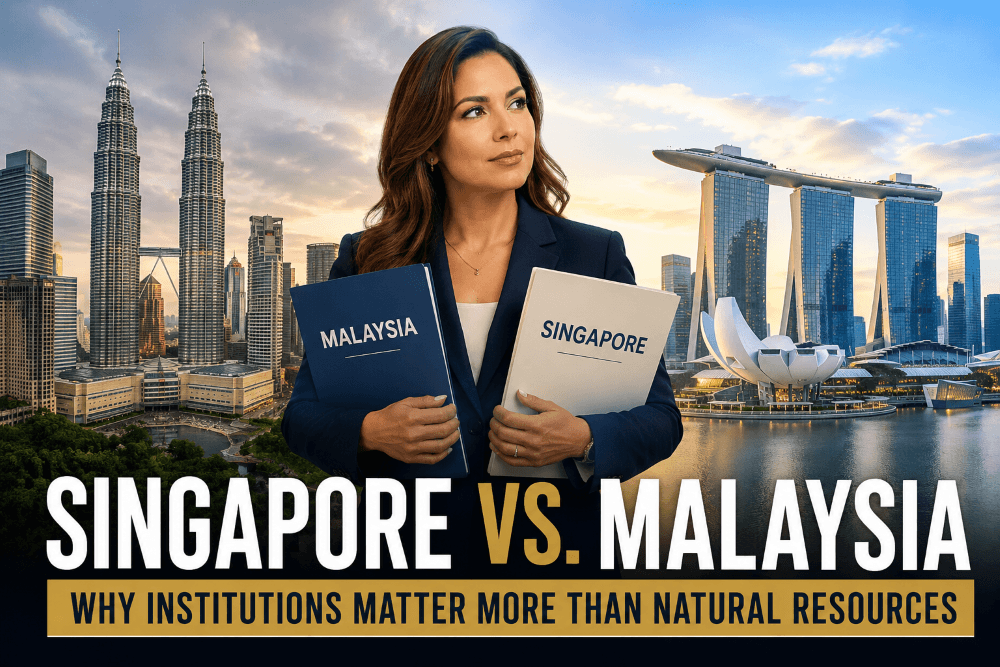
In the story of Singapore vs Malaysia, few comparisons in modern history are as fascinating. Two neighboring countries shared a colonial past, similar cultures, and close economic ties. Yet over the past six decades, one became one of the wealthiest nations on Earth, while the other remains a middle-income country with tremendous potential but a much lower standard of living.
Many people explain the difference by saying Singapore embraced free markets while Malaysia relied on government intervention. While there is some truth to that idea, the real story is more nuanced—and, in my opinion, far more interesting.
The lesson isn’t that government should disappear. The lesson is that the quality of a country’s institutions matters more than the quantity of its natural resources.
Singapore vs Malaysia: Two Nations, One History

Singapore and Malaysia share more than just a border.
Both were part of the British colonial empire. Singapore joined the Federation of Malaysia in 1963, but political disagreements led to its separation just two years later, in 1965.
When Singapore became independent, few observers believed it had a bright future.
The tiny island had:
- No oil.
- Very little farmland.
- Almost no natural resources.
- A population divided by ethnicity and language.
- Limited fresh water.
- A land area smaller than many cities.
Malaysia, by contrast, possessed abundant advantages.
It had:
- Large reserves of oil and natural gas.
- Rich deposits of tin and other minerals.
- Vast agricultural land.
- A much larger domestic market.
- Considerably more territory to develop.
If someone had been forced to bet in 1965 which country would become richer, many would likely have chosen Malaysia.
History had other plans.
Institutions Matter More Than Natural Resources
Natural resources can certainly make a country wealthier.
Countries rich in oil, gas, or minerals often enjoy large export revenues. However, history repeatedly shows that resources alone do not guarantee prosperity.
Economists sometimes refer to this as the “resource curse.”
Countries blessed with abundant resources can become overly dependent on them, while neglecting entrepreneurship, innovation, education, and competitive industries.
Meanwhile, countries with few natural resources often have no choice but to invest in their people.
Singapore became an extraordinary example of this principle.
Rather than asking, “What resources do we have?” its leaders asked a different question:
“How can we become the best place in Asia to do business?”
That simple change in thinking transformed the country’s future.

What Singapore Did Differently
Singapore’s success was not the result of a single policy.
Instead, it consistently built institutions that encouraged long-term investment, productivity, and trust.
Among its most important strengths were:
Rule of Law
Businesses thrive when contracts are enforced fairly.
Investors are more willing to build factories, create jobs, and invest capital when they know the legal system is predictable and impartial.
Singapore earned an international reputation for respecting property rights and enforcing contracts consistently.
Meritocracy
One of Singapore’s defining principles has been meritocracy.
The government sought to recruit talented individuals into the civil service regardless of ethnic background. Promotions in many areas emphasized competence and performance.
No system is perfect, but rewarding ability rather than political connections creates stronger institutions over time.
Fighting Corruption
Corruption acts like an invisible tax.
Every bribe increases costs, discourages investment, and rewards political influence instead of innovation.
Singapore became known for maintaining one of the least corrupt governments in the world through strong enforcement, competitive public-sector salaries, and strict accountability.
That reputation helped attract multinational companies looking for a stable place to invest.
Openness to Global Trade
Unlike countries that attempted to isolate themselves behind high tariffs and protectionist policies, Singapore embraced international trade.
Its world-class port became one of the busiest shipping hubs on the planet.
Global companies established regional headquarters there because they could efficiently reach markets across Asia.
Trade did not merely create wealth—it created opportunities for millions of people.
Fiscal Discipline
Singapore generally avoided the temptation to finance government spending through excessive borrowing or persistent deficits.
Long-term fiscal discipline increased investor confidence and helped preserve economic stability through multiple global crises.
Strong finances may not generate exciting headlines, but they create an environment where businesses can confidently plan decades into the future.
Malaysia Chose a Different Path
Malaysia’s economic story is not one of failure. In fact, the country has made remarkable progress since independence.
Millions of Malaysians have escaped poverty, infrastructure has improved dramatically, and the country has become an important manufacturing hub in Southeast Asia. Compared to many developing nations, Malaysia has performed well.
However, when compared directly with Singapore, a different picture emerges.
Following the tragic ethnic riots of 1969, the Malaysian government introduced the New Economic Policy (NEP) in 1971. Its objectives were understandable: reduce poverty and create greater economic opportunities for the ethnic Malay majority, known as the Bumiputera.
The policy included measures such as:
- Preferential access to government contracts.
- University admission quotas.
- Corporate ownership targets.
- Various forms of affirmative action in business and education.
Supporters argue these policies helped reduce inequality and expand the Malay middle class.
Critics argue they also discouraged investment, encouraged political favoritism, and reduced the incentive to compete purely on merit.
Reasonable people can disagree about the balance between fairness and economic efficiency. What is difficult to dispute is that Singapore’s economy grew substantially faster over the same period.
Singapore Was Not a Pure Free-Market Economy
One common misconception is that Singapore became wealthy simply because it embraced laissez-faire capitalism.
That isn’t entirely true.
Singapore’s government has always played an active role in the economy.
For example, it:
- Owns much of the country’s land.
- Invests through state-owned entities such as Temasek Holdings.
- Provides extensive public housing.
- Requires mandatory retirement savings through the Central Provident Fund.
- Plans long-term infrastructure decades in advance.
These are significant government interventions.
Yet they differ from interventions designed to protect politically connected groups or shield businesses from competition.
Singapore generally used government to strengthen markets rather than replace them.
It encouraged competition, welcomed foreign investment, maintained relatively low taxes, enforced contracts, and kept corruption under tight control.
The lesson is not that government should be large or small.
The lesson is that government should be competent, predictable, and focused on creating conditions where productive people can succeed.
Why Institutions Matter
Economists have debated the causes of prosperity for generations.
Today, there is broad agreement on several characteristics that successful economies tend to share:
- Strong property rights.
- Honest and efficient public institutions.
- Independent courts.
- High-quality education.
- Openness to trade.
- Stable monetary and fiscal policies.
- Low levels of corruption.
These institutions encourage investment because businesses can make long-term decisions with confidence.
When entrepreneurs know that success depends on serving customers instead of cultivating political connections, innovation flourishes.
That principle applies not only to countries but also to cities, companies, and even families.
Lessons for Investors
As an investor, I often think about countries the same way I think about businesses.
When evaluating a company, I don’t simply ask whether it has valuable assets. I ask whether management allocates capital wisely.
The same question applies to nations.
Natural resources can generate wealth, but institutions determine whether that wealth is invested productively or wasted.
Countries that protect property rights, encourage entrepreneurship, maintain stable policies, and reward competence tend to attract talent and capital from around the world.
Those advantages compound over decades, just like investment returns.
Final Thoughts
The comparison between Singapore and Malaysia is not about declaring winners and losers.
Malaysia has achieved impressive economic progress and continues to develop. Singapore, meanwhile, faces its own challenges, including an aging population, high housing costs, and dependence on global trade.
But the contrast between these neighbors offers an important lesson.
Prosperity is not guaranteed by geography.
It is not guaranteed by natural resources.
It is not guaranteed by good intentions.
Long-term prosperity is built on institutions that reward hard work, encourage innovation, enforce the rule of law, and create confidence that tomorrow’s investments will be protected.
Countries cannot choose their geography.
They can choose the quality of their institutions.
History suggests that choice makes all the difference.
Frequently Asked Questions
1. Why is Singapore richer than Malaysia?
Singapore benefited from strong institutions, low corruption, openness to international trade, stable economic policies, and a focus on meritocracy. Malaysia has also experienced significant growth, but its policy choices and institutional development followed a different path.
2. Did Singapore succeed because of free markets alone?
No. Singapore combines market-friendly policies with an active government. The state plays an important role in housing, infrastructure, retirement savings, and strategic investments while maintaining a competitive business environment.
3. What was Malaysia’s New Economic Policy?
Introduced in 1971, the New Economic Policy sought to reduce poverty and increase economic participation among the Bumiputera population through affirmative-action measures in education, business, and government contracts.
4. What is the biggest lesson from Singapore vs Malaysia?
The comparison suggests that long-term prosperity depends less on natural resources and more on strong institutions, good governance, low corruption, and policies that encourage investment, entrepreneurship, and innovation.