| 📊 Alain’s Holdings — July 7, 2026 | ||||
|---|---|---|---|---|
| Symbol | Name | Price | Change | Change % |
| VOO | Vanguard S&P 500 ETF | 687.08 | -3.54 | -0.51% |
| QQQ | Invesco QQQ Trust | 709.43 | -13.39 | -1.85% |
| XIU.TO | iShares S&P/TSX 60 ETF | 52.56 | +0.28 | +0.54% |
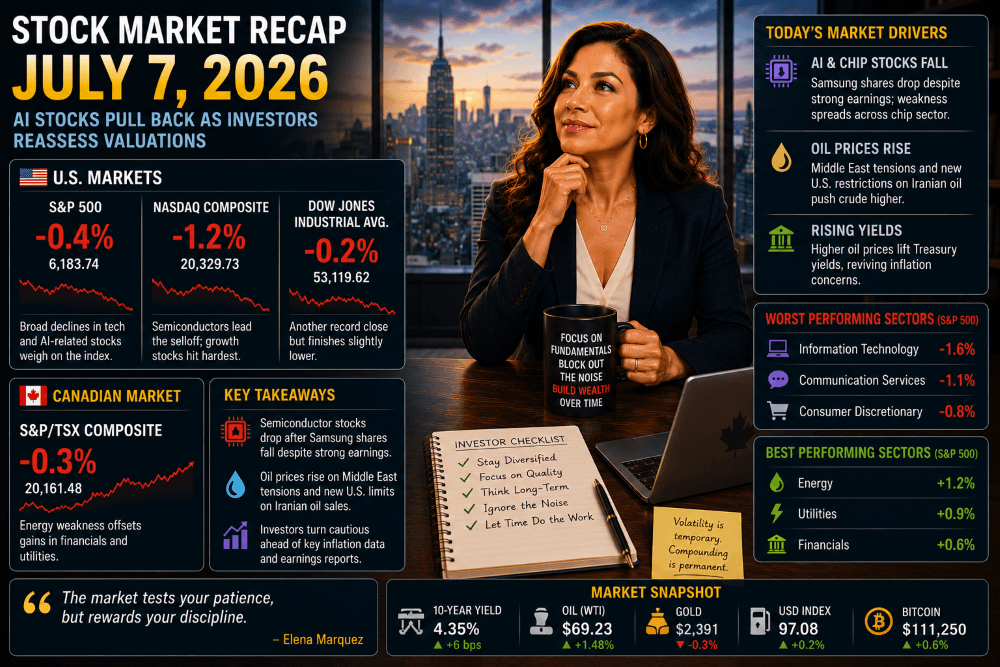
Wall Street pulled back Tuesday as renewed concerns about the artificial intelligence trade weighed heavily on semiconductor stocks, reminding investors that even the strongest bull markets experience periods of profit-taking.
The S&P 500 fell 0.4%, the Nasdaq Composite dropped 1.2%, and the Dow Jones Industrial Average slipped 0.2%. Despite the declines, most stocks in the S&P 500 actually finished higher—the weakness was concentrated in a handful of large technology and AI-related companies.
The catalyst came overnight from Asia.
Although Samsung Electronics reported another exceptionally strong quarter, its shares fell sharply as investors questioned whether expectations for AI chipmakers have become too optimistic. The weakness quickly spread across global semiconductor stocks, with companies such as Micron Technology, AMD, and Intel also declining.
Another factor weighing on sentiment was rising oil prices.
Crude oil climbed after reports of attacks on vessels near the Strait of Hormuz and new U.S. restrictions on Iranian oil sales. Higher energy prices pushed Treasury yields higher and revived concerns that inflation could prove more persistent than investors had hoped.
Despite today’s selloff, the broader picture remains encouraging.
The AI revolution is far from over.
Rather, the market is becoming increasingly demanding.
Investors are no longer willing to pay any price simply because a company is associated with artificial intelligence.
Instead, they are asking tougher questions:
- Can this company generate sustainable profits?
- Does it have a durable competitive advantage?
- Can earnings justify today’s valuation?
Those are healthy questions.
Every major technological revolution eventually moves from excitement to execution.
That transition can create volatility, but it also creates opportunities for disciplined, long-term investors who focus on business fundamentals instead of daily headlines.
Other Stock Market blog posts