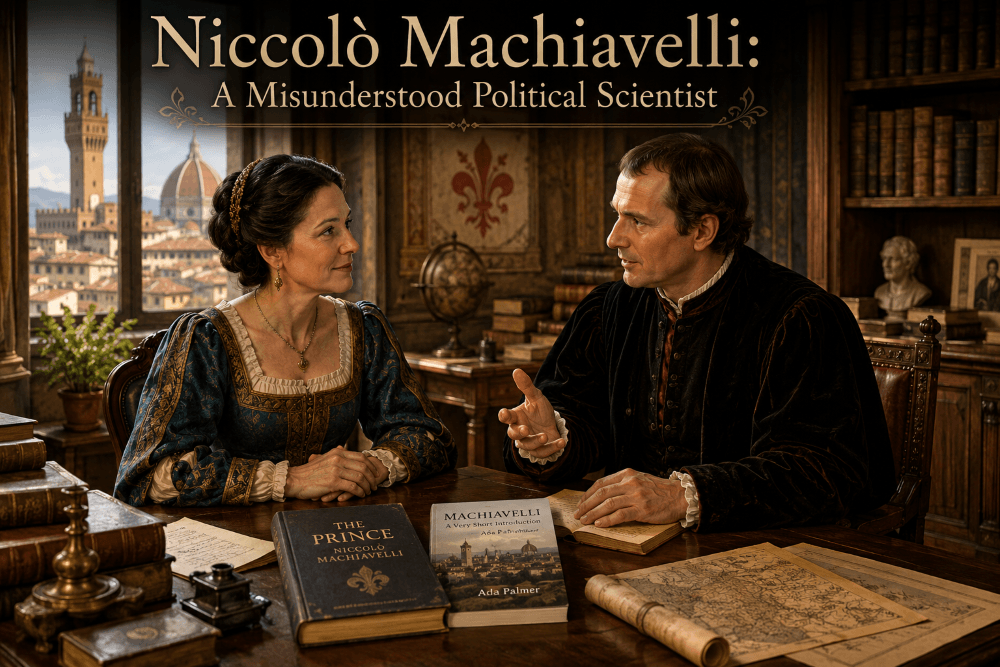
For centuries, Machiavelli has been portrayed as history’s greatest villain. Mention his name, and many people immediately think of deception, manipulation, and ruthless ambition. The word Machiavellian has become synonymous with dishonesty and the pursuit of power at any cost.
But what if nearly everything we’ve been taught about Machiavelli is wrong?
After lots of reading, I realized that the Florentine thinker may be one of the most misunderstood intellectuals in history. Far from encouraging people to become immoral, Machiavelli was attempting something much more radical: he wanted readers to understand how politics actually works rather than how we wish it worked.
That distinction matters just as much today as it did five hundred years ago.
Whether you’re running a business, investing your savings, or trying to understand world events, one of the most valuable habits you can develop is the ability to distinguish reality from wishful thinking.
Machiavelli Was a Realist, Not a Villain
Niccolò Machiavelli lived during one of the most unstable periods in Italian history.
Florence, Venice, Milan, the Papal States, and Naples competed for power while foreign armies from France and Spain repeatedly invaded the Italian peninsula. Governments rose and fell with astonishing speed. Alliances shifted constantly. Political leaders who made poor decisions often lost not only their offices but also their freedom—or their lives.
Machiavelli wasn’t writing from the comfort of a university classroom. He spent years working as a diplomat for the Republic of Florence, negotiating with kings, popes, generals, and princes. He observed power firsthand.
His greatest contribution wasn’t inventing ruthless politics.
It was describing the political world as he saw it.
The Real Lesson of Machiavelli
One of the reasons The Prince shocked readers was that Machiavelli refused to pretend that leaders always have ideal choices.
He asked difficult questions.
What should a ruler do when every available option is bad?
How do you protect an entire country from invasion?
What happens when your enemies ignore every moral rule?
These questions remain relevant today.
Imagine a firefighter entering a burning building. Breaking down a family’s front door causes damage, but it may also save lives. Likewise, a military commander may have to choose between two terrible options, hoping to minimize suffering rather than eliminate it entirely.
Machiavelli wasn’t celebrating hard decisions.
He was acknowledging that they exist.
Too often, critics confuse explaining reality with approving of it.
Describing Reality Isn’t the Same as Endorsing It
This misunderstanding extends far beyond Machiavelli.
Economists are often accused of supporting greed simply because they study incentives.
Scientists are sometimes criticized for explaining human behavior, as though explanation automatically implies approval.
Investors who acknowledge that markets fluctuate are occasionally accused of being pessimists.
But describing how something works is not the same as saying it is morally desirable.
A doctor who studies cancer isn’t promoting cancer.
An engineer who studies bridge failures isn’t encouraging bridges to collapse.
Likewise, Machiavelli studied political power because understanding it was essential to preserving freedom and stability.
Ignoring unpleasant realities doesn’t make them disappear.
Why Entrepreneurs Should Read Machiavelli
Although The Prince is usually classified as a political book, many of its lessons apply remarkably well to entrepreneurship.
Business owners face uncertainty every day. Markets change. Competitors emerge. Technology disrupts entire industries. Customer preferences evolve faster than ever.
Successful entrepreneurs share one important characteristic with Machiavelli:
They observe reality before making decisions.
Instead of asking, “How should customers behave?” they ask, “How do customers actually behave?”
Instead of assuming employees, investors, or competitors will always act according to ideals, they study incentives, habits, and observable facts.
The marketplace rewards people who understand reality.
It often punishes those who ignore it.
Investors Already Think Like Machiavelli
Long-term investing offers another useful example.
The stock market doesn’t reward optimism alone.
It rewards investors who accept reality—even when reality is uncomfortable.
Markets experience recessions.
Companies fail.
Technologies become obsolete.
Economic cycles come and go.
Successful investors don’t pretend these events won’t happen.
Instead, they prepare for them.
That’s one reason I’ve spent decades investing in broad market index funds rather than trying to predict tomorrow’s headlines. I don’t know what the market will do next week, next month, or even next year.
What I do know is that history consistently rewards those who understand reality, stay patient, and avoid making emotional decisions based on short-term events.
In many ways, that’s a very Machiavellian approach—not cynical, but realistic.
Machiavelli in the Age of AI
If Machiavelli were alive today, I suspect he would be fascinated by artificial intelligence.
Not because AI is inherently good or bad, but because it is changing the balance of power in business, politics, and society.
Some people insist AI will destroy civilization. Others claim it will solve every human problem.
Machiavelli would likely reject both extremes.
Instead, he would ask practical questions.
- Who benefits?
- Who loses?
- What incentives are being created?
- How should leaders prepare for the changes that are coming?
That approach is remarkably modern.
Rather than reacting emotionally, he would study the evidence and adapt accordingly.
It’s the same mindset successful entrepreneurs use when a disruptive technology appears. They don’t waste time wishing the old world would return. They learn, adapt, and look for opportunities.
The Danger of Living in an Imaginary World
One of the greatest mistakes leaders make is confusing the world they wish existed with the world that actually exists.
Businesses fail when executives ignore changing consumer preferences.
Governments fail when policymakers ignore economic incentives.
Investors lose money when they assume markets will always move in one direction.
History is full of examples where reality eventually defeated ideology.
Machiavelli’s enduring lesson is that facts don’t care about our preferences.
Reality always has the final word.
A Lesson Beyond Politics
I think we should see Machiavelli as a serious observer rather than a cartoon villain.
That distinction matters.
Many influential thinkers have suffered the same fate.
Adam Smith is often remembered as the apostle of greed, despite writing extensively about morality and human sympathy.
Charles Darwin is frequently blamed for ideas he never advocated.
Milton Friedman is often caricatured without people reading what he actually wrote.
Now add Machiavelli to that list.
Perhaps the greatest lesson isn’t about politics at all.
It’s about intellectual humility.
Before rejecting an idea, read the original source.
Before accepting popular opinion, ask whether it accurately represents the evidence.
The internet rewards quick judgments.
Wisdom requires curiosity.
The World Needs More Realists
Calling someone “Machiavellian” has become an easy insult.
But after learning more about the man himself, I think we’ve done him an injustice.
He wasn’t encouraging cruelty.
He wasn’t celebrating deception.
He wasn’t writing a handbook for tyrants.
He was trying to understand one of humanity’s oldest questions:
How do societies survive in an imperfect world?
That’s a question every business owner, investor, politician, and citizen still faces today.
The best decisions are rarely made by people who ignore reality.
They’re made by people who see reality clearly, understand human nature, and then act with wisdom, courage, and prudence.
Five hundred years after his death, Machiavelli still has something valuable to teach us—not about becoming ruthless, but about becoming better observers of the world around us.
And in an era overflowing with opinion but often short on careful thinking, that’s a lesson worth remembering.
Frequently Asked Questions
Was Machiavelli really evil?
No. Modern historians increasingly view Machiavelli as a realist rather than an advocate for cruelty. He described how political power operates in practice, which is different from endorsing every action taken by rulers.
Why is Machiavelli misunderstood?
Much of Machiavelli’s reputation comes from later interpretations of The Prince. Over time, the word “Machiavellian” became associated with manipulation, overshadowing his broader contributions to political thought and his deep concern for the stability of Florence.
What can entrepreneurs learn from Machiavelli?
Entrepreneurs can learn the importance of understanding reality, adapting to changing circumstances, studying incentives, protecting their reputation, and making decisions based on evidence rather than wishful thinking.
Is The Prince still worth reading today?
Absolutely. Whether or not you agree with every conclusion, The Prince remains one of history’s most influential books on leadership, strategy, and human behavior. Reading it alongside modern historical scholarship provides a richer understanding than relying on its popular reputation alone.