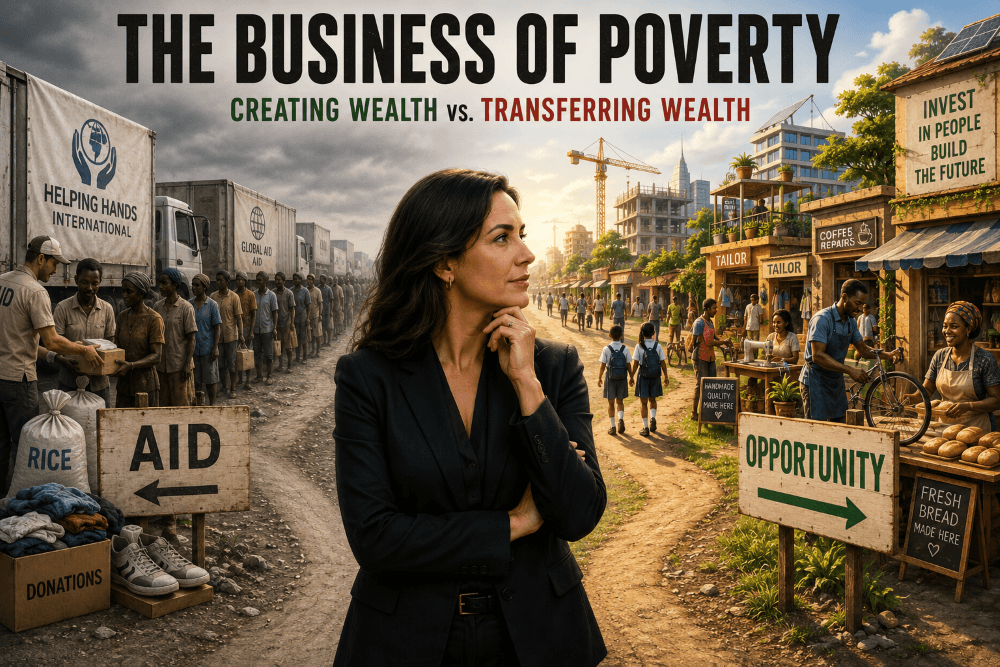
For decades, wealthy countries, charities, and international organizations have spent hundreds of billions of dollars trying to eliminate poverty. The intentions are admirable. Most people who donate money or volunteer their time genuinely want to improve the lives of others.
Yet The Business of Poverty raises an uncomfortable question: What if some forms of aid are actually making poverty harder to escape?
This idea is explored powerfully in the documentary Poverty, Inc., which argues that poverty has, in many ways, become an industry. Like every industry, it creates incentives. Unfortunately, those incentives do not always align with the interests of the people aid is intended to help.
The issue is not whether helping people is good. It certainly is. The real question is whether our methods actually produce long-term prosperity.
The Business of Poverty and the Incentive Problem
Every organization responds to incentives.
Businesses seek customers. Universities recruit students. Hospitals treat patients. Governments expand programs. Non-governmental organizations (NGOs) raise donations.
None of this is inherently wrong.
However, if an NGO’s funding depends on demonstrating that poverty continues to exist, what incentive does it have to declare its mission accomplished?
This does not mean the people working in these organizations have bad intentions. Most are deeply compassionate and genuinely committed to helping others. But good intentions cannot overcome poorly designed incentives.
The result can be an industry whose survival depends on the continuation of the very problem it seeks to solve.
Creating Wealth vs. Transferring Wealth
Economic development comes from creating wealth, not transferring wealth.
History repeatedly demonstrates this principle.
Countries that successfully escaped widespread poverty did not do so because they received endless aid. They built economies capable of creating jobs, producing goods, attracting investment, and encouraging entrepreneurship.
Examples include:
- South Korea
- Taiwan
- Singapore
- Vietnam
Each followed its own path, but they shared several important characteristics:
- Protection of private enterprise
- Investment in education
- Expansion of manufacturing
- Participation in global trade
- Stable institutions
- Opportunities for entrepreneurs
Prosperity was created through production, innovation, and investment—not permanent dependence on foreign aid.
When Charity Destroys Local Businesses
Sometimes generosity produces unintended consequences.
Imagine a village where local entrepreneurs manufacture shoes.
Several small businesses employ local workers, purchase leather from nearby suppliers, and sell affordable footwear within their community.
Now imagine a charity arrives and distributes 20,000 free pairs of shoes every year.
At first glance, this seems wonderful.
But what happens next?
The local shoe stores lose customers.
Factories reduce production.
Workers lose their jobs.
Entrepreneurs stop investing.
Eventually, the community becomes dependent on the next shipment of free shoes.
Ironically, one of the most famous examples came from TOMS Shoes. While the company’s “One for One” model inspired millions of consumers, it also sparked criticism from development economists who argued that flooding local markets with free imported shoes could undermine local manufacturers and retailers.
Helping consumers while eliminating local producers is rarely a recipe for lasting prosperity.
The Missing Ingredient: Entrepreneurs
Every wealthy country was once poor.
What changed?
Entrepreneurs.
Entrepreneurs identify problems, invest capital, create businesses, hire workers, pay taxes, and produce goods and services that improve people’s lives.
Foreign aid rarely creates this ecosystem.
Instead, long-term prosperity depends on institutions that allow ordinary people to build businesses without excessive corruption, unnecessary regulation, or weak property rights.
The greatest anti-poverty program ever invented is not charity.
It is entrepreneurship.
A Lesson Beyond Foreign Aid
The incentive problem is not unique to international development.
It appears wherever large organizations depend financially on solving social problems while simultaneously relying on those same problems for continued funding.
Consider the ongoing debate surrounding homelessness in California.
Billions of dollars have been spent over many years, yet many residents believe the visible crisis has not improved proportionally. This has prompted increasing scrutiny over how funds are allocated, whether programs are producing measurable outcomes, and whether existing institutions have sufficient incentives to prioritize lasting solutions.
The comparison is not perfect—homelessness and international development involve different challenges—but both illustrate an important economic lesson: funding alone does not guarantee results. Without accountability and incentives that reward successful outcomes, spending can grow while the underlying problem persists.
The Earthquake in Venezuela is an exeption
It is important to distinguish between emergency humanitarian relief and long-term economic development. The devastating twin earthquakes that struck Venezuela on June 24, 2026, killing thousands of people, injuring many more, and destroying billions of dollars’ worth of homes, hospitals, roads, and other critical infrastructure, are exactly the kind of tragedy that calls for an overwhelming international response. Search-and-rescue teams, doctors, engineers, food, clean water, temporary shelter, and financial assistance can save lives and help communities begin the difficult process of rebuilding. Providing emergency aid in the aftermath of a natural disaster is not only justified—it is a moral responsibility. The concerns raised in this article are directed not at disaster relief, but at long-term development programs that can unintentionally create dependency or undermine local entrepreneurship. The goal of emergency assistance should always be to help people recover so they can once again build businesses, create jobs, invest in their communities, and become economically self-sufficient.
Compassion Requires Results
None of this means we should stop helping people.
Emergency relief after earthquakes, wars, famines, or other disasters saves lives.
Public health campaigns have dramatically reduced diseases in many parts of the world.
These successes deserve recognition.
But emergency assistance is different from permanent economic development.
If our goal is to eliminate poverty, we should ask whether our efforts create independence or dependence.
The objective should never be to build a larger aid industry.
The objective should be to make that industry unnecessary.
Conclusion
Helping people is one of humanity’s greatest virtues.
But compassion alone is not enough.
We should judge anti-poverty programs not by the size of their budgets or the sincerity of their intentions, but by whether they leave communities stronger, more productive, and less dependent than before.
The greatest gift we can offer poor communities is not perpetual assistance.
It is the freedom, opportunity, and institutions that allow people to create wealth for themselves.
When people can build businesses, own property, invest, trade, and innovate, poverty becomes far more difficult to sustain.
That is how nations become prosperous.
And that is how the business of poverty eventually comes to an end.
Frequently Asked Questions
Does foreign aid always make poverty worse?
No. Emergency humanitarian aid and many public health programs have saved millions of lives. The criticism is aimed at forms of long-term aid that may unintentionally discourage local economic development or create dependency.
What is the main message of Poverty, Inc.?
The documentary argues that poverty has become an industry in which aid organizations can develop incentives that do not always align with creating lasting economic independence.
Why is entrepreneurship important for reducing poverty?
Entrepreneurs create jobs, invest capital, produce goods and services, and generate economic growth that allows communities to become self-sufficient over time.
What is the difference between creating wealth and transferring wealth?
Creating wealth involves producing new value through work, investment, innovation, and business creation. Transferring wealth simply redistributes existing resources without necessarily increasing a country’s productive capacity.