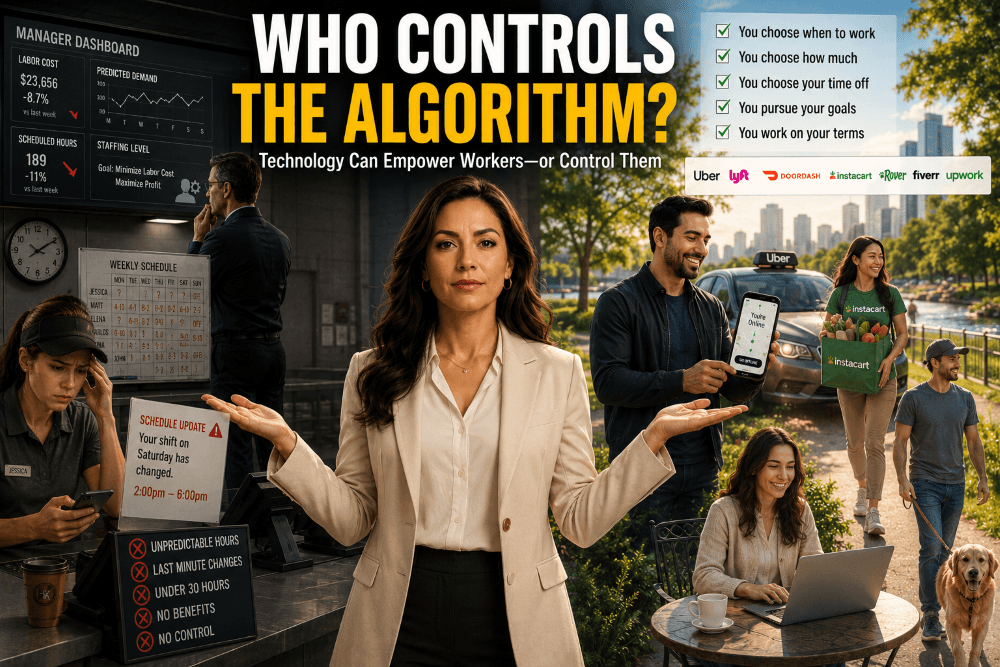
Politicians often portray the gig economy as a battle between good employers and bad employers. They argue that companies such as Uber exploit workers by classifying them as independent contractors instead of employees. According to this narrative, the solution is simple: force Uber drivers to become employees, and their problems disappear.
I was an Uber driver once, and I was very happy to be an independent worker. I would have not worked for Uber as an employee. I used to choose my hours and I even choose whether I wanted work or not. Obviously, I choose the hours that payed the most and didn’t work the hours that payed the least.
The debate, however, misses a far more important question.
The real issue isn’t whether someone receives a W-2 or works as an independent contractor. The real issue is who controls the algorithm.
Technology itself isn’t good or bad. Algorithms can be designed to concentrate power in the hands of managers, or they can be designed to give workers greater freedom and control over their own lives.
Those are two completely different visions of algorithmic management.
Algorithmic Management Is Here to Stay
Whether we like it or not, algorithms now determine much of our working lives.
Artificial intelligence forecasts customer demand, predicts staffing needs, assigns deliveries, sets prices, monitors productivity, and even recommends hiring and firing decisions.
The question is no longer whether technology should manage labor.
It already does.
The important question is whether technology serves the company alone—or whether it also serves the worker.
Two Very Different Types of Algorithmic Management
There are two fundamentally different approaches.
Model 1: Manager-Centered Algorithms
The first model is designed almost exclusively to maximize company profits.
Workers receive instructions.
Managers receive information.
The algorithm analyzes customer demand, predicts labor requirements, and schedules employees at the lowest possible labor cost.
Its objectives include:
- minimizing idle time
- reducing payroll expenses
- increasing productivity
- keeping labor costs predictable
- maximizing shareholder returns
From a business perspective, these are rational goals.
The problem is that the worker has almost no control over the process.
The algorithm decides.
Model 2: Worker-Centered Algorithms
The second model also uses sophisticated algorithms.
But instead of simply directing workers, it provides them with information that allows them to make their own decisions.
Ride-sharing and digital marketplaces illustrate this approach.
Drivers can decide:
- whether to work today
- how many hours to work
- whether to work mornings or evenings
- whether to accept a ride
- when to stop working
The platform still coordinates millions of transactions.
But the worker retains agency.
The algorithm becomes a tool rather than a supervisor.
That is a profound difference.
Flexibility Is a Benefit—Not a Bug
Critics often describe flexibility as a lack of security.
Yet for millions of workers, flexibility is exactly what they value most.
Imagine an Uber driver who wants to earn extra money before taking a two-week vacation.
The driver might choose to work sixty hours one week.
The following week, they work zero.
No permission required.
No manager needs to approve vacation days.
No supervisor decides whether the request fits the company’s staffing needs.
The worker decides.
That level of autonomy barely exists in traditional hourly employment.
For students, retirees, artists, caregivers, entrepreneurs, and parents, that flexibility can be worth more than many traditional employment benefits.
Traditional Employment Isn’t Always Stable
Political debates often compare gig work with an idealized version of full-time employment.
Reality looks very different.
Many hourly workers in retail, restaurants, hospitality, and other service industries experience unpredictable schedules.
Instead of receiving a consistent forty-hour workweek, employees may discover their schedule only a few days in advance.
One week they work thirty-two hours.
The next week twenty-one.
The following week thirty-eight.
Their income fluctuates.
Their childcare becomes difficult to arrange.
Planning a second job becomes nearly impossible.
Scheduling medical appointments becomes complicated.
Ironically, these workers often have far less control over their time than many independent contractors.
The Invisible Algorithms Inside Retail and Fast Food
Most consumers never see the software running behind the scenes.
Large retailers and restaurant chains increasingly rely on sophisticated scheduling systems.
These systems forecast customer traffic almost minute by minute.
If sales are expected to slow between 2:00 p.m. and 4:00 p.m., fewer workers are scheduled.
If demand unexpectedly rises, additional workers may be asked to come in.
If demand falls, workers may be sent home early.
The software is doing exactly what it was designed to do.
Its purpose is to optimize labor costs.
Not to optimize workers’ lives.
The Difference Is Who Receives the Information
This is where the distinction becomes important.
In many traditional workplaces:
- the algorithm knows everything
- management sees everything
- employees see almost nothing
Workers simply receive a schedule.
They rarely know why it changed.
They cannot negotiate with the software.
They cannot choose alternative shifts based on market demand.
They simply comply.
The algorithm serves management.
Not them.
That isn’t a criticism of technology.
It’s a criticism of how the technology has been designed.
Why the Political Debate Misses the Point
When lawmakers discuss the future of work, companies such as Uber, Lyft, DoorDash, Instacart, and similar platforms often become political targets.
The criticism usually follows the same script.
Independent contractors lack benefits.
They don’t receive paid vacation.
They don’t have employer-sponsored health insurance.
Therefore, the argument goes, the solution is to convert them into traditional employees.
But this approach assumes that traditional employment automatically gives workers greater control over their lives.
In many cases, it doesn’t.
Millions of hourly employees are already managed by algorithms that optimize labor costs with little regard for worker preferences. Their schedules can change from week to week—or even day to day—making it difficult to arrange childcare, attend school, hold a second job, or simply plan their lives.
The technology is remarkably similar.
The difference lies in who controls it.
Agency Is a Form of Compensation
Public debates tend to measure compensation only in dollars and benefits.
But people value more than money.
Many workers place enormous value on having control over their own schedules.
Agency has economic value.
The freedom to decide when to work allows people to:
- pursue an education
- care for children or aging parents
- build another business
- earn additional income during busy periods
- take time off without requesting permission
- adapt their work to changing life circumstances
These advantages are difficult to measure on a paycheck, but they are real.
For many workers, flexibility is not a consolation prize.
It is the primary reason they choose independent work. It’s the primary reason why I used to work for Uber, flexibility and autonomy.
The Best Technology Empowers People
History shows that technology can either concentrate power or distribute it.
The internet gave individuals the ability to publish without owning a newspaper.
Online investing allowed ordinary people to buy stocks without calling a broker.
GPS technology gave drivers information that was once available only to professional dispatchers.
The same principle applies to labor markets.
Technology should give workers better information, not merely better supervision.
Imagine if every employee had access to the same demand forecasts that managers see.
Instead of waiting for next week’s schedule, workers could volunteer for shifts, trade hours with coworkers, or plan weeks in advance based on expected demand.
Rather than making workers passive recipients of management decisions, technology could transform them into active participants.
That is a far more exciting vision of the future of work.
A Better Goal Than Eliminating Gig Work
The objective should not be to eliminate independent contracting.
Nor should it be to force every worker into the same employment model.
Different people have different needs.
A university student may prefer maximum flexibility.
A parent raising young children may value control over working hours more than guaranteed overtime.
A retiree may only want to work ten hours a week.
Others may prefer the stability of a traditional full-time job.
A healthy labor market should allow people to choose the arrangement that best fits their lives.
Technology makes that possible.
The challenge is ensuring that technology expands choice rather than limiting it.
The Future of Algorithmic Management
Artificial intelligence will continue to reshape the workplace.
Algorithms will become better at forecasting demand, matching workers with opportunities, optimizing logistics, and improving productivity.
That trend is inevitable.
The policy debate should therefore move beyond the outdated distinction between employee and independent contractor.
Instead, we should ask better questions.
- Does the worker have meaningful control over their schedule?
- Can workers see the information used to make scheduling decisions?
- Can they accept or decline work without punishment?
- Can they increase or decrease their hours according to their own needs?
- Does technology increase their freedom or reduce it?
These questions are far more important than the tax form a worker receives.
Technology Should Create Freedom
Too often, discussions about artificial intelligence focus on what technology takes away.
We should also ask what it can give us.
The best technology doesn’t simply make companies more efficient.
It makes people more capable.
It gives individuals access to information that was once reserved for managers.
It reduces dependence on gatekeepers.
It increases opportunity.
The future of work should not be built around algorithms that merely tell people what to do.
It should be built around algorithms that help people make better decisions for themselves.
That is the difference between technology that controls workers and technology that empowers them.
And that is the debate we should be having.
Conclusion
The future of work is not a choice between employees and independent contractors. It is a choice between two philosophies of technology.
One philosophy uses algorithms to centralize power, optimize labor costs, and maximize efficiency for the employer.
The other uses algorithms to provide information, increase flexibility, and give workers greater control over their own lives.
Technology itself is neutral.
Its impact depends on how we choose to design it.
Rather than asking whether algorithms should manage work, policymakers should ask who benefits from those algorithms.
If technology is truly transforming the labor market, its greatest achievement should not be making managers more powerful.
It should be giving workers more freedom.
Frequently Asked Questions
Is algorithmic management only used by gig economy companies?
No. Algorithmic management is increasingly used across retail, restaurants, warehouses, call centers, logistics, healthcare, and manufacturing. Many traditional employers use software to forecast demand, assign shifts, and monitor productivity.
Why do some workers prefer gig economy jobs?
Many workers value flexibility more than a fixed schedule. Independent contracting allows them to choose when, where, and how much they work, making it attractive for students, caregivers, retirees, and entrepreneurs. Alain Guillot was once an Uber drive and loved the flexibility and autonomy.
Are traditional employees always better protected?
Traditional employment often provides benefits such as paid leave and unemployment insurance. However, many hourly employees still experience unpredictable schedules and limited control over their working hours. The level of worker autonomy varies widely by employer.
What is the biggest challenge of algorithmic management?
The central challenge is ensuring that algorithms enhance productivity without removing worker autonomy. The most effective systems improve efficiency while giving workers greater transparency, flexibility, and control over their schedules.