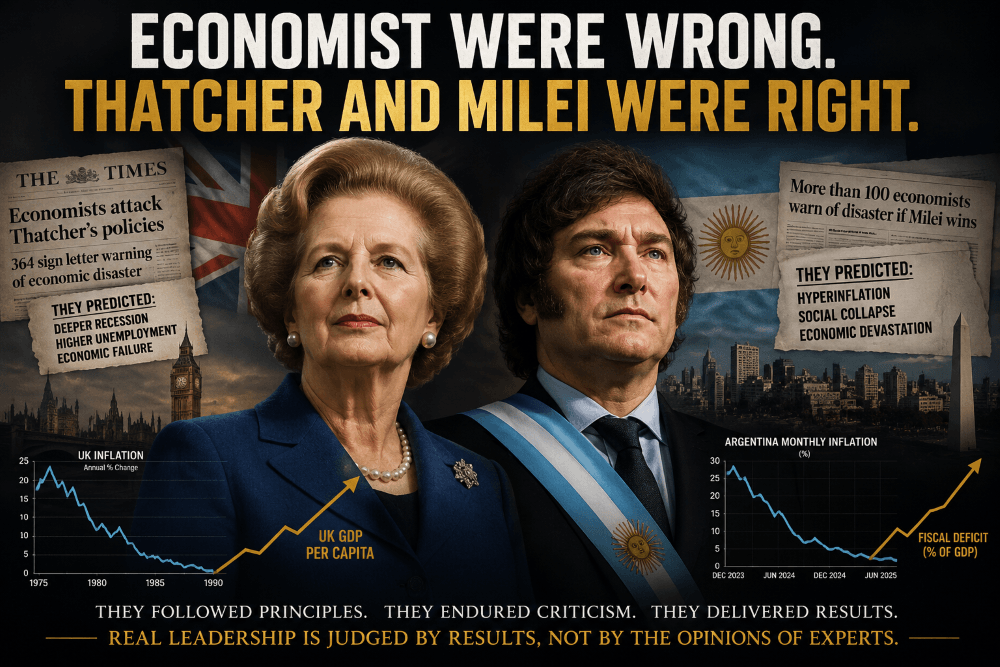
Economic forecasting influences elections, government policy, financial markets, and public opinion. When hundreds of respected economists speak with one voice, journalists report it, politicians cite it, and the public often assumes the debate has been settled.
But what happens when those forecasts are spectacularly wrong?
Unlike engineers whose bridges collapse or doctors whose treatments fail, economists rarely face professional consequences when their predictions prove inaccurate. That raises an uncomfortable question:
Should economists be held to a higher standard of accountability?
Economic Forecasting and the 1981 Letter Against Margaret Thatcher
One of the most famous examples occurred in Britain.
On March 30, 1981, 364 British economists signed an open letter published in The Times. They argued that Prime Minister Margaret Thatcher’s anti-inflation strategy had “no basis in economic theory or supporting evidence.”
The economists warned that her policies would:
- Deepen Britain’s recession.
- Increase unemployment.
- Threaten Britain’s social and political stability.
Their preferred alternative reflected the prevailing Keynesian consensus of the time: From my point of view, Keynesian policies are a complete failure, but that’s a topic for another post.
- More government spending.
- More public borrowing.
- Continued support for struggling industries.
- Easier monetary policy.
Thatcher rejected that advice.
Britain Was Already in Serious Trouble
To understand the debate, it’s important to remember Britain’s condition before Thatcher took office.
By the late 1970s Britain was often described as “the sick man of Europe.”
The country faced:
- Inflation exceeding 20%.
- Repeated labor strikes.
- Slow productivity growth.
- Heavy government ownership of industry.
- High tax rates.
- An IMF bailout in 1976 after a balance-of-payments crisis.
- The “Winter of Discontent,” when public-sector strikes disrupted essential services.
Whether one agrees with Thatcher’s prescriptions or not, few would argue that the status quo was working well.
Thatcher Chose a Different Path
Instead of following the advice of the 364 economists, Thatcher pursued a different economic philosophy.
Her government:
- Reduced marginal income tax rates from 83 percent to 60 percent in 1979 and to 40 percent by 1988
- Tightened monetary policy to fight inflation.
- Privatized major state-owned enterprises. British Telecom, British Gas, British Airways, and British Steel were sold to the public. It’s been proven many times that the government is a horrible business manager.
- Eliminated exchange controls.
- Reduced the power of labor unions.
- Deregulated financial markets, culminating in the 1986 “Big Bang.”
These reforms were controversial, and the early years were painful.
Unemployment rose sharply, and many traditional industries declined.
Yet by the mid-1980s Britain’s economy was expanding again.
Supporters point to:
- Lower inflation.
- Stronger productivity.
- Faster GDP growth.
- Increased entrepreneurship.
- London’s emergence as one of the world’s leading financial centers.
Critics acknowledge many of those economic improvements but argue they came at the cost of greater inequality, regional disparities, and the decline of industrial communities. When people argue against income inequality, they would rather have the poor be poorer, provided that the rich where less rich.
Both observations can be true.
Britain Began Recovering in 1982
GDP turned positive in 1982 and grew for the rest of the decade, peaking at 5 percent a year by 1988. British GDP per capita was growing faster than France’s, Germany’s, or Italy’s, reversing decades of relative decline. The recession the 364 said would deepen ended within twelve months of their letter.
The Productivity Gap with Germany Closed for the First Time in a Generation
In 1979, West German output per hour worked stood 40 percent above Britain’s. By 1989 that advantage had fallen to 17 percent. UK manufacturing output per worker rose roughly 78 percent over the broader period. Britain stopped losing ground to Europe and started catching up.
The Industries the Economists Said Couldn’t Survive Were Replaced by Something Larger
On 27 October 1986 the Big Bang deregulated the London Stock Exchange. Fixed commissions ended and electronic trading began. Within a decade London had reclaimed its position as a top-tier global financial center. The capital the 364 said would vanish reorganized itself around higher-value activity.
Did the 364 Economists Ever Retract Their Forecast?
No collective retraction was ever issued.
Some of the signatories later argued that Britain’s recovery occurred despite Thatcher’s policies rather than because of them.
Others maintained that their original concerns about unemployment and social disruption remained valid.
This illustrates an important point.
Economic forecasting is not only about numbers.
It also depends on how one interprets cause and effect.
The most prominent failed forecast in postwar British economics produced no professional consequences.
Thatcher Is Hated Because She Was Right
The results vindicated her and condemned her critics. People who build their identity around a vision of the world do not abandon that vision when the data contradicts it. They attack whoever the data vindicates. Her record is what their careers were built against. That is why the hatred has not faded in forty years.
The Debate Reappeared in Argentina
A similar debate emerged before Argentina’s 2023 presidential election.
In October 2023, 108 economists including Thomas Piketty and Gabriel Zucman signed an open letter warning that a Javier Milei‘s victory would cause “devastation” in Argentina.
Since taking office, Argentina has experienced:
- A dramatic decline in monthly inflation.
- A significant improvement in the government’s fiscal balance.
- Renewed investor confidence.
At the same time, economists continue to debate:
- The social costs of austerity.
- Poverty trends.
- Whether recent improvements will prove durable.
- Whether the reforms will produce sustained long-term growth.
He won. Monthly inflation fell from 25.5 percent in December 2023 to roughly 2 percent by mid-2025. Poverty dropped from 52.9 percent in early 2024 to 28.2 percent in the second half of 2025.
The Mechanism Repeats Because Nobody Pays for Being Wrong
A credentialed body issues a collective denunciation. Major outlets treat the letter as expert consensus. The policy succeeds anyway. No retraction follows, because the professional cost of being publicly wrong about a major economic prediction inside academic economics is approximately zero.
Should economists publicly revisit their predictions after the facts become known?
Imagine if major economic letters included a follow-up five years later answering questions such as:
- Which predictions proved accurate?
- Which did not?
- What did we learn?
- Would we make the same recommendation today?
Such a practice would improve public trust.
It would also reward intellectual humility.
Experts Should Not Be Afraid to Say, “I Was Wrong”
Science advances because ideas are constantly tested against reality.
Economics should be no different.
Being wrong is not a failure.
Refusing to learn from being wrong is.
Public confidence in expert opinion grows when experts demonstrate a willingness to revise their views as evidence changes.
A Better Standard for Economic Forecasting
Rather than treating open letters as unquestionable authority, perhaps journalists and the public should ask an additional question:
How accurate has this group been in the past?
Forecasts should have track records.
Just as investors evaluate fund managers by long-term performance, perhaps economic forecasters should also be evaluated by the accuracy of their public predictions.
Expertise deserves respect.
But accountability deserves equal respect.
Conclusion
The Thatcher debate and the more recent discussion surrounding Javier Milei illustrate something larger than any single politician.
They remind us that economics is not an exact science.
Reasonable experts can disagree.
Sometimes the majority is correct.
Sometimes it is not.
Rather than treating expert consensus as the final word, we should encourage a culture where predictions are measured against outcomes and where changing one’s mind in light of new evidence is seen as a strength rather than a weakness.
That would make both economics—and public debate—far healthier.
Frequently Asked Questions
Why is economic forecasting so difficult?
Economic forecasting involves predicting the behavior of millions of individuals, businesses, governments, and global markets. Unexpected events such as wars, technological breakthroughs, or financial crises can quickly change economic conditions.
Was Margaret Thatcher’s economic policy successful?
Many economists credit Thatcher with reducing inflation, increasing productivity, and making Britain’s economy more competitive. Others argue that these gains came with significant social costs, including higher unemployment in the early years and greater regional inequality. At the end, she is recognized as one of the best Prime ministers in history.
Why do economists often disagree?
Economists rely on different theoretical frameworks, assumptions, and values. Two economists examining the same data may reasonably reach different conclusions about the best policy. Many economists are in fact undercover activists.
Should economists be held accountable for failed predictions?
Many observers believe economists should publicly revisit major forecasts and explain why predictions succeeded or failed. Doing so could improve transparency, public trust, and the quality of future forecasting.