Whenever I hear someone criticize capitalism, I ask a simple question:
“Show me an economic system that works better than capitalism.”
The answer I often receive is Sweden.
Many people point to Sweden and other Nordic countries as examples of successful socialism. But the reality is more complicated. In fact, the story of capitalism in Sweden is one of the most misunderstood economic success stories of the modern era.
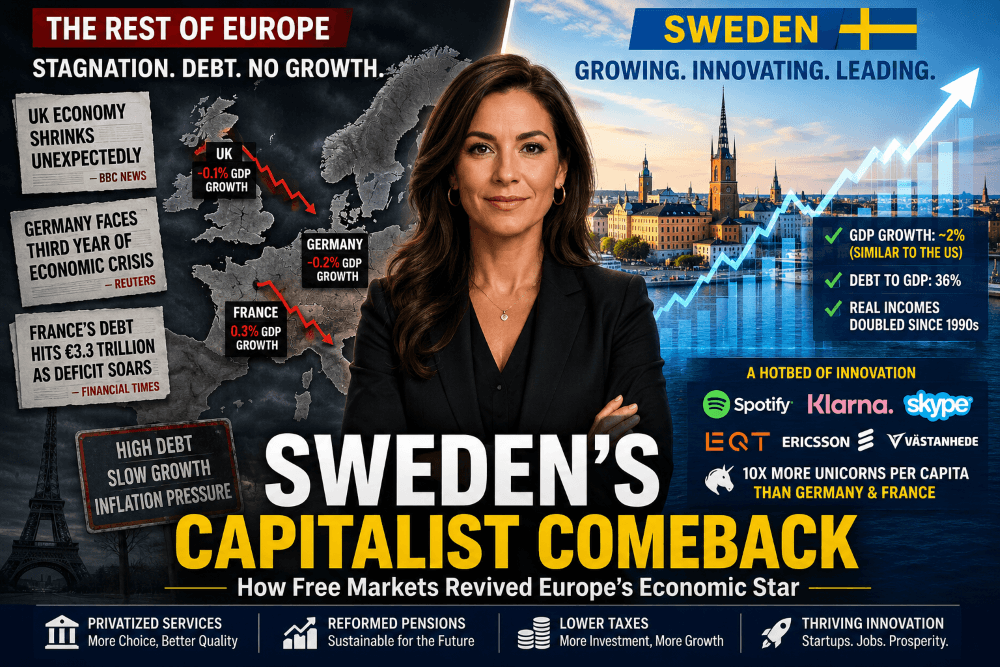
The country that many people view as a socialist paradise spent the last three decades moving away from government control and embracing market-oriented reforms. The result? Sweden has become one of Europe’s strongest and most dynamic economies.
The Myth of Socialist Sweden
Sweden earned its reputation as a high-tax welfare state during the 1960s and 1970s.
Government spending expanded dramatically. Taxes climbed to extraordinary levels. Welfare programs grew from cradle to grave.
One famous example came from Swedish author Astrid Lindgren, creator of Pippi Longstocking. In 1976, she revealed that her marginal tax rate had reached an astonishing 102%.
The revelation shocked the nation.
The public debate that followed contributed to the defeat of Sweden’s ruling Social Democratic Party, which lost power for the first time in four decades.
At the time, many Swedes began questioning whether the system had gone too far.
When the Welfare State Stopped Working
For a while, Sweden’s generous welfare model appeared sustainable.
However, by the 1980s, cracks were beginning to appear.
Several problems emerged:
- Wage growth stagnated.
- Inflation remained stubbornly high.
- Productivity slowed.
- Government spending kept rising.
Then came the economic crisis of the early 1990s.
Banks collapsed.
Real estate prices fell by roughly 50%.
The economy entered one of the worst downturns in modern Swedish history.
Many policymakers concluded that Sweden’s economic model needed a fundamental overhaul.
How Capitalism in Sweden Changed Everything
Beginning in the 1990s, Sweden embarked on a series of reforms that would fundamentally reshape the country.
The goal was not to eliminate the welfare state.
The goal was to make it affordable.
1. Strict Government Spending Rules
Sweden imposed fiscal discipline on government spending.
Unlike many European countries, Sweden adopted rules designed to prevent runaway deficits and debt accumulation.
Today, Sweden’s debt-to-GDP ratio is among the lowest in the developed world.
2. Privatization and Competition
Sweden opened sectors previously dominated by government monopolies.
Industries that saw significant reform included:
- Telecommunications
- Postal services
- Electricity
- Transportation
- Healthcare
- Education
Competition encouraged innovation and efficiency.
3. Healthcare Reform
One of the most surprising aspects of capitalism in Sweden is healthcare.
Healthcare remains publicly funded, but many providers are privately operated.
Nearly half of Sweden’s primary care clinics are privately owned.
This model allows private operators to compete while maintaining universal access.
Supporters argue that competition improves quality and efficiency without sacrificing coverage.
4. Pension Reform
Sweden also modernized its pension system.
Unlike many European countries struggling with aging populations, Sweden created mechanisms that automatically adjust retirement policies when costs rise.
The country also introduced private investment options.
For many Swedes, retirement savings now include investments similar to American 401(k) plans or Canada’s RRSP plans.
This reform helped create a stronger investing culture throughout society.
The Swedish Stock Market Culture
One major difference between Sweden and much of Europe is how ordinary citizens view investing.
In countries such as Germany and France, many people keep their savings in bank accounts.
Swedes are different.
Investing in stocks is widely accepted and encouraged.
This has created a population that is more connected to business ownership and wealth creation.
The culture of investing has become an important ingredient in Sweden’s economic success.
Lower Taxes Than Many People Realize
Sweden still has relatively high income taxes.
However, many taxes commonly associated with European welfare states have been reduced or eliminated.
Sweden has:
- No wealth tax
- No inheritance tax
- No gift tax
- No traditional property tax comparable to many jurisdictions
Research from the Stockholm School of Economics found that eliminating inheritance and gift taxes encouraged family-owned businesses to invest more and grow faster.
These changes helped strengthen entrepreneurship and capital formation.
Sweden’s Tech Boom
Perhaps the strongest evidence supporting capitalism in Sweden is the country’s remarkable technology sector.
Despite having a population of only around 10 million people, Sweden has produced an impressive number of globally successful companies.
The country has generated far more unicorn startups per capita than most European nations.
Examples include:
- Spotify
- Klarna
- Skype
Sweden consistently punches above its weight in innovation, entrepreneurship, and startup creation.
A strong investment culture, lower barriers to business, and access to capital have helped fuel this success.
Why Sweden Is Outperforming Much of Europe
While much of Europe struggles with slow growth, high debt, and aging populations, Sweden has maintained a more positive outlook.
Several factors contribute to its performance:
- Fiscal discipline
- Private-sector competition
- Strong investment culture
- Business-friendly reforms
- Pension sustainability
- Lower debt levels
The lesson is not that Sweden abandoned its social safety net.
The lesson is that Sweden made its safety net compatible with economic growth.
Conclusion
The popular image of Sweden as a socialist success story misses a crucial part of the picture.
Modern Sweden is not succeeding because it expanded government control over the economy.
It is succeeding because it spent the last 30 years introducing competition, encouraging investment, reducing certain taxes, privatizing services, and promoting entrepreneurship.
In other words, Sweden’s success may be less a victory for socialism and more a testament to the power of capitalism.
The next time someone points to Sweden as proof that socialism works, it may be worth asking a follow-up question:
Are they talking about Sweden of the 1970s—or Sweden of today?
Frequently Asked Questions
Is Sweden a socialist country?
No. Sweden has a large welfare state, but its economy is largely market-based, with extensive private ownership, entrepreneurship, and competition.
Did Sweden privatize healthcare?
Partially. Healthcare remains publicly funded, but many clinics and providers are privately operated.
Why is Sweden’s economy growing faster than many European countries?
Analysts point to fiscal discipline, pro-business reforms, investment culture, pension reforms, and competitive markets.
Does Sweden have lower taxes than the United States?
It depends on the tax category. Sweden has higher income taxes, but it has no wealth tax, inheritance tax, or traditional property tax comparable to many jurisdictions.