Every generation dreams of discovering the fountain of youth.
The ancient Chinese searched for immortality elixirs. European explorers sailed across oceans looking for mythical springs. Today, the wealthy and the worried board airplanes bound for luxury clinics promising something far more modern: stem cell therapy.
A few months ago, while traveling in Turkey, I met a man from England who had flown there specifically for medical treatment. He described the experience as “VIP medicine.” A driver met him at the airport. He stayed in a luxury hotel. A translator accompanied him throughout the process. The clinic looked more like a five-star spa than a hospital.
The treatment itself was expensive, but the entire package felt carefully designed to make patients believe they were stepping into the future.
His story led me down a rabbit hole into one of the fastest-growing and most controversial industries in modern medicine: stem cell tourism.
What Exactly Are Stem Cells?
Stem cells are the body’s raw materials.
Unlike ordinary cells that perform specific functions, stem cells have the remarkable ability to develop into different types of specialized cells. Under the right conditions, they can become muscle cells, blood cells, skin cells, nerve cells, and many other tissues.
Think of them as the body’s repair crew.
When we are young, our bodies naturally use stem cells to heal injuries and replace damaged tissues. As we age, the efficiency of these repair mechanisms declines.
Scientists have spent decades studying whether stem cells can be used to regenerate damaged organs, repair injuries, treat diseases, and perhaps even slow some aspects of aging.
The science is real.
Bone marrow transplants, which have been used for decades to treat leukemia and other blood disorders, are essentially stem cell therapies.
But the leap from proven medical treatments to anti-aging miracles is where things become complicated.
The Rise of Stem Cell Tourism
In countries with strict medical regulations, many stem cell treatments remain experimental.
Yet thousands of clinics around the world market stem cell procedures directly to consumers.
Patients travel internationally because treatments may be:
- Cheaper
- Available sooner
- Less regulated
- Marketed more aggressively
- Packaged as luxury experiences
The leading destinations include:
- Turkey
- Mexico
- Panama
- Thailand
- India
- Serbia
- Slovakia
- China
Turkey has emerged as one of the most aggressive players in the international medical tourism market.
The country already attracts hundreds of thousands of visitors annually for hair transplants, dental work, cosmetic surgery, and fertility treatments. Stem cell therapies fit naturally into that ecosystem.
Many clinics offer complete packages including airport pickup, hotel accommodations, translators, private drivers, concierge service, and social media-worthy luxury experiences.
The medicine becomes part of the tourism product.
How Big Is the Industry?
Precise numbers are difficult to obtain because many clinics are privately owned and operate across multiple jurisdictions.
However, analysts estimate that the global regenerative medicine market is worth tens of billions of dollars and continues growing rapidly.
Within that broader market, stem cell tourism represents a multi-billion-dollar international business.
Individual treatments often cost between $5,000 and $50,000.
Some elite anti-aging programs exceed six figures.
Unlike traditional healthcare, insurance rarely covers these procedures.
Patients pay cash.
For clinics, this creates an extremely attractive business model.
Who Are the Customers?
The stereotype is that stem cell patients are billionaires chasing immortality.
Reality is more nuanced.
The Desperate
Many patients suffer from chronic illnesses such as Parkinson’s disease, multiple sclerosis, ALS, or severe arthritis.
Conventional medicine offers limited options.
When a clinic promises hope, many people are willing to take the chance.
The Affluent
Successful executives, entrepreneurs, celebrities, and professionals often seek anti-aging treatments.
For them, aging feels like a threat to their earning power.
In industries where appearance matters, looking younger can translate into tangible economic advantages.
The Biohackers
A growing community of longevity enthusiasts treats their bodies like science experiments.
They track biomarkers, monitor sleep, optimize diets, and pursue cutting-edge interventions.
Stem cells fit naturally into their worldview.
The Influencers
Social media has created a new category of consumer.
Influencers monetize their appearance.
Every wrinkle, every gray hair, every visible sign of aging can potentially affect engagement and income.
For some, anti-aging procedures become business investments.
The Fearful
Perhaps the largest group is driven by something simpler.
Fear.
Fear of aging.
Fear of becoming invisible.
Fear of losing attractiveness.
Fear of being replaced.
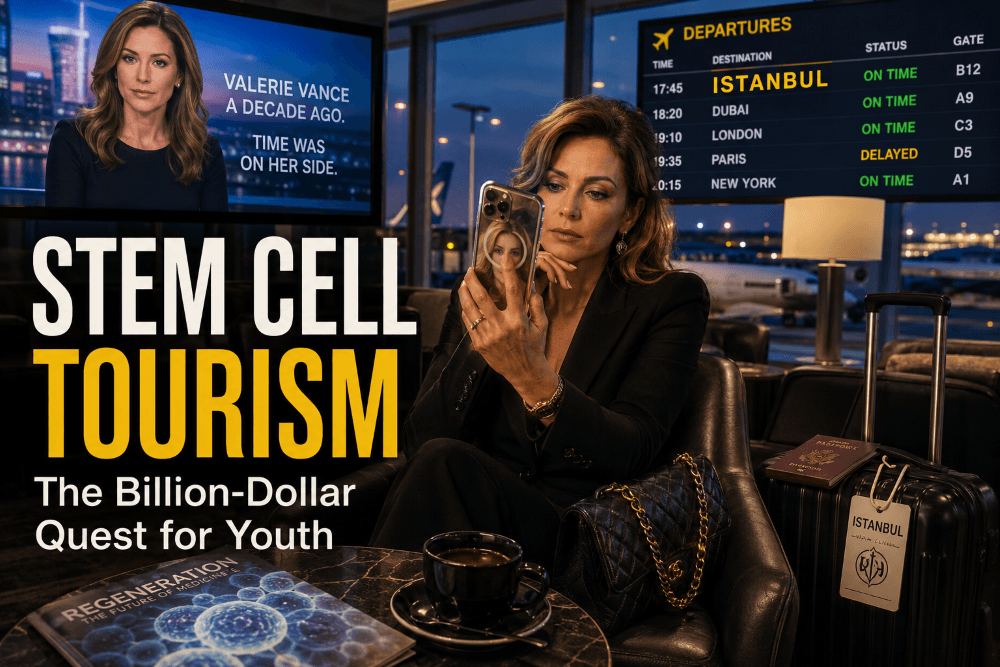
Which brings us to Valerie Vance.
Valerie’s Flight to Istanbul
Valerie Vance had spent twenty years becoming one of the most recognizable faces on television.
Millions trusted her.
Millions watched her.
Millions knew her face better than they knew their neighbors’.
For years, her appearance had been an asset.
Then technology turned against her.
The network upgraded to ultra-high-definition cameras.
The makeup department changed products.
The lighting became harsher.
Tiny lines appeared around her eyes.
A slight sagging along her jawline.
Nothing dramatic.
Nothing unusual.
But television is not an industry built on reasonable standards.
It is built on impossible standards.
Every morning Valerie walked past giant promotional posters featuring herself from ten years earlier.
Every afternoon she watched a younger colleague rehearse in the adjacent studio.
Twenty-six years old.
Flawless skin.
Perfect smile.
Unlimited ambition.
Valerie became convinced that aging was no longer a biological process.
It was a career threat.
One evening, scrolling through Instagram, she encountered advertisements for a luxury stem cell clinic in Istanbul.
The marketing was brilliant.
Before-and-after photos.
Celebrity testimonials.
Private jets.
Luxury suites.
Words like “regeneration,” “renewal,” and “cellular rejuvenation.”
The clinic promised that stem-cell-derived treatments could stimulate collagen production, improve skin texture, accelerate healing, and restore youthful appearance.
The science sounded plausible.
The results looked miraculous.
The fear was real.
She booked the flight.
What Beauty Procedures Are Most Common?
Many people imagine stem cells as magical injections that erase decades overnight.
The reality is less dramatic.
Common procedures include:
Stem Cell Facial Rejuvenation
Cells or cell-derived products are injected into the face to stimulate tissue repair and collagen production.
Stem Cell Microneedling
Growth factors are applied after controlled skin injury to encourage healing and rejuvenation.
Fat-Derived Stem Cell Treatments
Fat is harvested from the patient’s body, processed, and reinjected into areas requiring volume restoration.
Hair Restoration
Stem-cell-related therapies are marketed as treatments for thinning hair and hair loss.
Skin Regeneration Programs
These often combine stem-cell products with lasers, fillers, and other cosmetic procedures.
Many clinics market these interventions as revolutionary.
The actual scientific evidence varies considerably depending on the specific treatment.
Some approaches show promise.
Others remain largely unproven.
The Hidden Economics of Beauty
Suppose Valerie’s treatment costs $20,000.
If maintaining her appearance helps preserve a television contract worth $500,000 annually, the expense may seem rational.
This illustrates a broader reality.
Beauty has economic value.
Research consistently finds that attractive people often enjoy advantages in hiring, promotions, earnings, and social interactions.
Whether those advantages are fair is another discussion entirely.
But they exist.
For some consumers, anti-aging treatments are not vanity purchases.
They are perceived career investments.
What Happens When It Doesn’t Work?
This is where the story becomes murky.
Many patients report satisfaction.
Many report disappointment.
The most common outcome is not disaster.
It is simply no significant improvement.
Patients may spend tens of thousands of dollars and see minimal change.
Yet lawsuits are relatively uncommon.
Why?
Partly because outcomes are subjective.
Partly because treatments occur overseas.
Partly because hope is difficult to abandon.
Patients often convince themselves they need more time or another round of treatments.
The industry thrives in the gap between possibility and proof.
Did Valerie Find the Fountain of Youth?
When Valerie returned home, her skin looked fresher.
Perhaps the treatment helped.
Perhaps the luxury vacation reduced stress.
Perhaps the improvement came from accompanying procedures.
Perhaps placebo played a role.
No one could say with certainty.
What mattered was that she felt more confident.
For a few months, the anxiety receded.
Then a new wrinkle appeared.
Then another.
And Valerie discovered the uncomfortable truth at the heart of the anti-aging industry.
The real product being sold is not youth.
It is reassurance.
Every generation invents new technologies to fight aging.
Creams.
Supplements.
Hormones.
Cosmetic surgery.
Now stem cells.
Some innovations genuinely work.
Others promise more than they deliver.
But the demand remains constant because the underlying problem never changes.
No one wants to grow old.
And there will always be an industry ready to sell hope to those who fear time the most.
Final Thoughts
Stem cell tourism sits at the intersection of legitimate science, luxury travel, cosmetic enhancement, and human psychology.
Some patients pursue it for medical necessity.
Others seek beauty.
Others seek longevity.
Many simply seek control over a process that none of us can ultimately stop.
The stem cell industry may continue to grow into a major pillar of global healthcare.
Or regulators may crack down on clinics making exaggerated claims.
Either way, one fact seems certain:
As long as people fear aging, there will always be a market for anyone promising to slow it down.
FAQ
What are stem cells?
Stem cells are undifferentiated cells capable of developing into specialized cells such as blood, muscle, skin, or nerve cells. They play an important role in tissue repair and regeneration.
What is stem cell tourism?
Stem cell tourism occurs when patients travel to another country to receive stem cell treatments that may be unavailable, experimental, or less regulated in their home country.
Which countries are popular for stem cell treatments?
Turkey, Mexico, Panama, Thailand, India, Serbia, Slovakia, and China are among the most common destinations for international stem cell patients.
Are stem cell beauty treatments proven to work?
Some treatments show promising results, particularly for skin rejuvenation and healing. However, many procedures marketed by private clinics remain experimental and lack large-scale clinical evidence.
Previous opinion posts
- Hollywood Challenges: Why Indie Films Are Winning
- Car Dealership Disruption: Why the Old Model Is Cracking
- The New Luddites: Why Communities Are Revolting Against AI Data Centers