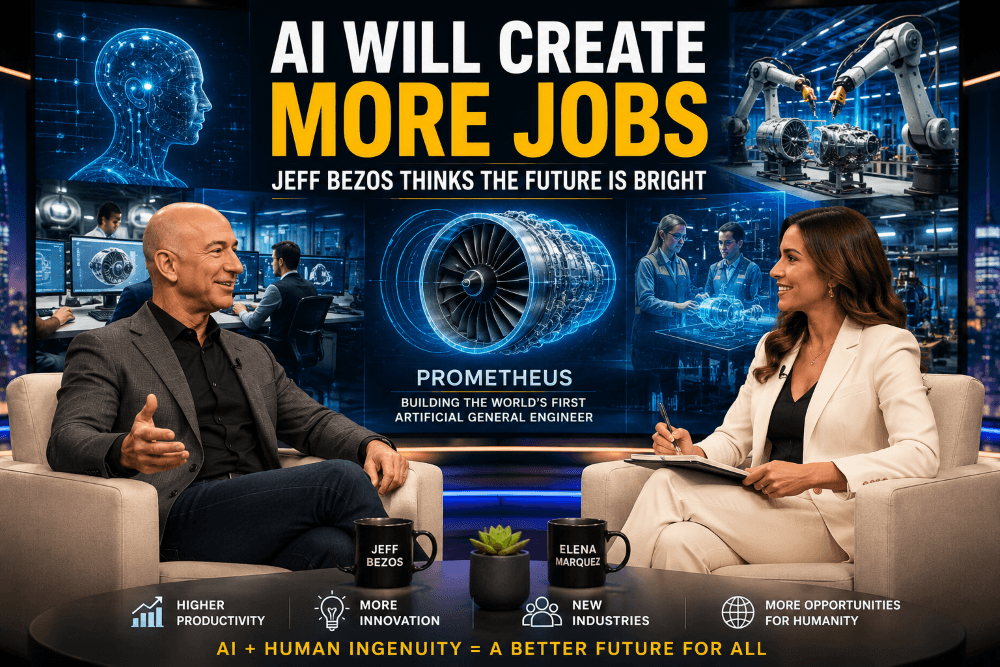
When people talk about artificial intelligence, the conversation often turns gloomy. Headlines warn about robots taking jobs, software replacing workers, and entire professions becoming obsolete. Yet one of the world’s most successful entrepreneurs sees a very different future.
AI Job Creation is at the heart of Jeff Bezos’ vision for the economy. The Amazon founder recently launched a new venture called Prometheus, a company dedicated to building what he calls an “artificial general engineer.” While many fear that AI will eliminate jobs, Bezos believes the technology will ultimately create more opportunities than it destroys.
History suggests he may be right.
The Prometheus Vision
Prometheus aims to develop AI systems capable of designing and manufacturing complex physical products such as jet engines, industrial equipment, and advanced machinery.
Think of it as moving beyond chatbots and content creation. Instead of writing emails or generating blog posts, Prometheus wants AI to help engineers invent and build real-world products.
The goal is not merely automation. The goal is amplification.
Just as a calculator made mathematicians more productive, Prometheus hopes to make engineers dramatically more productive.
AI Job Creation Has Happened Before
Whenever a revolutionary technology emerges, people fear the worst.
The Industrial Revolution eliminated many manual jobs. Yet it also created factories, railroads, manufacturing industries, and millions of new opportunities.
The automobile replaced horse-drawn transportation. At the same time, it created entirely new industries involving manufacturing, repair, insurance, tourism, and logistics.
The internet destroyed some traditional jobs while creating others that previous generations could never have imagined.
Today, millions of people work as:
- Software developers
- Digital marketers
- Content creators
- E-commerce entrepreneurs
- Social media managers
- Online educators
None of these careers existed in meaningful numbers a few decades ago.
AI may follow the same pattern.
Why Jeff Bezos May Be Right
One reason Bezos is optimistic is that human wants are virtually unlimited.
When productivity increases, society does not simply stop working. Instead, people use their newfound resources to create additional products, services, and businesses.
Imagine a future where engineers become ten times more productive.
Companies could:
- Build better products faster
- Reduce development costs
- Launch new businesses more easily
- Solve complex scientific challenges
- Create products that are currently too expensive to develop
As innovation accelerates, demand for skilled workers may actually increase.
The Productivity Effect
Throughout history, increased productivity has often led to economic growth rather than permanent unemployment.
Farm mechanization reduced the number of agricultural workers needed to grow food. Yet the economy expanded into manufacturing, healthcare, technology, education, and countless other industries.
The same principle could apply to artificial intelligence.
If AI helps engineers design products faster, businesses may launch more products. More products can lead to more factories, more sales teams, more customer service roles, and more entrepreneurial opportunities.
The Entrepreneurial Opportunity
One aspect often overlooked in discussions about AI is entrepreneurship.
Many people focus on jobs that might disappear.
Few focus on businesses that have not yet been created.
AI dramatically lowers barriers to entry.
A small startup can now access capabilities that once required large teams and significant capital.
Entrepreneurs can:
- Build products faster.
- Reach global markets.
- Automate repetitive tasks.
- Focus on innovation and strategy.
- Launch companies with fewer resources.
This democratization of innovation may create an explosion of small businesses and independent creators.
That is a future worth celebrating.
What Workers Should Do
Even if Bezos is correct, the transition will not be effortless.
Some jobs will change.
Others will disappear.
New ones will emerge.
The best strategy is adaptation.
Workers who embrace technology rather than resist it will likely enjoy the greatest opportunities.
Consider focusing on:
- Problem-solving skills
- Communication abilities
- Leadership
- Creativity
- Technical literacy
- Lifelong learning
AI may handle routine tasks, but human judgment, relationships, and vision will remain valuable.
AI Job Creation and the Future Economy
The future is unlikely to be a battle between humans and machines.
More likely, it will be a partnership.
The most successful workers and businesses will learn how to combine human creativity with machine intelligence.
Jeff Bezos has built one of the world’s largest companies by recognizing trends before most people see them. His optimism regarding AI deserves serious consideration.
Prometheus may become much more than another startup.
It may become a glimpse into a future where artificial intelligence helps humanity build more, invent more, and create more wealth than ever before.
Rather than fearing AI, we should focus on how to use it to expand human potential.
If history is any guide, innovation creates opportunities for those willing to adapt. The age of AI may prove no different.
Frequently Asked Questions
Will AI eliminate jobs?
AI will likely eliminate some jobs while creating new ones. Historically, major technological advances have transformed labor markets rather than permanently reducing employment.
What is Prometheus?
Prometheus is a new venture backed by Jeff Bezos that aims to develop an “artificial general engineer” capable of helping design and manufacture complex physical products.
Why does Jeff Bezos believe AI will create jobs?
Bezos believes AI will boost productivity, stimulate innovation, and create new industries that generate demand for workers.
How can workers prepare for an AI-driven economy?
Workers can prepare by developing skills in communication, leadership, creativity, problem-solving, and technological literacy while remaining adaptable to change.