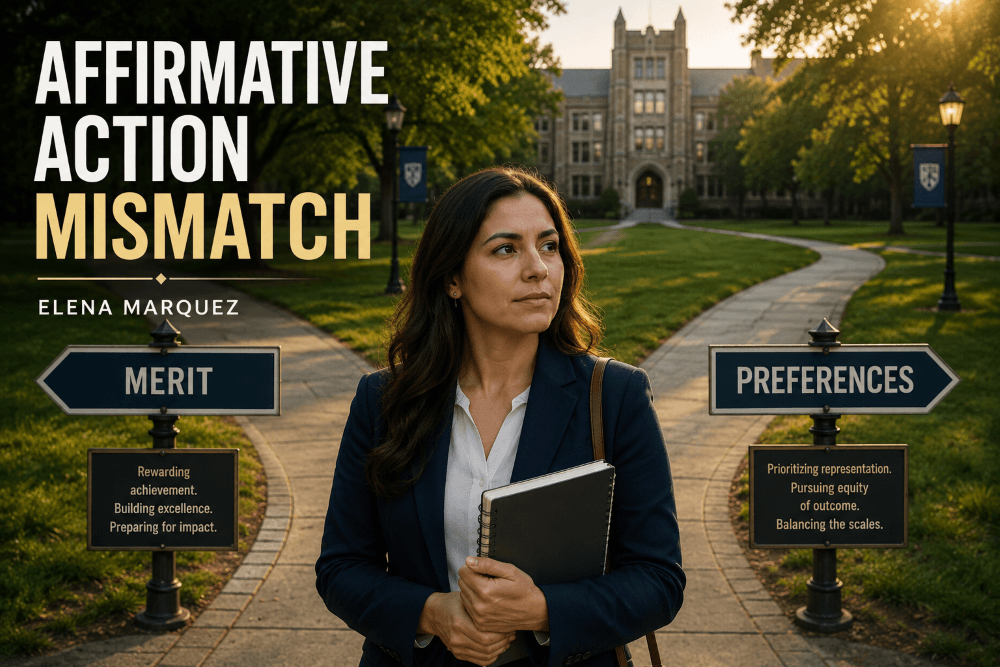
The affirmative action mismatch debate asks a difficult but important question: can policies designed to help disadvantaged students sometimes leave them worse off?
For decades, universities have considered race or gender as one factor in admissions, arguing that diverse classrooms create better educational environments and provide opportunities for historically underrepresented groups. Those goals are understandable and, in many respects, admirable. But they are also discriminatory.
But good intentions do not automatically produce good outcomes.
If a policy consistently places students in environments where they are less academically prepared than their classmates, it is worth asking whether the policy is truly serving the students it intends to help.
What Is the Affirmative Action Mismatch Theory?
The affirmative action mismatch theory argues that students tend to learn best when they are surrounded by peers with similar levels of academic preparation.
When a student is admitted to a university where the average preparation of classmates is significantly higher, several things may happen:
- Lower grades
- Greater academic stress
- Less confidence
- Higher likelihood of changing majors
- Lower graduation rates in demanding fields such as engineering, mathematics, or physics
This idea has been studied by several scholars, including legal scholar Richard Sander, who argues that in some circumstances students admitted through significant admissions preferences would achieve better outcomes at institutions where they are academically closer to the median student.
The debate remains active, and researchers disagree on the size and frequency of these effects.
A Hypothetical Example
Imagine a young woman whose dream is to become an engineer.
She scores 650 out of 800 on the SAT Math section—a respectable score that could earn admission to many excellent engineering schools.
Now imagine that an elite university admits her partly because it hopes to increase the number of women in its engineering program.
Meanwhile, many of her classmates scored close to 800.
From the first week of classes, she finds herself surrounded by students who entered with substantially stronger mathematical preparation.
Calculus moves faster than she expected.
Physics becomes overwhelming.
Assignments that take classmates two hours take her six.
Her confidence begins to erode.
Instead of enjoying engineering, she starts wondering whether she belongs there at all.
Eventually, she switches to a less mathematically demanding major.
Had she attended a university where the incoming students’ preparation more closely matched her own, she might have graduated near the top of her class, developed greater confidence, and become an outstanding engineer.
The point is not that she lacked ability.
The point is that where someone studies can matter as much as whether they study.
What Happens When Diversity is Imposed by The Leftist
When equality of outcome is not the end result of imposed diversity quotas, the diversity bureaucrats show and tell the less competent student:
If you are feeling out of place,
if you are struggling,
if you are doing not as well as your peers,
is because you are in a rape culture,
is becaus you are in a patriarchy,
it’s because you are surrounded by a female-hostile environment.
They are not going to be hones and say the truth, they are not going to say:
“No, it’s because you have been catapulted into an academic environment for which you are competitively qualified.”
The end result is that those accpeted under some kind of quota, or some left leaning ideology, they never catch up.
It’s cruel. It’s an act of narcissim and ego. on the par of those left leaning college administrators who only care about the photos that show up on their college website, making sure those photos are suitably diverse, and they don’t care about the fate of the students who have been admitted.
Equality of Opportunity vs. Equality of Outcome
This debate reflects two competing visions of fairness.
One vision emphasizes equality of opportunity.
Everyone competes under the same standards, and admission depends primarily on academic achievement and demonstrated potential.
The other emphasizes equality of outcome.
If certain groups remain underrepresented, admissions standards may be adjusted to produce a student body that more closely reflects society’s demographics.
Supporters argue this promotes diversity and compensates for historical inequalities. This also promotes racism and sexism.
Critics argue that lowering admission standards—even for well-intentioned reasons—can unintentionally harm the very students the policy is trying to help.
Does Society Care Who Designed the Bridge?
When we cross a bridge, ride an elevator, or enter a skyscraper, most people are not concerned with the race or sex of the engineer who designed it.
They care that it is safe.
They care that the engineer possessed the knowledge, judgment, and competence necessary to do the job well.
Engineering, medicine, aviation, and architecture all involve enormous responsibility.
The public benefits when professionals are selected because they have mastered their disciplines.
The debate, therefore, is not whether women or minorities can become excellent engineers—they unquestionably can.
Rather, it is whether admissions standards should differ depending on a person’s demographic characteristics.
The Hidden Cost of Preferences
Admissions preferences can also create unintended social consequences.
Even students who would have been admitted on their own merits may find classmates questioning whether they earned their place.
That perception can create unnecessary stigma.
Ironically, policies intended to promote inclusion may sometimes undermine confidence and trust.
Better Ways to Expand Opportunity
Increasing opportunity does not necessarily require lowering admissions standards.
Universities could instead invest more heavily in:
- Better K–12 education
- Summer bridge programs
- Intensive tutoring
- Academic mentoring
- Scholarships based on financial need
- Outreach to talented students from disadvantaged schools
These approaches seek to prepare students before they arrive at highly competitive universities, increasing their chances of long-term success.
A Debate Worth Having
The affirmative action mismatch debate is ultimately about outcomes rather than intentions.
If admissions preferences improve graduation rates, career success, and long-term achievement, they deserve support.
If they instead increase academic struggle, discourage students from pursuing challenging fields, or reduce confidence, policymakers should be willing to reconsider them.
Every student deserves not merely admission to a prestigious university, but the opportunity to flourish once they arrive.
The best education policy is one that maximizes both opportunity and success.
Blacks, latinos, and females should be admitted to college on the same contiditions as every body else.
It’s mostly Virtual Signaling Anyway
At the end of the day, I don’t believe a school diploma is that important anyway. I did go to school, to the one that accepted me. Not the one I would have prefered. Due to racial discrimiation in Quebec, I never got the job in finace I wanted. Well, it didn’t matter. I created my own portfolio, found my own clients, and instead of working for the man, I worked for myself and retired, finacially independent, 20 years after my graduation. The diploma didn’t help me one bit. It was my desire to succeed that was my guiding light.
Frequently Asked Questions
Does research support the mismatch theory?
Some studies have found evidence consistent with mismatch effects, particularly in demanding STEM fields, while others conclude that attending more selective universities provides long-term benefits that outweigh the challenges. The evidence remains debated.
Does opposing affirmative action mean opposing diversity?
No. Many critics support increasing diversity through improved K–12 education, socioeconomic assistance, mentoring, and outreach rather than using race or gender preferences in admissions.
Has affirmative action changed in the United States?
Yes. In 2023, the U.S. Supreme Court significantly limited the use of race-conscious admissions at colleges and universities, prompting many institutions to revise their admissions policies.
Why is this debate controversial?
Because it involves competing values: fairness, equal opportunity, historical disadvantage, diversity, and academic merit. Reasonable people can disagree on how best to balance these goals.