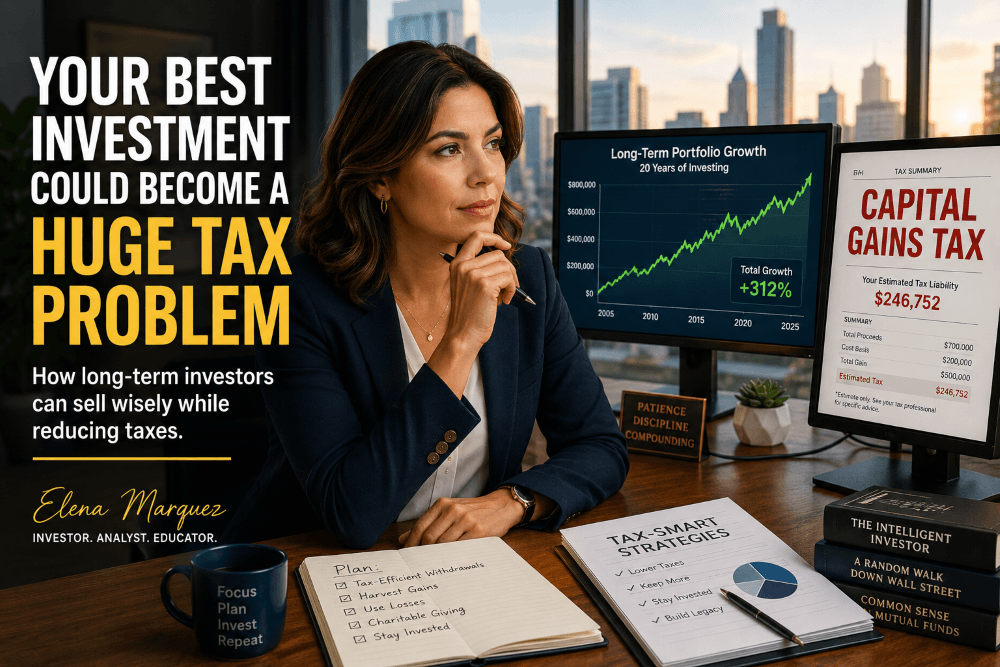
How American and Canadian investors can reduce capital gains taxes after decades of buying and holding.
Buying a broad-market ETF and holding it for decades is one of the simplest ways to build wealth.
You buy an ETF like the Vanguard S&P 500 ETF (VOO) for U.S. investors or the iShares S&P/TSX 60 Index ETF (XIU) for Canadian investors. You reinvest the dividends, ignore the daily market noise and continue adding money whenever you can.
Twenty years later, the strategy has worked beautifully.
But now you have a new problem: how do you reduce capital gains tax when selling an ETF that has increased enormously in value?
This is the strange punishment for being a successful long-term investor.
You followed the advice to buy and hold. You resisted panic selling. You avoided speculation and unnecessary trading.
Now your portfolio may contain hundreds of thousands of dollars in unrealized gains.
Selling a large amount in one year could create a substantial tax bill. It could also push your income into a higher tax bracket and affect income-tested benefits.
This is not merely a theoretical question for me. I have accumulated VOO and XIU for many years, and I know that selling a large portion at once could create a painful tax expense.
Fortunately, selling everything in one year is not the only option.
First, Understand the Capital Gains Problem
Suppose you invested $200,000 in VOO over many years.
Your investment is now worth $700,000.
Your unrealized capital gain is approximately:
$700,000 market value − $200,000 cost = $500,000 gain
You do not owe capital gains tax simply because VOO increased in value.
The tax is generally triggered when you sell or otherwise dispose of the investment.
That means you have some control over when the gain is realized.
The central question is not:
How can I avoid paying any tax?
A better question is:
How can I realize this gain gradually and pay the lowest reasonable amount of tax over my lifetime?
That change in perspective is important.
Reduce Capital Gains Tax by Avoiding One Giant Sale
The worst approach may be to sell the entire position without first calculating the consequences.
A large sale could concentrate decades of gains into a single tax year.
In both Canada and the United States, capital gains interact with the investor’s other income. Realizing more gains can bump you up to a higher tax braket and thus you will pay a higher tax rate.
A more efficient strategy is often to sell your ETF gradually.
For example, an investor could sell enough each year to cover:
- Annual living expenses
- Planned travel
- Major purchases
- Charitable donations
- Portfolio rebalancing
Instead of realizing a $500,000 gain in one year, the investor might spread the gain over 10, 15 or 20 years.
This does not eliminate the tax.
It gives the investor more control over the rate and timing and hi might be taxed in a lower tax bracket.
Strategy 1: Sell More During Low-Income Years
Some years are naturally better than others for realizing capital gains.
Good opportunities may arise:
- After retirement but before pensions begin
- Before collecting Social Security or government benefits
- Before mandatory retirement-account withdrawals
- During a sabbatical or period of reduced employment
- In a year with large deductions
- In a year when business income is unusually low
These lower-income years can create room to realize gains at a more favourable rate.
For American investors
The United States applies special federal tax rates to long-term capital gains.
Depending on taxable income, some long-term capital gains may fall into the 0% federal capital gains bracket. Higher-income investors generally face 15% or 20% federal rates, and some may also owe the 3.8% net investment income tax. State taxes may apply as well.
This creates a powerful planning opportunity.
An American investor with unusually low taxable income may sell some VOO, realize a long-term gain and potentially pay no federal capital gains tax on part of that gain.
The investor can then buy VOO again.
The newly purchased shares receive a higher cost basis, reducing a future taxable gain.
For Canadian investors
Canada does not have a special 0% capital gains bracket comparable to the American system.
Instead, only a portion of a capital gain is included in taxable income. The proposed increase in Canada’s capital gains inclusion rate was cancelled, leaving the one-half inclusion system in place.
If a Canadian investor realizes a $20,000 capital gain, $10,000 is generally included in taxable income under the one-half inclusion rate.
The final tax depends on the investor’s federal and provincial marginal tax rates.
A Canadian investor with little other income may therefore realize gains at a relatively modest tax cost. The investor can repurchase their ETF immediately, increasing the adjusted cost base.
This practice is known as capital gain harvesting.
Strategy 2: Harvest Capital Gains Every Year
Most investors have heard about tax-loss harvesting.
Capital gain harvesting receives far less attention.
Here is how it works:
- Estimate your taxable income for the year.
- Calculate how much additional capital gain you can realize without entering an undesirable tax bracket.
- Sell enough of your ETF to realize that gain.
- Repurchase the same ETF inmediately after selling it.
- Record the transaction and update the cost basis.
The investor remains invested while gradually increasing the tax cost of the portfolio.
Over many years, this can reduce the unrealized gain that remains in the account. I use this strategy every year. I sell a portion of my investments, realize some capital gains, and buy the same investment inmediately after selling it.
Can you buy the same ETF back immediately?
Yes, when you sold it for a gain.
The American wash-sale rule and the Canadian superficial-loss rule are designed to restrict the recognition of losses when substantially identical securities are quickly repurchased.
They do not generally prevent an investor from repurchasing an investment immediately after realizing a gain.
Capital gain harvesting can therefore be completed without remaining out of the market for 30 days.
The disadvantage is that you are paying some tax earlier than necessary. As a citizen of this wonderful country, I don’t mind paying some taxes on my gains, as long as those taxes are not exessive and feel as a punishment for my success.
Money paid in tax today can no longer remain invested and compound.
The strategy is most attractive when the current tax rate is lower than the rate you reasonably expect to face later.
Strategy 3: Use Capital Losses to Offset Your ETF Gains
A diversified portfolio may contain investments that have declined in value.
Selling one of those investments creates a capital loss that may offset part of the gain realized from selling your ETF. This strategy is called Tax-loss harvesting.
For example:
- Gain from selling VOO: $30,000
- Loss from selling another investment: $12,000
- Net capital gain: $18,000
This allows the investor to reduce the VOO position while limiting the immediate tax bill.
United States
American investors can use capital losses against capital gains.
When losses exceed gains, a limited amount may generally be deducted against other income, with unused losses carried forward to later years.
The wash-sale rule must be considered before repurchasing the losing investment.
Canada
Canadian net capital losses can generally be used against taxable capital gains.
Unused net capital losses may normally be carried back as far as three years or carried forward to future years.
Canada’s superficial-loss rule may deny an immediate loss when the investor—or an affiliated person—buys the same or identical property during the restricted period and still owns it 30 days after the sale.
Again, this rule matters for losses, not gains.
Strategy 4: Donate your ETF Instead of Cash
Investors who regularly support charities should consider donating appreciated ETF shares directly.
This can be much more tax-efficient than selling your ETF and donating cash.
For American investors
An American investor who donates qualifying appreciated securities held for more than one year may generally avoid recognizing the embedded capital gain.
The investor may also qualify for a charitable deduction, subject to deduction limits, documentation requirements and whether the investor itemizes deductions.
The charity receives the shares and can sell them without creating a capital gains tax bill for the donor.
Instead of donating $10,000 in cash, the investor could transfer $10,000 of his long held ETF containing a large unrealized gain.
The investor keeps the cash and removes some of the portfolio’s oldest, lowest-cost shares.
For Canadian investors
Canada also offers favourable treatment for direct donations of publicly traded securities to registered charities.
Qualifying donations can receive a zero capital-gains inclusion rate, while the donor may also receive a charitable donation tax credit.
The important word is directly.
Selling your ETF first and donating the cash may trigger the capital gain. Transferring the ETF shares directly to the charity may avoid it.
This is one of the few strategies that can genuinely eliminate the tax on part of an appreciated ETF position.
Of course, it only makes financial sense for money that the investor already intends to give to charity.
Strategy 5: Choose Which Shares to Sell
This is one area where the American and Canadian systems differ significantly.
American investors may identify specific shares
An American investor may have purchased his favorite ETF at many different prices.
Some shares may have a cost basis of $150, while newer shares may have a basis of $500.
When selling, the investor may be able to instruct the broker to sell specific shares.
Selling the highest-cost shares first produces a smaller taxable gain.
For example:
- Sale price: $600
- Old share cost: $150
- Gain: $450
Compared with:
- Sale price: $600
- Newer share cost: $500
- Gain: $100
Specific-share identification can help American investors control which gains are realized. Proper instructions and records are essential. IRS guidance requires investors to maintain records supporting the basis of their investments.
Canadian investors use an average adjusted cost base
Canadian investors generally cannot select the highest-cost ETF shares and pretend those were the only units sold.
Identical securities are pooled together.
The investor must calculate the average adjusted cost base of all identical ETF units held in non-registered accounts. The gain on a sale is based on that average cost.
This makes accurate recordkeeping especially important.
Broker records may not always correctly combine ETF held across multiple Canadian taxable accounts.
Honestly I prefer the Canadian systeme of average adjusted cost much better. I have been making many different purchases during more than 10 years. It’s a headache to keep record of that small purchase I did of the XIU ETF 10 years ago.
Strategy 6: Keep Accurate Records
Before worrying about how to reduce capital gains tax, make sure the gain has been calculated correctly.
An incorrect cost basis can produce an unnecessarily large tax bill.
The records should include:
- Every purchase
- Reinvested distributions
- Brokerage commissions
- Stock splits
- Transfers between brokers
- Return-of-capital distributions
- Previous sales
- Currency conversions, when applicable
Special issue for Canadians holding U.S ETFs in U.S. dollars
U.S. ETF trades in U.S. dollars, but Canadian taxes must generally be calculated in Canadian dollars.
The purchase cost must be translated into Canadian dollars using the appropriate exchange rate at the time of purchase. The sale proceeds must also be translated using the relevant exchange rate at the time of sale.
A gain that appears to be modest in U.S. dollars may be larger in Canadian dollars if the Canadian dollar weakened during the holding period.
The CRA calculates gains by subtracting the adjusted cost base and selling expenses from the proceeds of disposition.
Investors who accumulated a U.S. ETF over 20 years may need to reconstruct many transactions.
That effort can be worthwhile.
Finding forgotten purchases, commissions or reinvested distributions may increase the adjusted cost base and reduce the taxable gain.
Strategy 7: Stop Reinvesting Dividends
An investor who is approaching retirement may not need to continue reinvesting every dividend from their ETF.
Instead, the cash distributions can be used for living expenses.
This reduces the need to sell shares.
It does not directly reduce the existing capital gain, but it may delay future sales and allow those sales to be planned more carefully.
There is also an administrative benefit.
Automatic dividend reinvestment creates many small purchases, each of which must be included in the cost-basis calculation.
Taking dividends in cash can simplify future recordkeeping.
I used to reinvest all my dividends, but now, while in retirement, I see dividends as extra pocket money.
Strategy 8: Use New Savings Before Selling Your ETF
Before selling appreciated shares, consider whether expenses can be paid from:
- Cash reserves
- Employment income
- Pension income
- Bond interest
- Dividends
- Maturing guaranteed investments
- Withdrawals from other accounts
- The sale of assets with smaller gains
This is not always the best solution.
However, investors should examine their entire financial picture instead of assuming that the oldest ETF shares must be sold first.
The goal is to choose the most tax-efficient source of cash each year.
Strategy 9: Contribute Future Investments to Tax-Sheltered Accounts
Registered accounts cannot erase a gain that already exists in a taxable account.
Moving appreciated shares of your ETF into an IRA, Roth IRA, RRSP or TFSA will normally be treated as a sale or deemed disposition.
However, future contributions can prevent the problem from becoming even larger.
Every year, I transfer the maximum allowed from my non-registered account to my TFSA.
American investors
Future ETF purchases may be made inside accounts such as:
- 401(k) plans
- Traditional IRAs
- Roth IRAs
- Health savings accounts, when eligible
Each account has different contribution and withdrawal rules.
Canadian investors
Future ETF purchases may be placed inside:
- TFSAs
- RRSPs
- FHSAs, when eligible
Investment growth inside a TFSA is generally tax-free, including withdrawals. RRSP growth is tax-deferred, although withdrawals are generally taxable as income.
The lesson is not to transfer appreciated ETFs into a registered account without understanding the tax.
The lesson is to use available registered room before adding even more money to a taxable account.
Strategy 10: Borrow Against Shares Instead of Selling
Some wealthy investors borrow against their portfolios.
Because borrowing is not a sale, it does not immediately trigger a capital gain.
This can provide temporary liquidity while leaving VOO invested.
But borrowing does not truly reduce the tax bill. It postpones the sale and introduces new costs and risks:
- Interest expenses
- Variable interest rates
- Market declines
- Collateral requirements
- Forced selling
- Growing debt
Borrowing against investments can be dangerous when used to fund ordinary living expenses for many years.
It is better viewed as a short-term liquidity tool than a permanent tax solution.
Every year, I decide how much I need to sell to meet my ordinary expense while I try to stay at a low tax braket. If my living expensses exceed that amount that I sold, I simply borrow against my shares and pay the money some time in the future years.
Strategy 11: Consider What Happens at Death
The tax treatment at death is one of the largest differences between the United States and Canada.
United States: heirs may receive a step-up in basis
Under current U.S. rules, inherited assets generally receive a tax basis related to their fair market value at the owner’s death.
This is commonly called a step-up in basis.
If VOO has a very large unrealized gain and is held until death, much of that embedded gain may disappear for income-tax purposes when the shares pass to heirs.
Estate taxes and other rules may still apply to sufficiently large estates.
This creates a strong incentive for some American investors to spend other assets first and preserve highly appreciated shares for their heirs.
Tax laws can change, so this strategy requires ongoing review.
Canada: death usually triggers a deemed disposition
Canada generally treats a person as having disposed of capital property immediately before death.
That can trigger the accumulated capital gain on your ETF even if the shares were never sold during the investor’s lifetime.
A tax-deferred rollover may be available when qualifying property passes to a spouse or spousal trust. In that case, the tax is generally deferred rather than eliminated.
The surviving spouse may eventually face the gain when the investment is sold or when that spouse dies.
Canadian investors therefore cannot generally assume that holding a ETF until death will make the gain disappear.
Strategy 12: Coordinate Sales With Retirement Benefits
Capital gains do not exist in isolation.
A large gain can affect other parts of a tax return.
American investors should consider
- Social Security taxation
- Medicare income-related premiums
- The net investment income tax
- State income taxes
- Affordable Care Act subsidies
- Required minimum distributions
Canadian investors should consider
- Old Age Security recovery tax
- The age amount
- Provincial tax credits
- Income-tested benefits
- RRSP and RRIF withdrawals
- Pension income
Selling your ETF simply because there is room in a particular tax bracket may overlook these additional effects.
A proper plan should estimate the investor’s complete tax return, not merely the capital gains line.
A Simple Plan for the Long-Term ETF Investor
The number of possibilities can feel overwhelming.
A practical plan might look like this:
- Calculate the true cost basis.
Include purchases, reinvested distributions, commissions and currency conversions. - Estimate future annual income.
Include employment, pensions, retirement withdrawals and government benefits. - Identify low-tax years.
These may be the best years to realize larger gains. - Sell gradually.
Avoid realizing decades of gains in a single year unless there is a compelling reason. - Use losses when available.
Offset gains without allowing taxes to dictate poor investment decisions. - Donate appreciated shares.
Use VOO instead of cash for charitable giving. - Harvest gains deliberately.
Sell and repurchase enough ETF to increase the cost basis during favourable years. - Review the plan annually.
Tax brackets, benefits, investment values and tax laws change.
The Biggest Mistake: Refusing to Sell Because of Taxes
Taxes are painful, but they are evidence that the investment made money.
An investor should not sell ther ETF carelessly.
But the investor should not become so frightened of taxes that the portfolio can never be used.
The purpose of accumulating wealth is not to die with the largest possible brokerage statement.
The purpose is to create financial security and improve your life.
A gradual, tax-aware selling plan can allow an investor to enjoy the wealth while avoiding an unnecessarily large tax bill in any one year.
The Bottom Line
Buying and holding an ETF for 20 years can produce an excellent result.
It can also create a large unrealized capital gain.
The best solution is rarely one secret loophole.
Instead, investors can reduce capital gains tax through a combination of:
- Selling gradually
- Realizing gains during low-income years
- Harvesting gains annually
- Using capital losses
- Donating appreciated shares
- Improving cost-basis records
- Coordinating sales with retirement income
- Using tax-sheltered accounts for future investments
- Planning for the different rules at death
American investors have several advantages, including a possible 0% long-term capital gains bracket, specific-share identification and a potential step-up in basis at death.
Canadian investors benefit from the partial inclusion of capital gains and favourable treatment for donated securities, but they must use an average adjusted cost base and generally face a deemed disposition at death.
The most important lesson is simple:
Buy and hold does not have to mean never sell.
It means avoiding unnecessary trading while allowing your investment to compound.
When the time comes to use the money, sell thoughtfully, gradually and with a lifetime tax plan.
This article is for educational purposes only and does not provide individualized tax, legal or investment advice. Tax rules can change, and the best strategy depends on income, province or state, account type, family circumstances and estate plans.
Frequently Asked Questions
How can I reduce capital gains tax when selling an ETF?
You may be able to reduce capital gains tax by spreading sales over several years, realizing gains during low-income periods, offsetting gains with losses and donating appreciated shares directly to charity.
Can I sell Mt ETF and buy it back immediately?
Generally, yes, when the sale produces a gain. American wash-sale rules and Canadian superficial-loss rules normally apply to losses rather than gains. The repurchase establishes a new cost basis.
Should I sell all my ETFs before reaching the highest tax bracket?
Not necessarily. Tax brackets are only one consideration. Investors should also evaluate government benefits, Medicare premiums, OAS recovery tax, retirement withdrawals, charitable plans and future expected tax rates.
Is it better to hold my ETFs until death?
It depends on the country. American heirs may receive a stepped-up tax basis under current rules. Canada generally imposes a deemed disposition at death, although transfers to a spouse may qualify for tax deferral.
Other personal finance blog posts