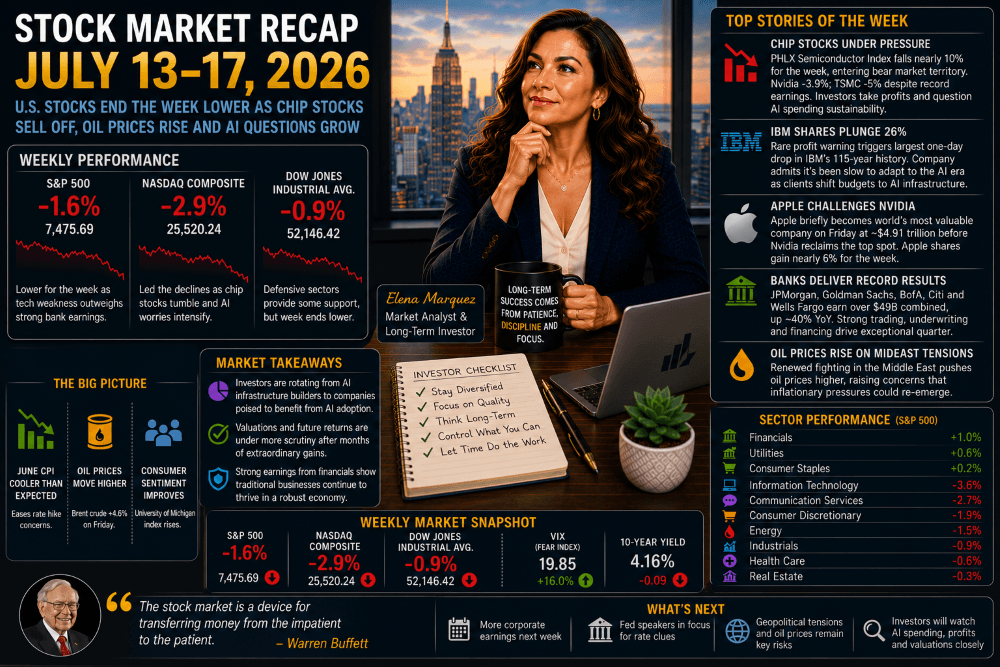
U.S. stocks ended the week lower as encouraging inflation data and strong bank earnings were overshadowed by rising oil prices and a sharp reversal in semiconductor and AI-related stocks.
For the week:
- Nasdaq Composite: −2.9%
- S&P 500: −1.6%
- Dow Jones Industrial Average: −0.9%
The Nasdaq suffered the largest decline because the week’s selling was concentrated in technology and chip stocks. The S&P 500 recorded its first weekly loss in three weeks and only its third since March.
Cooler Inflation Meets Higher Oil Prices
June’s Consumer Price Index came in below economists’ expectations, temporarily easing concerns that the Federal Reserve might need to raise interest rates again soon.
However, renewed fighting in the Middle East pushed oil prices sharply higher. Brent crude climbed 4.6% on Friday alone, reviving concerns that rising energy costs could eventually place renewed pressure on inflation, consumers and corporate profit margins.
The opposing signals left investors with a complicated outlook: inflation may be cooling now, but a prolonged energy shock could make the Federal Reserve’s job more difficult.
IBM Suffers a Historic Collapse
One of the week’s biggest stories was IBM, whose shares plunged approximately 26% after the company issued a rare profit warning.
The decline became IBM’s worst one-day performance on record and erased roughly $69 billion from its market value. Preliminary results indicated revenue and earnings would fall short of Wall Street’s expectations.
IBM acknowledged that corporate customers had redirected portions of their technology budgets toward AI infrastructure, including high-performance memory and storage products.
That raised a difficult question for one of America’s oldest technology companies:
Can IBM successfully reinvent itself for the AI era—or will it once again struggle to keep pace with a major technological transition?
Apple Challenges Nvidia for the Crown
Another closely watched contest involved Apple and Nvidia, which traded places during Friday’s session as the world’s most valuable publicly traded company.
Apple’s market capitalization briefly reached approximately $4.91 trillion. By the close, Nvidia was narrowly ahead at roughly $4.908 trillion, compared with Apple at approximately $4.902 trillion.
Apple gained nearly 6% during the week as investors became more optimistic about its ability to integrate artificial intelligence into the iPhone and its broader ecosystem.
The contest represents a change in the AI narrative. Investors are beginning to look beyond the companies building AI infrastructure and toward businesses capable of distributing AI products to billions of existing customers.
Chip Stocks Enter a Correction
The broader semiconductor sector experienced a brutal week.
The Philadelphia Semiconductor Index fell about 10%, pushing it more than 20% below its June peak and officially into bear-market territory. Nvidia, Micron and other high-flying chip stocks came under pressure as investors took profits and questioned whether the current pace of AI infrastructure spending can continue indefinitely.
Even excellent earnings were not enough to satisfy investors.
TSMC reported another quarter of powerful profit growth, yet its shares declined as the market focused on higher spending plans and increasingly demanding expectations.
This does not necessarily mean the AI boom is ending. It means investors are becoming more selective about valuations, competition and the potential returns generated by enormous capital expenditures.
Banks Deliver a Blockbuster Quarter
While technology struggled, financial stocks were among the week’s strongest performers.
JPMorgan Chase, Goldman Sachs, Bank of America, Citigroup and Wells Fargo all reported strong quarterly results. JPMorgan alone earned a record $21.2 billion, the highest quarterly profit ever reported by a U.S. bank, as investment-banking fees rose 30% and markets revenue surged 35%.
Banks benefited from active capital markets, strong trading revenue, corporate financing activity and resilient consumers.
The contrast was striking:
AI infrastructure companies faced questions about future returns, while banks were already earning substantial profits from financing and trading the AI boom.
The Bottom Line
The week highlighted a changing market landscape.
Investors rewarded Apple as a potential beneficiary of the next phase of AI adoption, while taking profits in many companies responsible for building the infrastructure behind it.
At the same time, strong financial-sector earnings demonstrated that traditional businesses can continue creating substantial value even when technology dominates the headlines.
Artificial intelligence remains a powerful long-term investment theme.
But revolutionary technology does not eliminate the importance of valuation, profitability and disciplined capital allocation.
The market is no longer asking only:
“Who will benefit from AI?”
It is increasingly asking:
“Who will earn an attractive return from it?”
Other Stock Market blog posts