| 📊 Alain’s Holdings — July 17, 2026 | ||||
|---|---|---|---|---|
| Symbol | Name | Price | Change | Change % |
| VOO | Vanguard S&P 500 ETF | 683.17 | -6.97 | -1.01% |
| QQQ | Invesco QQQ Trust | 795.33 | +89.39 | +12.66% |
| XIU.TO | iShares S&P/TSX 60 ETF | 52.83 | -0.15 | -0.28% |
Wall Street ended the week on a cautious note as another sharp selloff in semiconductor stocks overshadowed encouraging economic data and a generally solid start to earnings season.
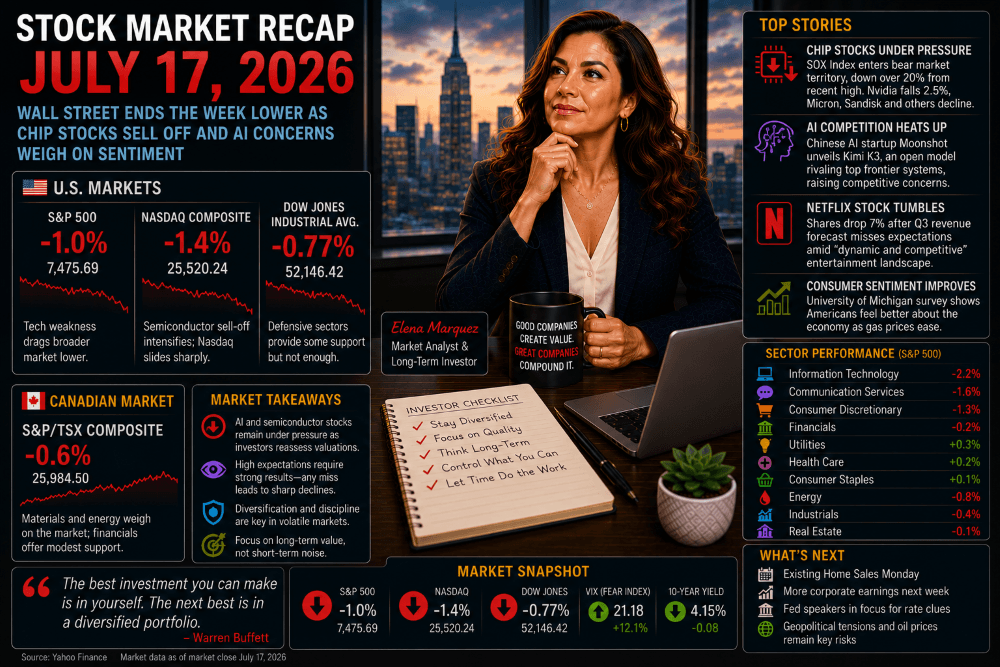
The Dow Jones Industrial Average fell by about 0.7%, while the S&P 500 declined by 1%. The Nasdaq Composite shed 1.4% following a downbeat day on Wall Street and the release of the world’s most powerful open AI model.
The biggest story remained the semiconductor industry.
The PHLX Semiconductor Index (SOX) officially entered bear market territory, having fallen more than 20% from its recent high. Despite the sharp decline, buyers stepped in during the afternoon, allowing many chip stocks to recover from their session lows.
The question investors are asking has shifted.
For nearly two years, markets rewarded companies simply for increasing AI spending.
Now investors want proof that those billions of dollars are producing meaningful profits.
Adding to the uncertainty, Chinese AI startup Moonshot AI unveiled Kimi K3, an open-weight large language model the company claims rivals some of the world’s most advanced AI systems. The announcement reinforced the idea that competition in artificial intelligence is accelerating much faster than many investors expected.
Another notable loser was Netflix.
Shares fell roughly 7% after the company issued third-quarter revenue guidance that disappointed Wall Street. Even though subscriber growth remains healthy, management acknowledged the streaming market has become increasingly competitive.
On the economic front, there was better news.
The University of Michigan’s preliminary consumer sentiment survey improved as lower gasoline prices boosted household confidence. Several regional banks also delivered generally solid earnings, suggesting the financial sector remains resilient despite ongoing economic uncertainty.
Today’s market illustrates an important investing lesson.
Great industries do not always make great investments at every price.
Artificial intelligence continues to transform the global economy.
But markets are now demanding something more than exciting technology.
They want profitability.
They want returns on capital.
They want execution.
That transition may create more volatility in the months ahead, but it is also how healthy bull markets mature.
For long-term investors, periods like these often reward patience more than prediction.
Comments
2 responses to “Stock Market Recap — July 17, 2026”
Hello Elizabeth,
Thank you for your comment. It gives me a lot of joy to know that someone reads at my posts.
I’m especially glad to hear the market recaps helped you stay invested. In my experience, resisting the urge to react emotionally during periods of uncertainty is one of the biggest advantages an individual investor can have.
I answered one of your previous comments before stating that my primiry goal is not to maximize return if the the price is additional stress. I feel confortable holding broadbased ETF because I have the faith that on the long run, 5 to 10 years from now, they will be higher. That is not the case with individual stocks. Look at the big winners of 10 years ago, you will see many of them gone.
Regarding SK Hynix, I think it’s an excellent company with impressive execution and a strong position in the high-bandwidth memory (HBM) market. That said, I try to separate great companies from great investments. A wonderful business purchased at an overly optimistic valuation can still produce disappointing long-term returns.
Missing a few spectacular winners is a price I’m happy to pay for owning a diversified portfolio that lets me sleep well at night. I love when I take long vacations and I don’t even have to look at a ticker to know that on the long run, I will be better off.
Thanks again for reading and for contributing such a thoughtful discussion.
Love these market recaps! I’ve been holding a sizeable QQQ position, and your posts honestly helped me stay the course back in June when I was second‑guessing it. QQQ is around 695 as I’m writing this (not the price in this post), so I’m hoping that patience continues to pay off.
I can also see why, as a more valuation‑sensitive investor, you’ve stayed away from SOXX and the more speculative memory names during the parabolic phase.
Curious on your take on SK Hynix specifically. I followed it closely but resisted FOMO when people around me were piling in.
I keep hearing the same AI narrative from most commentators, so it’s refreshing to read someone who’s more focused on returns on capital, profitability, and execution instead of just top‑line AI spend.