| 📊 Alain’s Holdings — July 24, 2026 | ||||
|---|---|---|---|---|
| Symbol | Name | Price | Change | Change % |
| VOO | Vanguard S&P 500 ETF | 679.14 | +0.53 | +0.08% |
| QQQ | Invesco QQQ Trust | 684.23 | -7.73 | -1.12% |
| XIU.TO | iShares S&P/TSX 60 ETF | 52.74 | +0.31 | +0.59% |
Wall Street ended the week under pressure as investors continued digesting Big Tech earnings, renewed tariff concerns, and an intensifying debate over the future of artificial intelligence.
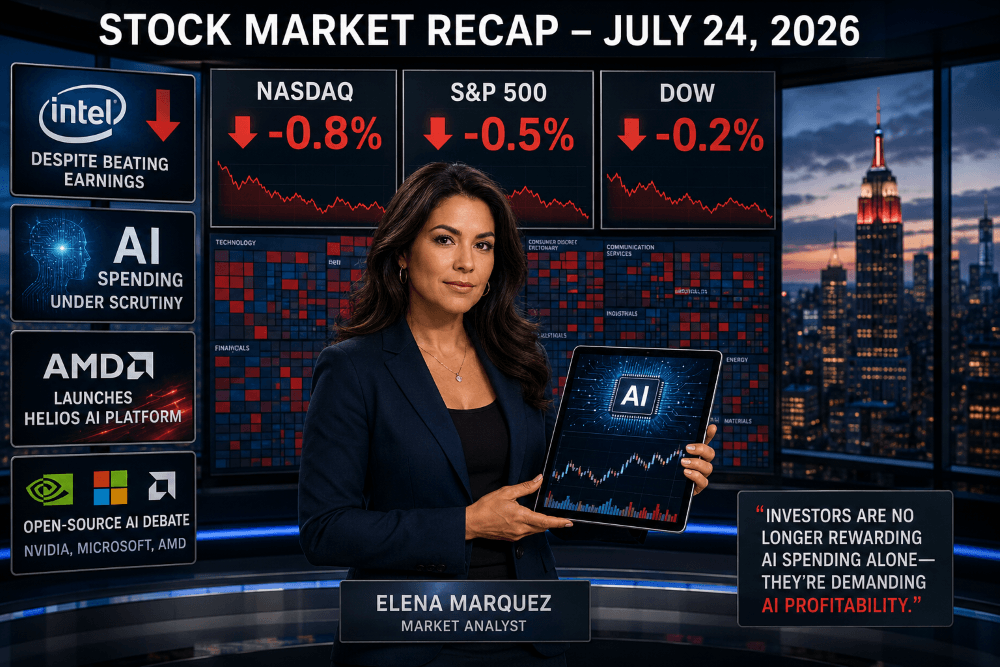
The Nasdaq Composite fell 0.8%, the S&P 500 declined 0.5%, and the Dow Jones Industrial Average slipped 0.2% as technology stocks remained the market’s weakest sector.
The dominant theme wasn’t disappointing earnings.
It was rising expectations.
AI Spending Faces More Scrutiny
Investors continue asking the same question:
When will AI spending translate into higher profits?
Earlier in the week, both Alphabet and Tesla reported strong revenue growth but also announced even larger capital spending plans.
Friday brought another reminder that Wall Street has become much more demanding.
Intel reported better-than-expected earnings and raised its outlook, yet its shares fell nearly 8% as investors questioned whether traditional chipmakers can keep pace with Nvidia and AMD in the next phase of AI infrastructure.
Today’s market demonstrated that beating earnings estimates is no longer enough.
Investors want accelerating profits—not simply larger investment budgets.
Open Source vs Closed AI
Another important story emerged from the AI industry itself.
During the week, Nvidia CEO Jensen Huang, Microsoft CEO Satya Nadella, and AMD CEO Lisa Su all expressed support for the rapid growth of open-source AI models developed by Chinese companies.
These models allow businesses to customize AI software rather than relying exclusively on proprietary systems from companies such as OpenAI, Anthropic, and Google.
This debate could become one of the most important themes in artificial intelligence over the next several years.
If open-source AI becomes widely adopted, competition could increase dramatically while reducing costs for businesses around the world.
AMD Raises the Stakes
AMD also unveiled its new Helios rack-scale AI platform, designed to compete directly with Nvidia’s newest AI systems.
The announcement reinforces that the AI race is becoming increasingly competitive.
Investors are no longer betting on one winner.
They’re evaluating an entire ecosystem of companies building chips, servers, cloud infrastructure, and AI software.
The Bottom Line
This week marked an important transition.
Markets are moving beyond excitement about artificial intelligence.
They are entering the stage where every dollar invested in AI must eventually produce measurable returns.
That’s a healthy evolution.
Innovation creates opportunity.
Profits create shareholder value.
Over the long run, the companies that successfully combine both are likely to become tomorrow’s biggest winners.
Other Stock Market blog posts