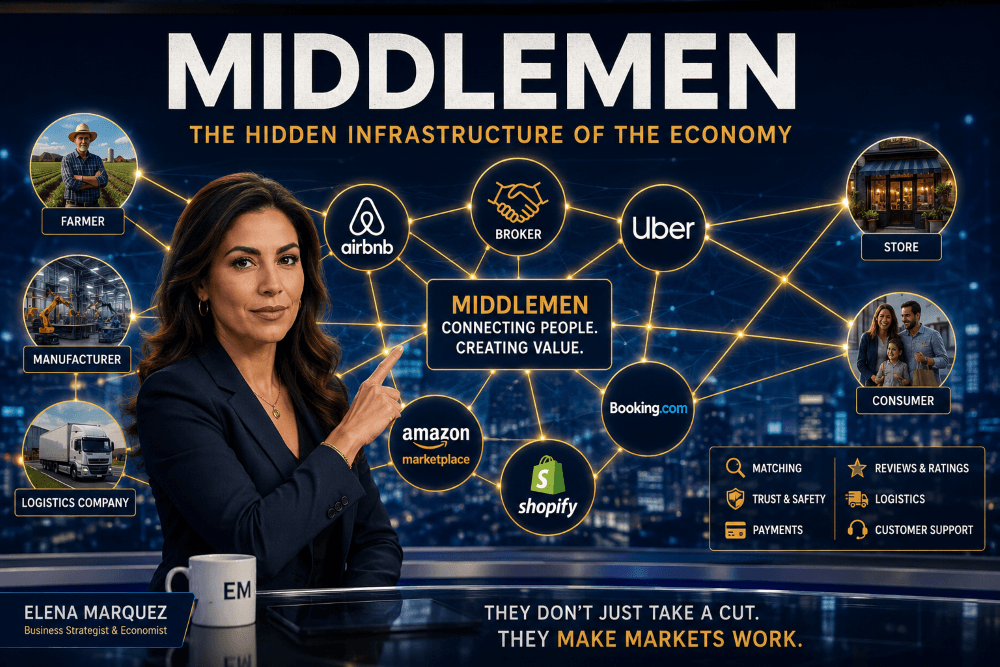
Middlemen: Why They Matter More Than Ever
The word middlemen often carries negative connotations. Many people assume that middlemen simply insert themselves between buyers and sellers, taking a cut without creating real value. Yet throughout history, middlemen have played an essential role in making markets more efficient, reducing transaction costs, connecting people, and enabling economic growth.
Without middlemen, modern economies would be far less productive. From ancient merchants to today’s digital platforms like Airbnb and Uber, middlemen solve problems that neither buyers nor sellers can easily solve on their own.
Ironically, while many predicted that the internet would eliminate middlemen, it actually created some of the largest and most valuable middlemen in history.
The History of Middlemen
Ancient Civilizations
Middlemen are almost as old as civilization itself.
Thousands of years ago, farmers rarely sold directly to distant customers. Merchants purchased grain, livestock, spices, textiles, and metals before transporting them to other cities.
These merchants assumed enormous risks:
- Transportation
- Theft
- Weather
- Storage
- Price fluctuations
Without them, long-distance trade would have been nearly impossible.
The Silk Road
The famous Silk Road wasn’t simply a road.
It was a massive network of thousands of merchants passing goods from one region to another.
A Chinese silk producer never sold directly to a Roman noble.
Instead, dozens of middlemen handled transportation, financing, warehousing, and negotiations along the journey.
Each middleman added value.
Medieval Europe
During the Middle Ages, wholesalers connected craftsmen with local markets.
Merchants financed voyages, maintained inventories, managed warehouses, and accepted commercial risk.
These activities dramatically expanded trade across Europe.
The Industrial Revolution
Factories produced goods on an unprecedented scale.
But factories could not sell millions of products directly to consumers.
An entire ecosystem emerged:
- Wholesalers
- Retailers
- Sales representatives
- Insurance brokers
- Freight companies
- Distributors
The industrial economy depended on middlemen.
Why People Distrust Middlemen
Middlemen often appear invisible.
A farmer grows food.
A factory manufactures products.
A carpenter builds furniture.
These activities are tangible.
Middlemen, however, coordinate information rather than produce physical goods.
People therefore assume they “aren’t doing anything.”
But appearances can be misleading.
What Value Do Middlemen Actually Create?
Economists describe middlemen as specialists in reducing transaction costs.
Instead of every buyer searching for every seller, middlemen make markets work more efficiently.
They create value by:
- Matching buyers with sellers
- Providing information
- Building trust
- Reducing search time
- Negotiating prices
- Handling payments
- Managing logistics
- Resolving disputes
- Marketing products
- Offering customer service
Many of these services become visible only when they disappear.
Middle Managers Are Middlemen Too
The term “middleman” doesn’t only apply to commerce.
Inside organizations, middle managers serve as information brokers.
They coordinate departments, allocate resources, solve conflicts, and ensure everyone works toward the same objectives.
Without coordination, organizations become chaotic.
Similarly, wedding planners act as middlemen between couples and dozens of vendors.
Real estate agents coordinate buyers, sellers, inspectors, lawyers, and lenders.
Talent agents connect actors with studios.
Recruiters connect employers with employees.
My frien Elijah, creator of Musiprof, connects music students with music teachers.
These people don’t manufacture products.
They manufacture coordination.
Why the Internet Didn’t Kill the Middleman
During the late 1990s, many experts believed the internet would eliminate middlemen.
Consumers would supposedly buy directly from manufacturers.
Producers would reach customers without brokers.
This process became known as disintermediation.
Some traditional middlemen did disappear.
Travel agencies shrank after online booking.
Stockbrokers lost business as online investing became common.
Classified ads moved online.
Yet something unexpected happened.
The internet created entirely new kinds of middlemen.
Rather than eliminating intermediaries, technology produced super-middlemen.
Why?
Because the internet dramatically increased information—but also increased complexity.
When millions of buyers and sellers can potentially connect, someone still needs to organize the marketplace.
Today’s digital middlemen solve new problems:
- Identity verification
- Reputation systems
- Secure payments
- Fraud prevention
- Customer support
- Search algorithms
- Recommendation engines
- Pricing optimization
The internet removed geographic barriers.
Middlemen removed informational barriers.
The Five Biggest Middlemen in Today’s Economy
1. Airbnb
Airbnb owns almost no hotels.
Instead, it connects travelers with property owners.
It provides trust through reviews, secure payments, insurance programs, and dispute resolution.
Without Airbnb, millions of individual hosts would struggle to reach global travelers.
2. Uber
Uber doesn’t own a large fleet of taxis.
Its value lies in matching drivers with passengers in seconds.
Its software handles routing, payments, pricing, ratings, and fraud prevention.
3. Amazon Marketplace
Although Amazon sells its own inventory, much of its business connects independent merchants with customers.
It provides logistics, payment processing, warehousing, customer service, and delivery.
Millions of small businesses rely on Amazon’s marketplace.
4. Booking.com
Hotels could theoretically sell rooms directly.
Yet Booking.com helps customers compare thousands of hotels worldwide.
It aggregates information, reviews, pricing, and availability in one place.
Convenience creates value.
5. Shopify
Unlike Amazon, Shopify enables merchants to build independent online stores.
Yet Shopify still acts as a middleman by providing payment processing, inventory tools, website hosting, shipping integrations, and marketing services.
It intermediates between merchants and the digital infrastructure required to operate online.
Are Middlemen Parasites?
Sometimes.
Poorly functioning markets can attract unnecessary intermediaries who merely extract fees.
History contains many examples of monopolistic brokers, corrupt licensing systems, and rent-seeking organizations.
But competitive markets usually eliminate middlemen who fail to create value.
Successful middlemen survive because they reduce costs by more than they charge.
If customers can easily bypass an intermediary without losing value, they eventually do.
The Future of Middlemen in the Age of AI
Artificial intelligence won’t eliminate middlemen.
It will transform them.
Many traditional coordination tasks will become automated.
AI agents will negotiate prices, compare products, schedule meetings, and process contracts.
However, new forms of intermediation will emerge.
Future middlemen may specialize in:
- AI-to-AI negotiations
- Verifying AI-generated information
- Authenticating identities
- Managing digital reputations
- Coordinating autonomous businesses
- Monitoring AI compliance
- Curating trusted information
- Human oversight for high-value decisions
Ironically, AI may increase the importance of trust.
As fake content becomes easier to generate, trusted intermediaries may become even more valuable.
The future middleman may look less like a salesperson and more like a trusted algorithm—or a human supervising one.
What We Can Learn from Middlemen
The history of commerce shows a consistent pattern.
Middlemen emerge wherever they reduce friction.
When markets become larger and more complex, the need for coordination grows.
Technology changes how middlemen operate, but it rarely eliminates the need for them.
From Silk Road merchants to Airbnb’s digital marketplace, intermediaries continue to solve one of the oldest problems in economics: helping people find one another and transact efficiently.
Far from being parasites, the best middlemen are invisible infrastructure that makes modern economies function.
Frequently Asked Questions
What is a middleman in economics?
A middleman is an individual or organization that connects buyers and sellers while reducing transaction costs through coordination, information, logistics, payments, or trust.
Why didn’t the internet eliminate middlemen?
The internet removed many traditional barriers but created new challenges such as trust, discovery, payments, fraud prevention, and reputation management. Digital platforms evolved to solve these problems.
Are middlemen necessary?
In many markets, yes. Efficient middlemen save time, reduce risk, and lower overall transaction costs. Poor middlemen eventually disappear when customers find better alternatives.
Will AI replace middlemen?
AI will automate many routine intermediary tasks, but it will also create new roles involving trust, verification, oversight, and coordination between humans and intelligent systems.