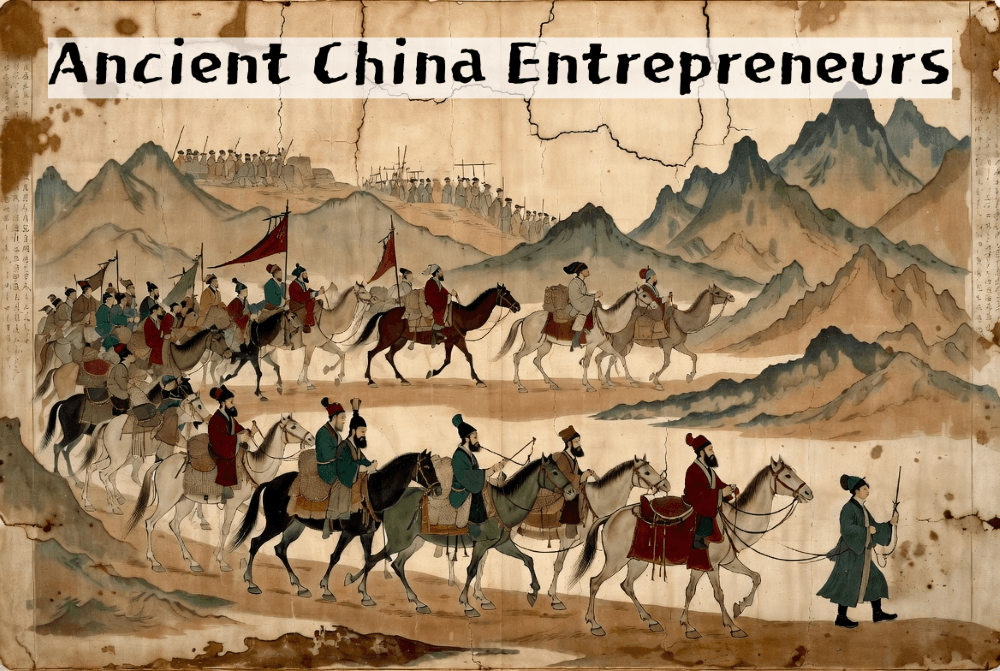
While Phoenician ships crossed the Mediterranean, an entirely separate commercial world was developing along the Yellow River. Ancient China entrepreneurs were building trade networks, currency systems, and merchant traditions largely isolated from the civilizations of the Near East.
This is the fifth article in our history of entrepreneurship series. China’s early commercial history followed its own path, shaped by dynasties, river systems, and eventually one of the most famous trade routes in history.
Who Were the First Ancient China Entrepreneurs?
Organized commerce in China emerged during the Shang dynasty (roughly 1600–1046 BC) and expanded significantly under the Zhou dynasty that followed. Unlike the merchant-led societies of Phoenicia, early Ancient China entrepreneurs operated within a strict social hierarchy.
Merchants were often viewed with suspicion by Confucian scholars, who ranked them below farmers and artisans in social importance. Despite this, trade flourished anyway, driven by necessity and opportunity.
1. The Shang Dynasty and Early Trade
The Shang dynasty is where China’s first clear evidence of organized commerce appears.
- Bronze workshops required tin and copper, often sourced through trade
- Cowrie shells were used as an early form of currency
- Trade networks connected the Yellow River region with surrounding areas
2. The Zhou Dynasty Expands Commerce
Under the Zhou dynasty (1046–256 BC), trade became more structured and widespread.
- Standardized weights and measures made trade more reliable
- Different regions specialized in specific goods, encouraging exchange
- Merchant families began accumulating real wealth and influence
3. The Rise of Metal Currency
Bartering with cowrie shells gradually gave way to something more familiar.
- Bronze coins, often shaped like tools such as knives and spades, appeared by the late Zhou period
- Standardized currency made trade faster and disputes easier to resolve
- This shift mirrors similar developments happening independently in Mesopotamia and the Mediterranean
What Did Ancient China Entrepreneurs Trade?
China’s geography, rivers, mountains, and vast distances, shaped what merchants could realistically move and sell.
- Silk – already prized domestically long before it reached the wider world
- Jade – highly valued for ornamental and ceremonial use
- Salt and iron – essential goods that became heavily regulated by the state
- Bronze goods – tools, weapons, and ceremonial vessels
- Grain – traded regionally to balance surplus and shortage
Salt and Iron: China’s First Major Regulated Industries
Salt and iron deserve special attention, since they became flashpoints between merchants and the state.
- Both were essential, giving merchants who controlled them significant power
- Some rulers attempted to monopolize these industries to control wealth and taxation
- This tension between private enterprise and state control became a recurring theme in Chinese economic history
The Birth of the Silk Road
No discussion of Ancient China entrepreneurs is complete without mentioning the origins of the Silk Road. While the route became truly famous later, its foundations were laid within this era.
- Around the 2nd century BC, Chinese envoy Zhang Qian was sent westward to form alliances
- His journeys revealed trade opportunities with Central Asia
- This groundwork eventually connected China to Persia, India, and the Mediterranean world
Merchants who took on these long, dangerous westward journeys were taking enormous risks, much like their Phoenician counterparts at sea, but on camelback across deserts and mountains instead.
Merchants vs. Confucian Values
One of the more unique aspects of Ancient China entrepreneurs is the tension between commerce and cultural values.
- Confucian philosophy placed merchants near the bottom of the social order
- Farmers were seen as producing real value; merchants were seen as merely moving goods
- Despite this stigma, successful merchants still amassed significant wealth and, eventually, influence
This created a uniquely Chinese pattern: entrepreneurship that thrived economically while facing constant philosophical and social skepticism.
Why This Matters for the History of Entrepreneurship
Ancient China shows us another distinct model of early commerce, shaped by geography, philosophy, and state power all at once.
- Trade flourished even within a culture that officially looked down on merchants
- Standardized currency and measurements solved the same problems Sumer and Egypt faced independently
- Long-distance trade risk-taking, later formalized by the Silk Road, mirrors patterns seen in Phoenician maritime trade
Different geography, different philosophy, same underlying human drive to trade, specialize, and profit.
FAQ: Ancient China Entrepreneurs and Early Trade
When did organized commerce begin in Ancient China? Clear evidence of organized trade appears during the Shang dynasty, around 1600–1046 BC, with significant expansion during the later Zhou dynasty.
What did Ancient China entrepreneurs use as currency? Early trade relied on cowrie shells, later replaced by bronze coins, often shaped like miniature tools such as knives and spades.
Why were merchants looked down upon in Ancient China? Confucian philosophy valued farmers and producers over merchants, viewing trade as less honorable than direct production, even though merchants often grew quite wealthy.
How does the Silk Road connect to this period? Its foundations were laid around the 2nd century BC through diplomatic missions like Zhang Qian’s journey west, eventually opening trade routes connecting China to Central Asia and beyond.
Previous History of Entrepreneurship posts