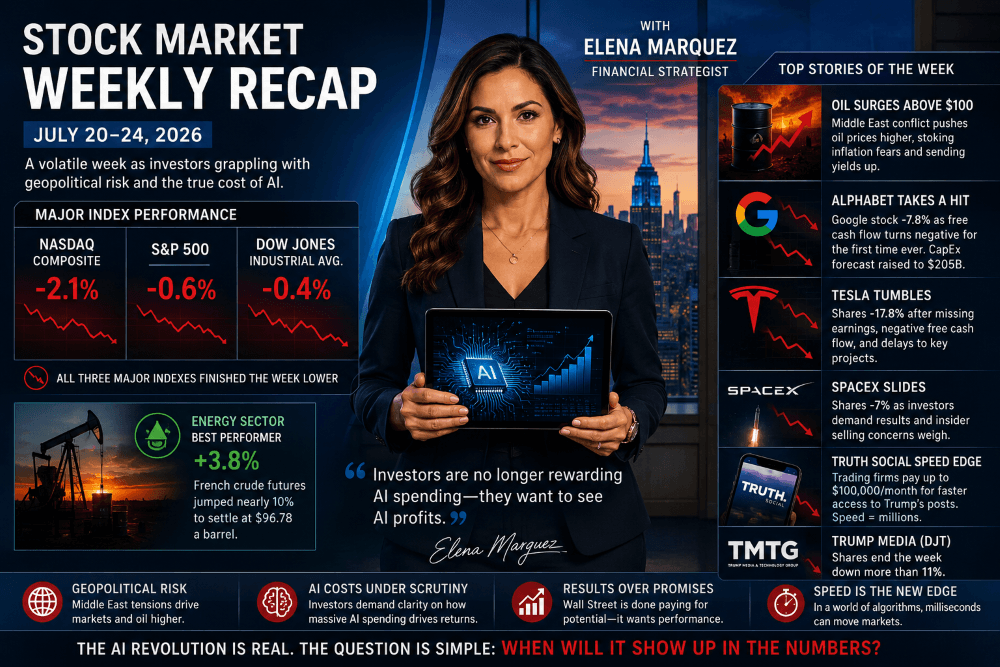
The week began with optimism but ended with investors confronting three powerful realities: higher oil prices, rising geopolitical risk, and the staggering cost of the AI revolution.
By Friday’s close, all three major U.S. indexes finished lower:
- 📉 Nasdaq Composite: -2.1%
- 📉 S&P 500: -0.6%
- 📉 Dow Jones Industrial Average: -0.4%
While new tariffs from the Trump administration made headlines, they were overshadowed by developments in the Middle East and a dramatic reassessment of Big Tech’s AI spending.
Oil Returns Above $100
The conflict in the Middle East intensified throughout the week, pushing oil prices sharply higher.
Brent crude briefly climbed above US$100 per barrel, while French crude futures surged nearly 10%.
The result was immediate:
- Inflation fears returned.
- Treasury yields climbed to their highest levels in months.
- Investors reduced expectations for Federal Reserve rate cuts.
Energy became the week’s best-performing sector, gaining 3.8%, while most growth stocks moved lower.
The AI Reality Check
This may be remembered as the week Wall Street stopped rewarding AI spending—and started demanding AI profits.
Alphabet reported another strong quarter, but investors focused almost exclusively on one statistic:
Free cash flow.
For the first time since becoming a public company more than twenty years ago, Alphabet’s free cash flow turned negative after enormous investments in AI infrastructure.
Management also raised its capital spending forecast to US$205 billion, exceeding what many analysts had viewed as a psychological limit.
The market’s response was swift.
Alphabet shares fell 7.8% for the week.
The message from investors was clear:
Show us how AI spending becomes AI earnings.
Tesla’s Toughest Week in Years
Tesla endured an even more painful week.
Shares plunged nearly 18% after the company:
- Missed earnings expectations.
- Reported negative free cash flow for the first time in two years.
- Delayed several high-profile projects, including Robotaxi, Optimus humanoid robots, and its electric semi-truck.
Investors are increasingly shifting their focus from ambitious long-term visions to measurable financial results.
Competition in AI Intensifies
Another important story emerged away from the earnings reports.
Nvidia CEO Jensen Huang, Microsoft’s Satya Nadella, and AMD’s Lisa Su all expressed support for China’s rapidly growing open-source AI ecosystem.
Meanwhile, AMD officially launched its Helios AI platform to compete directly with Nvidia’s newest AI systems.
The AI race is no longer simply about building bigger models.
It’s becoming a battle over open versus closed ecosystems, software flexibility, hardware leadership, and long-term profitability.
Markets Become Faster Than Ever
One of the week’s most fascinating stories wasn’t about earnings.
It was about speed.
According to reports, several high-frequency trading firms are paying US$100,000 per month for immediate access to President Trump’s Truth Social posts through a premium API.
Algorithms scan each post in milliseconds for words like Iran, tariffs, or company names before automatically placing trades.
Artificial intelligence isn’t just transforming products.
It’s transforming how financial markets themselves operate.
The Bottom Line
This week’s selloff wasn’t driven by weak economic data.
It reflected a changing investment mindset.
Wall Street remains enthusiastic about artificial intelligence.
But enthusiasm alone is no longer enough.
Investors now want to see:
- Strong free cash flow.
- Disciplined capital spending.
- Clear paths to profitability.
- Measurable returns on AI investments.
The companies that can successfully balance innovation with financial discipline are likely to define the next phase of this market.
Other Stock Market blog posts