What made entrepreneurship possible?
Most people assume entrepreneurship began when someone opened the first shop, built the first company, or invented money. In reality, entrepreneurship is far older than any of those innovations.
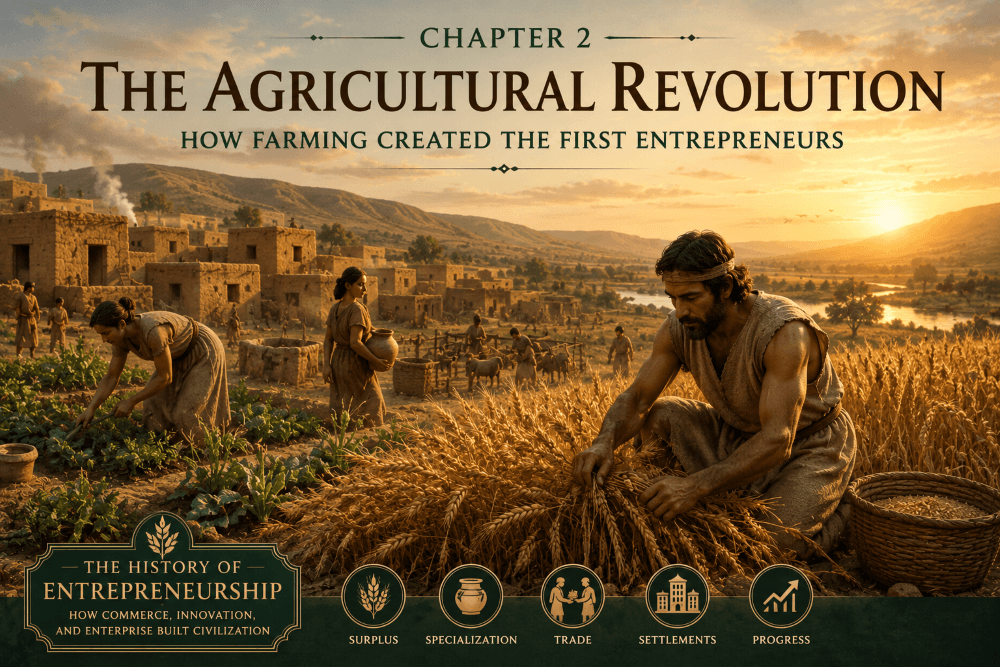
The Agricultural Revolution transformed humanity from wandering hunter-gatherers into settled communities capable of producing surplus food, specializing in different occupations, and trading with one another. Without agriculture, there would have been no cities, no markets, no merchants, and ultimately no entrepreneurs.
If Chapter 1 showed that entrepreneurship begins with voluntary exchange, this chapter explains why that exchange became sustainable.
Life Before the Agricultural Revolution
For hundreds of thousands of years, humans lived as hunter-gatherers.
People survived by hunting animals, fishing, and gathering edible plants. Small communities moved frequently in search of food and water. Most people performed similar tasks because survival required everyone to contribute in roughly the same way.
This lifestyle left little room for entrepreneurship.
Without permanent settlements:
- There were no stores.
- There were no workshops.
- There were no warehouses.
- There were no regular customers.
People consumed what they found.
Very little could be saved for tomorrow.
The Agricultural Revolution Changed Everything
Around 10,000 BCE, several human societies made one of history’s greatest discoveries.
Instead of simply collecting wild plants, they learned to cultivate crops.
Instead of hunting only wild animals, they began domesticating livestock.
Agriculture emerged independently in several parts of the world, including:
- The Fertile Crescent
- Ancient China
- The Indus Valley
- Mesoamerica
- The Andes
- New Guinea
Although each civilization followed a different path, the economic consequences were remarkably similar.
People settled permanently.
Villages expanded.
Populations grew.
Trade increased.
The foundations of entrepreneurship were established.
Surplus: The Birth of Economic Growth
The Agricultural Revolution introduced one revolutionary concept:
Surplus.
A successful harvest often produced more food than a family could immediately consume.
That extra grain represented far more than additional meals.
It became:
- Savings
- Investment
- Insurance against poor harvests
- A valuable trading commodity
For the first time in history, families could produce more than they needed for immediate survival.
This simple idea remains the foundation of every modern business.
Profits are today’s surplus.
Investment is tomorrow’s growth.
Specialization Created the First Entrepreneurs
Once communities consistently produced enough food, not everyone needed to become a farmer.
Some individuals focused entirely on one craft.
Examples included:
- Potters
- Toolmakers
- Weavers
- Builders
- Metalworkers
- Merchants
Because these specialists practiced their craft every day, their skills improved dramatically.
Higher quality products encouraged trade.
Trade encouraged innovation.
Innovation encouraged prosperity.
Economists call this specialization, one of the most powerful drivers of productivity ever discovered.
Markets Begin to Form
As villages expanded, people naturally began exchanging goods and services.
A potter traded jars for grain.
A shepherd exchanged wool for clothing.
A carpenter built homes in exchange for food.
Over time, regular trading locations emerged.
These early markets became the economic heart of growing communities.
Markets did not require governments to invent them.
They emerged because voluntary exchange benefited everyone involved.
The same principle continues to drive free markets today.
The First Investments
Agriculture also introduced long-term thinking.
Farmers planted seeds months before harvest.
They built irrigation canals.
They stored grain for future seasons.
They domesticated animals that would not produce offspring immediately.
Each decision involved sacrificing resources today in anticipation of greater rewards tomorrow.
Modern entrepreneurs operate on exactly the same principle.
Launching a startup often requires years of work before earning significant profits.
The tools have changed.
The mindset has not.
Property Rights Encourage Innovation
Permanent settlements also strengthened the idea of ownership.
Families invested time improving land because they expected to benefit from those improvements.
They built homes.
They dug wells.
They planted orchards.
They stored food.
Secure property rights encouraged people to think long term.
Throughout history, societies with relatively stable property rights often experienced greater investment and economic development because individuals expected to enjoy the rewards of their efforts.
The Costs of Progress
The Agricultural Revolution brought extraordinary benefits, but it also introduced new challenges.
Growing populations led to:
- Disease outbreaks
- Competition over land
- Social inequality
- Organized warfare
- Taxation
- More complex governments
History rarely moves in one direction.
Innovations create opportunities while also creating new problems that future generations must solve.
Entrepreneurship follows this same pattern throughout history.
Why the Agricultural Revolution Still Matters
Although few modern entrepreneurs work on farms, nearly every business still depends on principles established during this period.
Successful companies create surplus.
They specialize.
They invest.
They plan for the future.
Whether building software, manufacturing automobiles, or opening a neighborhood bakery, entrepreneurs continue applying lessons first learned by the world’s earliest farming communities.
Technology evolves.
Human incentives remain remarkably consistent.
The Entrepreneur’s Toolbox
Surplus
The first great entrepreneurial breakthrough was not money.
It was producing more than was immediately needed.
Surplus allows people to:
- Save
- Invest
- Experiment
- Hire workers
- Build businesses
- Improve productivity
Without surplus, entrepreneurship cannot scale.
Five Lessons Modern Entrepreneurs Can Learn
1. Produce More Value Than You Consume
Businesses grow when they consistently create value beyond their operating costs.
2. Think Long Term
Farmers waited months for harvests.
Entrepreneurs often wait years for success.
Patience remains a competitive advantage.
3. Specialization Creates Excellence
Mastering one craft usually produces better results than trying to do everything.
4. Invest Before You Harvest
Every successful business requires upfront investment.
Growth comes from planting today’s seeds for tomorrow’s returns.
5. Prosperity Is Built Through Cooperation
Markets succeed because voluntary exchange benefits both buyers and sellers.
The best entrepreneurs create value for everyone involved.
Frequently Asked Questions
Why is the Agricultural Revolution important to entrepreneurship?
The Agricultural Revolution created food surplus, allowing people to specialize in different occupations. Specialization led to trade, markets, innovation, and eventually entrepreneurship.
What is surplus in economics?
Surplus is production beyond immediate consumption. It allows individuals and societies to save resources, invest in future growth, and support specialized workers.
Did entrepreneurship exist before money?
Yes. Long before coins existed, people exchanged goods and services through barter. Entrepreneurship began with creating value for others, not with the invention of currency.
Why does specialization increase productivity?
When individuals focus on a single skill or profession, they become more efficient and produce higher-quality goods and services, benefiting both themselves and society.
Looking Ahead
Agriculture allowed villages to grow into thriving communities.
As trade expanded, people encountered a new problem.
How could they keep track of inventories, debts, taxes, and business agreements?
The answer would become one of the greatest business innovations in history:
Writing.
In the next chapter, we travel to ancient Mesopotamia, where merchants and scribes developed the first systems of accounting and record-keeping—tools that still underpin modern business today.
North Star
Entrepreneurship flourishes when societies create surplus. Surplus makes specialization possible, specialization encourages trade, and trade becomes the foundation of civilization itself.
Previous History of Entrepreneurship posts