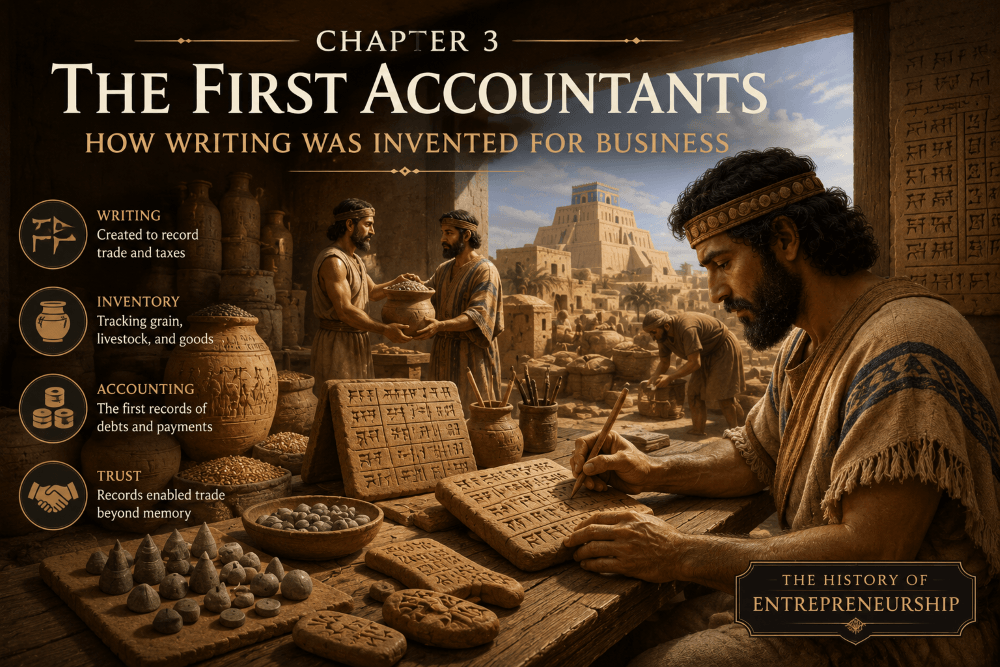
When most people think about the invention of writing, they imagine ancient literature, religious texts, or the first great works of history.
The reality is far more surprising.
Writing was invented for business.
Long before people wrote poems, they recorded inventories.
Long before they wrote philosophy, they tracked taxes.
Long before they wrote history, they managed commerce.
One of humanity’s greatest inventions did not begin in a library.
It began in a warehouse.
The Problem That Commerce Created
As explained in the previous chapters of The History of Entrepreneurship, agriculture created food surplus.
Surplus allowed people to specialize.
Specialization encouraged trade.
Trade created markets.
As villages grew into cities, business became increasingly complex.
Merchants needed to know:
- How much grain remained in storage?
- Which farmer had already been paid?
- How many sheep belonged to each family?
- Which debts remained outstanding?
Memory alone could no longer manage growing economies.
Civilization needed a better system.
Ancient Mesopotamia: The Birthplace of Business Records
Around 3500 BCE, cities in southern Mesopotamia—including Uruk and Ur—became thriving centers of commerce.
Large temple complexes functioned as economic institutions.
They:
- Stored grain.
- Managed livestock.
- Paid workers.
- Collected taxes.
- Organized construction projects.
- Traded with neighboring regions.
Managing thousands of transactions required accurate records.
This need gave rise to one of history’s most important innovations.
Writing.
Before Writing Came Accounting
Interestingly, accounting existed before writing.
Archaeologists have discovered small clay tokens dating back thousands of years before written language.
Each token represented something valuable.
Examples include:
- Sheep
- Grain
- Oil
- Livestock
- Manufactured goods
Merchants stored these tokens inside clay envelopes known as bullae.
Marks pressed onto the outside identified what was sealed within.
Eventually, people realized something remarkable.
If the marks already represented the goods, there was little need to keep the tokens themselves.
The symbols became the record.
Writing had begun.
Cuneiform: The World’s First Business Language
The earliest known writing system, called cuneiform, appeared in Mesopotamia around 3400–3200 BCE.
Rather than telling stories, the earliest tablets recorded practical information such as:
- Grain deliveries
- Livestock inventories
- Worker payments
- Taxes
- Commercial transactions
The first known scribes were not authors.
They were accountants.
Their work helped merchants organize increasingly sophisticated businesses.
Why Accounting Changed the World
Accounting may not seem as exciting as the wheel or the steam engine.
Yet it transformed civilization.
Accurate records made it possible to:
- Manage larger organizations.
- Reduce disputes.
- Track profits and losses.
- Plan future investments.
- Expand trade.
- Build trust between strangers.
Without accounting, modern business would be impossible.
Every invoice, balance sheet, payroll system, inventory report, and tax return can trace its intellectual roots back to ancient Mesopotamia.
The Rise of Professional Scribes
As writing became more sophisticated, a new profession emerged.
The scribe.
Learning cuneiform required years of education.
Scribes prepared contracts.
Recorded inventories.
Calculated taxes.
Managed business records.
In many ways, they became the world’s first professional information managers.
Today their descendants include:
- Accountants
- Auditors
- Financial analysts
- Lawyers
- Bookkeepers
- Controllers
Although the tools have changed dramatically, the underlying role remains remarkably similar.
Why Entrepreneurs Should Care About Accounting
Many entrepreneurs love creating products.
Fewer enjoy bookkeeping.
History shows that successful businesses need both.
Good accounting allows entrepreneurs to answer essential questions.
For example:
- Which products are profitable?
- Which customers still owe money?
- How much inventory remains?
- Can the business afford to expand?
- Are expenses growing too quickly?
Entrepreneurs who ignore their numbers often lose control of their businesses.
Those who understand their numbers make better decisions.
Writing Made Business Scalable
The earliest entrepreneurs could rely on memory because they served relatively small communities.
Large organizations required something different.
They required systems.
Writing became the technology that allowed business to scale beyond personal relationships.
Instead of trusting only people they knew personally, merchants could increasingly rely on written records.
This shift helped commerce expand across cities, kingdoms, and eventually continents.
The Entrepreneur’s Toolbox
Accounting
Accounting is the language of business.
It transforms information into decisions.
It allows entrepreneurs to measure performance, control costs, and plan for growth.
One timeless principle remains true:
What gets measured gets managed.
Five Lessons for Modern Entrepreneurs
1. Systems matter as much as ideas.
Creative businesses still need organized records.
2. Numbers tell stories.
Financial statements reveal what customers truly value.
3. Growth increases complexity.
The larger a business becomes, the more important accurate information becomes.
4. Trust depends on transparency.
Clear records strengthen relationships with employees, investors, suppliers, and customers.
5. Accounting is a competitive advantage.
Entrepreneurs who understand their finances make better long-term decisions.
Frequently Asked Questions
Why was writing invented?
The earliest known writing was developed in ancient Mesopotamia primarily to record business transactions, inventories, taxes, and agricultural production.
What is cuneiform?
Cuneiform is one of the world’s earliest writing systems. It was developed by the Sumerians in Mesopotamia around 3400–3200 BCE using wedge-shaped marks pressed into clay tablets.
Were the first writers accountants?
In many cases, yes. The earliest scribes were responsible for recording commercial transactions, inventories, taxes, and payments rather than literature or history.
Why is accounting important to entrepreneurship?
Accounting helps entrepreneurs measure performance, manage cash flow, monitor inventory, make informed decisions, and build trust with investors, suppliers, and customers.
Continue the Journey
Entrepreneurship did not begin with corporations.
It began with exchange.
Agriculture created surplus.
Surplus made specialization possible.
Writing allowed commerce to grow beyond memory.
But another challenge remained.
How could merchants trade efficiently across long distances without transporting sacks of grain or herds of livestock?
The answer would become one of humanity’s greatest economic innovations:
Money.
In the next chapter, we’ll explore how the invention of money transformed local trade into global commerce.
Related Articles
- The First Entrepreneur: When Did Entrepreneurship Begin?
- The Agricultural Revolution: How Farming Created the First Entrepreneurs
- The Birth of Money: Why Currency Changed Everything (Coming Soon)
- The History of Accounting (Coming Soon)
- The Sumerians: The World’s First Great Business Civilization (Coming Soon)
About The History of Entrepreneurship
This article is part of The History of Entrepreneurship, a long-form series exploring how commerce, innovation, and enterprise shaped civilization—from the first traders in prehistory to today’s AI pioneers.
Follow the series as we trace the ideas, inventions, and entrepreneurs that transformed the world.
North Star
Writing was humanity’s first information technology—and business was its first customer.
Previous History of Entrepreneurship posts