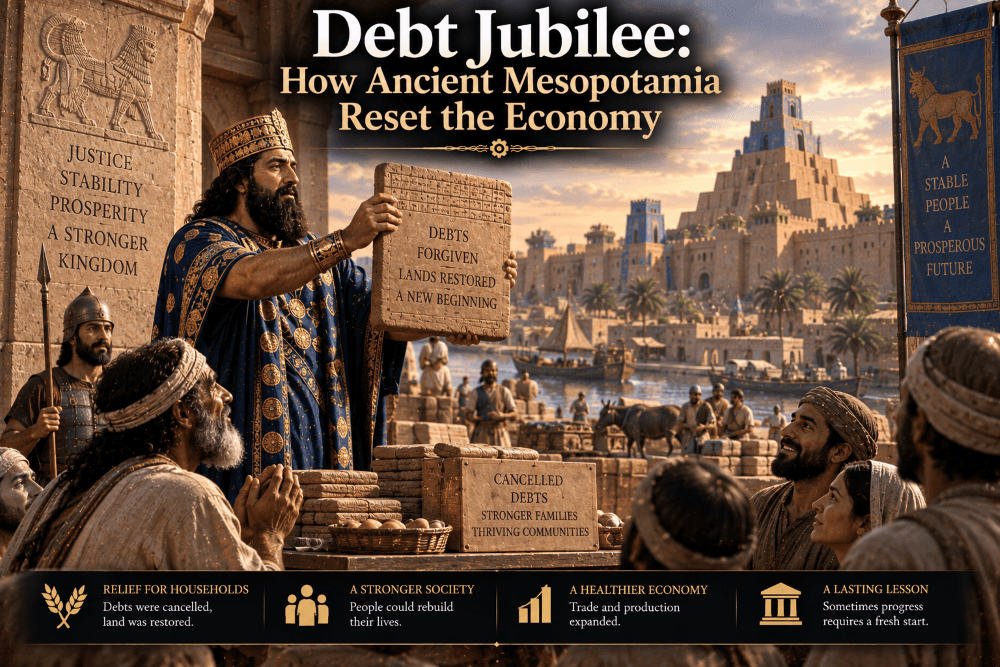
Modern economies keep running into the same wall: debt accumulates faster than it can realistically be repaid, and there’s rarely a clean mechanism to reset the system. Ancient Mesopotamia faced the identical problem thousands of years ago, and its solution, the debt jubilee, offers a striking historical case study in how early economies managed the risk of runaway debt before it tore society apart.
The Problem: Debt Without a Reset
Contemporary financial systems have grown remarkably sophisticated at extending credit, but far less capable of managing what happens when that credit becomes unpayable.
- Public and private debt levels in many modern economies have grown to levels many economists consider structurally unstable.
- Bankruptcy law offers some relief, but it operates individually and unevenly rather than addressing systemic overindebtedness.
- Few modern mechanisms exist for a coordinated, society-wide debt reset, the kind ancient Mesopotamian rulers used regularly.
Understanding how one of history’s earliest civilizations approached this exact problem offers useful perspective on a challenge that clearly isn’t new.
Ancient Mesopotamia and the Record of Clay
The World’s First Urban Societies
Mesopotamia, located in what is now Iraq and parts of Syria, gave rise to some of humanity’s earliest urban civilizations, beginning around 3,300 BCE.
- Cities like Uruk, Ur, and later Babylon developed complex systems of governance, religion, and commerce.
- This urbanization required increasingly sophisticated economic recordkeeping as trade and taxation grew more complex.
- Mesopotamian societies developed some of the earliest known writing systems specifically to manage this growing administrative need.
Clay Tablets as Financial Records
Unlike the papyrus used in Egypt or later parchment, Mesopotamians recorded information on durable clay tablets, leaving behind an extraordinarily detailed historical record.
- These tablets recorded transactions, debts, contracts, and legal rulings in remarkable day-to-day detail.
- Their durability means thousands of these records have survived for millennia, giving historians direct insight into ancient financial life.
- This record is precisely how modern historians know so much about Mesopotamian debt practices, including the debt jubilee itself.
The Economic Roots of Mesopotamian Debt
An Agricultural Foundation
Mesopotamia’s economy was built primarily around agriculture, particularly barley cultivation and livestock, sustained through river irrigation managed largely by palaces and temples.
- Farmers depended heavily on predictable harvests to meet their tax and rent obligations to palace or temple authorities.
- Poor harvests, caused by drought, flooding, or other disruptions, left farmers unable to meet these obligations through normal means.
- In these situations, farmers frequently took out loans, often in grain, simply to survive until the next harvest.
This dependence on agricultural output created a recurring cycle where bad years pushed ordinary farmers directly into debt.
High Interest and Debt Slavery
The terms of these loans were often severe, creating serious risk for already vulnerable borrowers.
- Interest rates on grain loans could reach as high as 33⅓ percent, an extraordinarily high burden for subsistence farmers.
- When debtors defaulted, they were frequently required to pledge land, livestock, or property as collateral.
- In the most severe cases, debtors were forced to pledge family members, and eventually themselves, into debt slavery to work off the outstanding balance.
Left unchecked, this cycle risked concentrating land and labor into the hands of a small creditor class while leaving much of the population in bondage.
The Debt Jubilee: Wiping the Slate Clean
Why Rulers Intervened
Mesopotamian kings recognized that unchecked debt accumulation threatened more than individual families. It threatened the stability of the kingdom itself.
- Widespread debt slavery reduced the pool of free farmers available for royal labor and military service.
- Extreme inequality and social breakdown risked undermining a king’s authority and the broader social order.
- Periodic debt cancellation offered a way to prevent these outcomes while reinforcing a new ruler’s legitimacy and public goodwill.
The Meaning of Ama-ar-gi
The Sumerian term for this practice, ama-ar-gi, is often translated as “return to mother” or, more broadly, freedom, capturing the idea of returning debtors to their original, unencumbered status.
- Debt jubilees were most commonly declared when a new king ascended to the throne, functioning as both economic policy and political statement.
- These decrees aimed to restore the economic starting conditions that existed before debt had accumulated and spiraled.
- This practice appears repeatedly across Mesopotamian history, suggesting it functioned as a recognized, expected mechanism rather than a rare emergency measure.
How a Debt Jubilee Was Enforced
The process of actually carrying out a debt jubilee involved clear public signals and physical enforcement mechanisms.
- A king would light a golden torch as a symbolic announcement, spreading word of the cancellation across the kingdom.
- Local officials established committees where debtors could bring their loan tablets.
- These tablets were then physically broken, permanently destroying the creditor’s legal claim to repayment.
Consumer Debt Versus Commercial Debt
Mesopotamian rulers drew an important distinction that made their debt jubilee more economically sustainable than a blanket cancellation might have been.
- Debts of need, those taken on by ordinary people simply to survive, particularly the poor, widows, and orphans, were typically canceled.
- Commercial debts tied to trade and business ventures were generally left intact, preserving incentives for continued economic activity.
- This distinction allowed rulers to relieve social distress without completely undermining the broader commercial credit system.
Hammurabi and the Legal Codification of Debt Relief
The Code of Hammurabi
Hammurabi, who ruled Babylon beginning around 1792 BCE, is remembered for one of history’s most extensive legal codes, inscribed on a seven-foot basalt stele now housed in the Louvre.
- His code covered an enormous range of economic, social, and legal matters, including specific provisions addressing debt.
- Law 48 within his code explicitly stated that if natural disasters, such as floods or droughts, destroyed a farmer’s crop, that farmer’s grain debt and accrued interest for the affected year were canceled.
- This provision functioned as an early form of force majeure protection, directly linking debt relief to circumstances genuinely beyond a debtor’s control.
Active Governance and Enforcement
Historical correspondence shows that Hammurabi took a notably hands-on approach to enforcing these protections.
- Surviving letters indicate he personally intervened in regional disputes to ensure fair treatment of debtors.
- He worked to prevent wealthy creditors from exploiting poorer citizens through excessive or unjust debt claims.
- This active governance style reinforced his legal code’s provisions with real, ongoing enforcement rather than leaving them as purely symbolic law.
Lessons from the Mesopotamian Debt Jubilee
- Unchecked debt threatens more than individuals. Mesopotamian rulers recognized that widespread debt slavery destabilized the entire kingdom, not just indebted families.
- Selective relief can preserve incentives. Distinguishing between survival debt and commercial debt allowed relief without collapsing the broader credit system.
- Legal protection against uncontrollable circumstances has ancient roots. Hammurabi’s force majeure provision shows this concept predates modern contract law by millennia.
Frequently Asked Questions
What was a Mesopotamian debt jubilee? It was a periodic royal decree canceling certain debts, particularly those owed by ordinary farmers and workers, aimed at preventing widespread debt slavery and social instability.
What does ama-ar-gi mean? Ama-ar-gi is a Sumerian term often translated as “return to mother” or freedom, referring to the restoration of debtors to their original, unencumbered economic status.
Did Mesopotamian debt cancellations apply to all debt? No, rulers typically distinguished between consumer debts of need, which were often canceled, and commercial debts tied to trade, which were generally preserved to maintain economic activity.
What did Hammurabi’s Code say about debt? Law 48 in Hammurabi’s Code canceled a farmer’s grain debt and interest for a given year if natural disasters like floods or droughts destroyed their crop, an early form of force majeure protection.