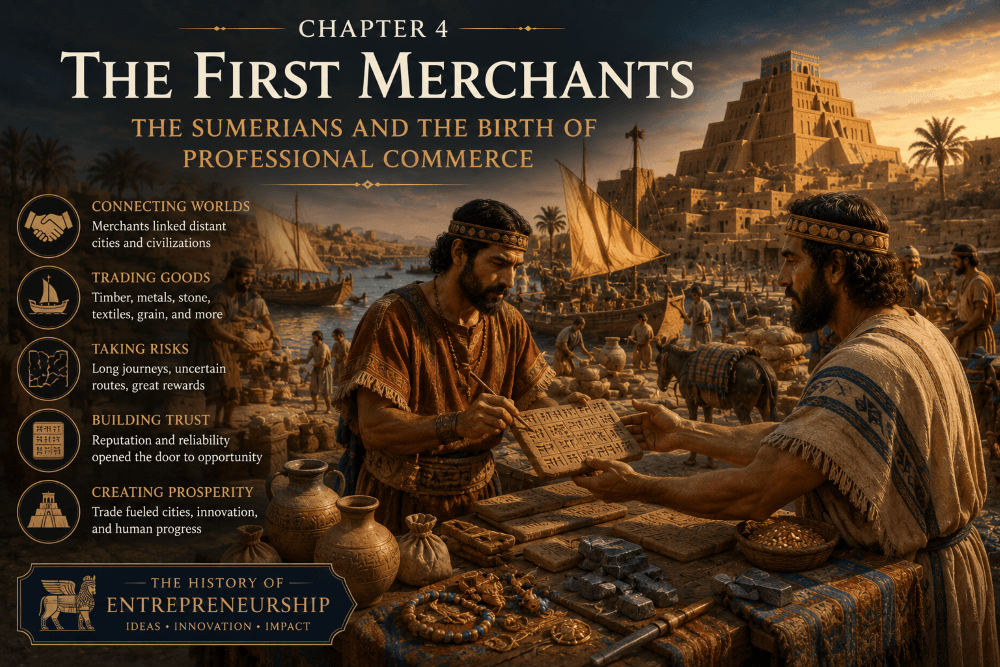
Who were the world’s first professional entrepreneurs?
Many people assume entrepreneurship began with famous business leaders like Henry Ford, John D. Rockefeller, or Steve Jobs.
In reality, the first professional entrepreneurs lived more than 5,000 years ago.
They were the Sumerian merchants of ancient Mesopotamia.
These traders did far more than buy and sell goods. They connected distant civilizations, reduced shortages, spread new technologies, and built the first large-scale commercial networks.
Without them, the modern global economy might never have emerged.
From Farmers to Merchants
In the previous chapters of The History of Entrepreneurship, we explored how voluntary exchange, agriculture, and accounting created the conditions necessary for entrepreneurship.
Now a new profession appeared.
The merchant.
Earlier communities traded occasionally.
Farmers exchanged grain.
Craftspeople bartered pottery.
Shepherds traded wool.
The Sumerians transformed trade into a full-time occupation.
For the first time in history, some individuals specialized in connecting buyers and sellers across long distances.
They became professional entrepreneurs.
Why the Sumerians Needed Trade
Around 3500 BCE, the cities of southern Mesopotamia—including Uruk, Ur, Lagash, and Eridu—were among the world’s most advanced urban centers.
The fertile land between the Tigris and Euphrates Rivers produced abundant crops.
But Mesopotamia had one major problem.
It lacked many essential natural resources.
There was little:
- Timber
- Building stone
- Copper
- Tin
- Precious metals
To continue growing, the Sumerians needed to obtain these materials from distant lands.
Trade became a necessity rather than a luxury.
The World’s First Professional Merchants
Sumerian merchants organized expeditions that traveled hundreds and sometimes thousands of kilometers.
Their caravans crossed deserts and mountains.
Their boats navigated rivers and the Persian Gulf.
They purchased valuable resources from neighboring civilizations and returned home with goods that local communities desperately needed.
Their success depended on far more than transportation.
They had to:
- Identify profitable opportunities.
- Negotiate prices.
- Build trusted partnerships.
- Manage inventories.
- Organize logistics.
- Accept significant financial risks.
These are the same challenges entrepreneurs face today.
What Did the Sumerians Trade?
Ancient trade connected civilizations across remarkable distances.
Imports
The Sumerians imported:
- Cedar wood from Lebanon
- Copper from Anatolia and Oman
- Lapis lazuli from present-day Afghanistan
- Gold from Egypt and Nubia
- Shells from the Persian Gulf
Exports
They exported:
- Grain
- Wool
- Fine textiles
- Leather goods
- Pottery
- Manufactured tools
Every successful exchange made both societies wealthier.
Trade was never simply about products.
It also spread knowledge, technology, artistic ideas, and cultural traditions.
Risk Was Part of the Business
Long-distance commerce was dangerous.
Merchants faced:
- Bandits
- Floods
- Disease
- Political conflicts
- Failed harvests
- Changing prices
A single unsuccessful expedition could wipe out years of profits.
Successful merchants became experts at managing uncertainty.
Modern entrepreneurs still confront similar risks.
The industries have changed.
Human decision-making has not.
Trust Was Their Greatest Competitive Advantage
Without modern banking, insurance, or instant communication, reputation became one of a merchant’s most valuable assets.
An honest merchant found new trading partners more easily.
Customers returned.
Suppliers offered better terms.
Communities welcomed reliable traders.
Trust lowered the cost of doing business.
Even today, trust remains one of the strongest competitive advantages any entrepreneur can possess.
Merchants Were Information Experts
The greatest merchants did not simply transport goods.
They transported information.
Successful traders knew:
- Which cities faced shortages.
- Where harvests had failed.
- Which rulers encouraged trade.
- Which routes had become dangerous.
- Which goods commanded the highest prices.
Information often proved more valuable than the merchandise itself.
In today’s economy we call this market intelligence.
Five thousand years ago, it was simply good business.
The First Supply Chains
Every successful trade expedition required cooperation among many different people.
Farmers produced raw materials.
Craftspeople manufactured products.
Warehouse managers stored inventory.
Scribes kept records.
Caravan leaders organized transportation.
Merchants negotiated sales.
This became one of history’s earliest supply chains.
Modern global businesses—from Amazon to Toyota—still rely on the same basic principle.
Prosperity depends on coordinated networks rather than isolated individuals.
Why the Sumerians Still Matter
The Sumerians demonstrated that entrepreneurs create value not only by producing goods but also by connecting people.
Whenever one region had abundance and another experienced scarcity, merchants created opportunities.
Their businesses reduced shortages.
Expanded markets.
Spread innovation.
Created prosperity.
They showed that entrepreneurship is fundamentally about solving problems through exchange.
That lesson remains just as relevant today.
The Entrepreneur’s Toolbox
Opportunity Recognition
Great entrepreneurs notice opportunities that others overlook.
The Sumerian merchants understood a timeless principle.
One community’s surplus often solves another community’s shortage.
By connecting those communities, merchants created wealth for everyone involved.
Opportunity begins with seeing connections that others fail to recognize.
Five Lessons Modern Entrepreneurs Can Learn
1. Opportunity Often Exists Between Markets
Some of the best businesses connect people who already need each other.
2. Information Creates Competitive Advantage
Understanding customers and markets remains one of the entrepreneur’s greatest strengths.
3. Reputation Is an Investment
Trust compounds over time and becomes increasingly valuable as a business grows.
4. Risk Cannot Be Eliminated
Successful entrepreneurs manage uncertainty rather than avoid it.
5. Commerce Benefits Both Sides
The most successful businesses create value for customers, suppliers, employees, and owners alike.
Frequently Asked Questions
Who were the Sumerians?
The Sumerians were one of the world’s earliest civilizations, living in southern Mesopotamia around 3500 BCE. They developed cities, writing, accounting, and extensive trade networks.
Why are Sumerian merchants considered entrepreneurs?
They specialized in identifying opportunities, organizing trade, managing risk, and connecting distant markets—activities that closely resemble modern entrepreneurship.
What goods did the Sumerians trade?
They exported grain, wool, textiles, leather goods, and pottery while importing timber, copper, precious stones, gold, and other scarce resources.
Why was trade important to Mesopotamia?
Mesopotamia lacked many natural resources, making long-distance trade essential for economic growth and technological development.
Continue the Journey
The Sumerians transformed trade into a profession.
Yet commerce still faced one enormous obstacle.
Barter.
Finding someone who possessed exactly what you wanted while also wanting what you offered made every transaction difficult.
Humanity needed a universal medium of exchange.
The next great entrepreneurial innovation would solve that problem.
Money.
In Chapter 5, we’ll explore how the invention of money revolutionized trade and accelerated the growth of markets across the ancient world.
Related Articles
- The First Entrepreneur: When Did Entrepreneurship Begin?
- The Agricultural Revolution: How Farming Created the First Entrepreneurs
- How Writing Was Invented for Business: The First Accountants
- The Birth of Money: Why Currency Changed Everything (Coming Soon)
- The History of Ancient Trade Routes (Coming Soon)
- The Sumerians: The World’s First Great Business Civilization (Coming Soon)
About The History of Entrepreneurship
This article is part of The History of Entrepreneurship, an ongoing series by Alain Guillot exploring how commerce, innovation, and enterprise have shaped civilization—from prehistoric traders to today’s AI pioneers.
Each chapter examines the people, ideas, and institutions that transformed the world through entrepreneurship.
North Star
Entrepreneurs create wealth by connecting people, markets, and opportunities. The Sumerian merchants proved that commerce is not simply the movement of goods—it is the movement of value.